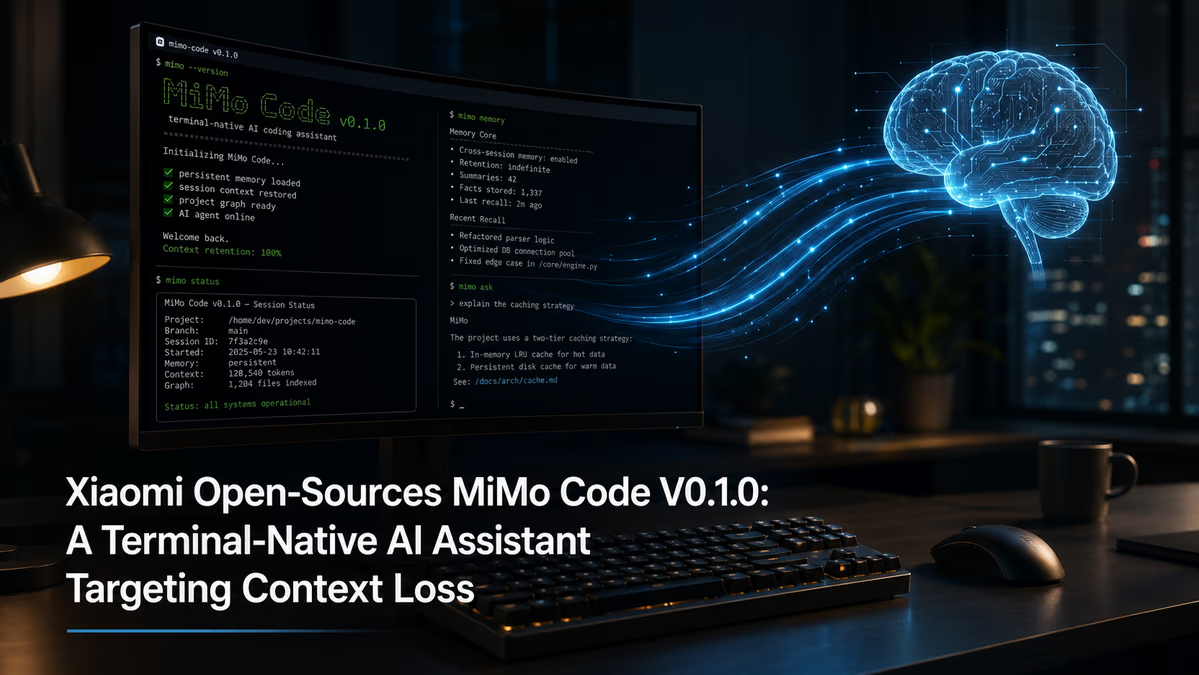
Xiaomi Open-Sources MiMo Code V0.1.0: A Terminal-Native AI Assistant Targeting Context Loss
Xiaomi open-sources MiMo Code V0.1.0, an agentic AI coding assistant designed to solve context loss in long-term development projects.
Xiaomi's MiMo AI team has officially open-sourced MiMo Code V0.1.0, a terminal-native AI coding assistant designed to solve context degradation in complex, long-horizon software development projects. Released on June 10, 2026, under the permissive MIT license, the tool allows developers globally to freely use, modify, and build upon the codebase. This release marks a significant milestone in open-source developer tooling, aiming to challenge proprietary rivals by addressing the key architectural limits that cause AI coding agents to falter over time.
In their official announcement on X, the Xiaomi MiMo team described the tool as more than just a standard terminal AI assistant, framing it instead as a highly intelligent, collaborative coding partner designed to integrate directly into active workspaces.
Solving Context Degradation via Persistent Memory
Unlike conventional AI coding assistants that lose critical project history once their context window fills up, MiMo Code V0.1.0 implements a cross-session memory system. This memory framework operates over four distinct layers: a persistent `MEMORY.md` file that acts as the core project memory, individual session checkpoints, localized scratch notes, and task progress logs. The underlying database is managed via SQLite FTS5 for efficient full-text searches.
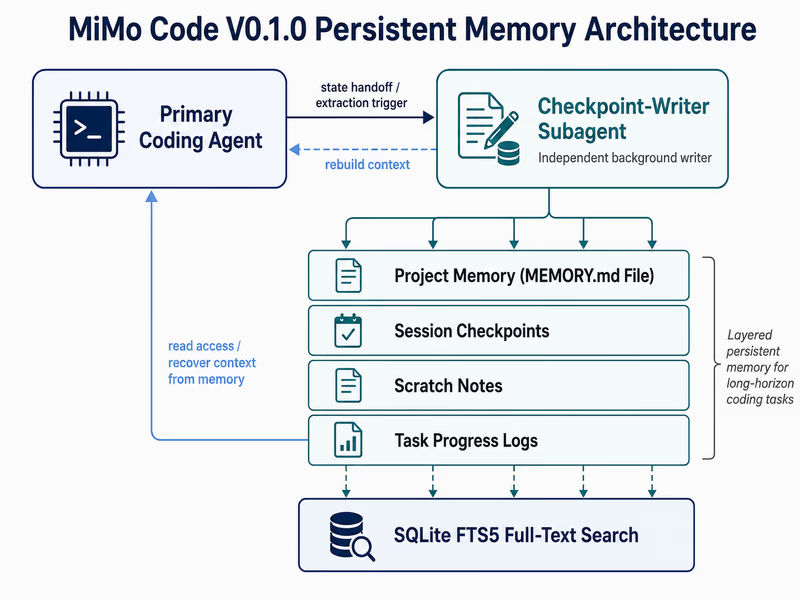
To keep performance high, MiMo Code uses an independent 'checkpoint-writer' subagent that handles note-taking and context summarization in the background, freeing the primary coding agent from memory management overhead. Additionally, the assistant features an automated `/dream` command, which runs every seven days to review, deduplicate, and compress past project sessions into long-term storage.
In their launch blog, the MiMo team pointed out that preventing AI degradation during long sessions requires an explicit storage-and-retrieval framework rather than simple context compression. This design ensures the system knows exactly what information should be written to persistent structures and when it should be recalled.
Outperforming Proprietary Benchmarks
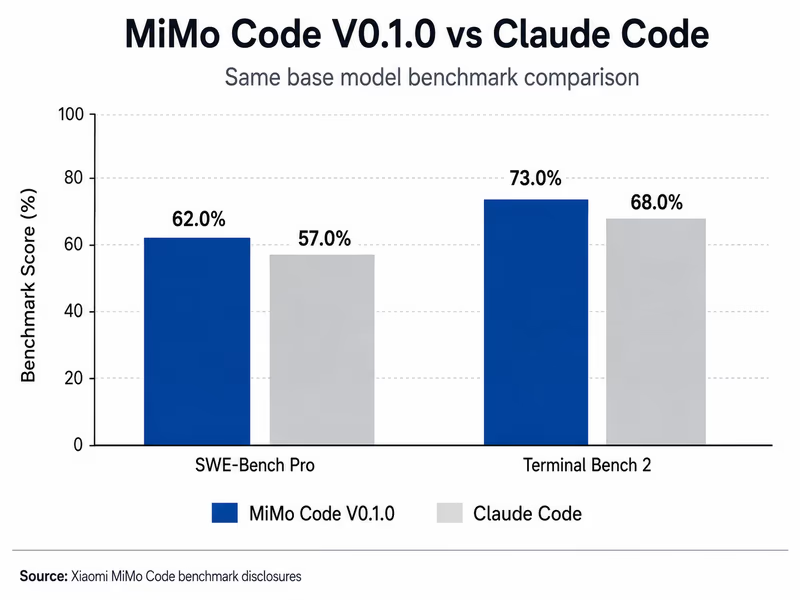
According to Xiaomi's internal testing, this persistent memory architecture yields a substantial performance advantage on long-horizon, multi-step tasks. In evaluations against Anthropic's Claude Code using identical base models, MiMo Code V0.1.0 achieved a score of 62% on SWE-Bench Pro and 73% on Terminal Bench 2. Both scores represent an approximate five-percentage-point lead over Claude Code under standardized testing conditions.
Built upon the open-source OpenCode foundation, MiMo Code allows developers to bypass proprietary vendor lock-in. While it ships with integrated access to Xiaomi's flagship models, it natively supports integration with third-party alternative AI services, including DeepSeek, Kimi, and GLM, giving engineering teams complete control over their model routing and data privacy.
Powering the Assistant with MiMo-V2.5
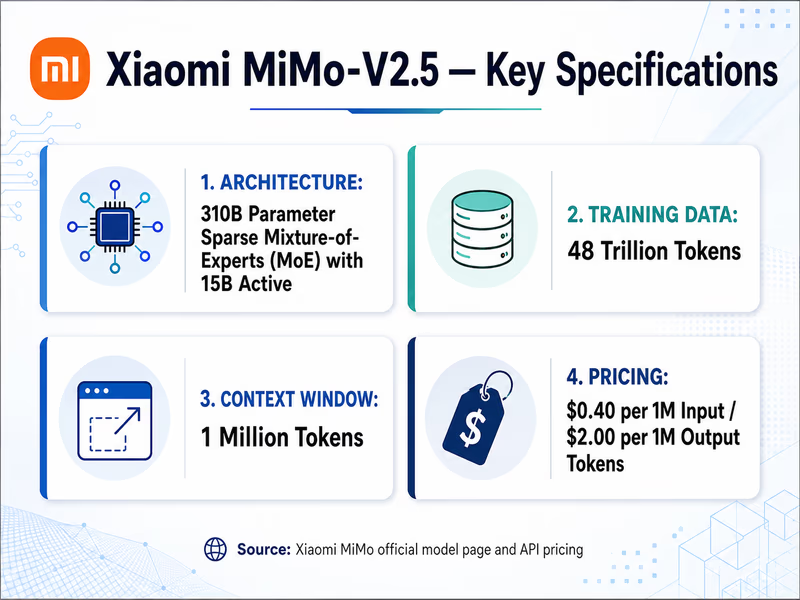
To support the launch, Xiaomi is offering limited-time free access to its advanced MiMo-V2.5 model. Released in late April 2026, MiMo-V2.5 is a 310-billion-parameter Sparse Mixture-of-Experts (MoE) model with 15 billion active parameters per token. Trained on a massive 48 trillion tokens, it boasts native visual and audio understanding alongside a 1-million-token context window.
MiMo-V2.5 is designed to compete directly with proprietary models like Anthropic's Claude Sonnet 4.6 in agentic performance, but at a highly competitive pricing tier of $0.40 per million input tokens and $2.00 per million output tokens. This cost-effective model infrastructure lowers the barrier for running continuous agentic workloads, which are increasingly straining enterprise development budgets.
Advanced Workflows and Modular Interface
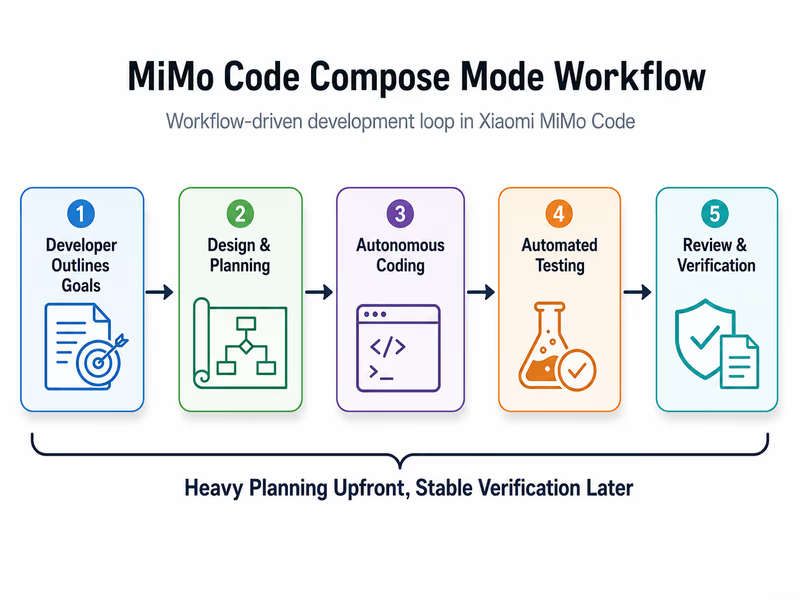
Beyond basic terminal commands, MiMo Code introduces 'Compose mode,' a specification-driven workflow designed for end-to-end development tasks. Developers define high-level engineering goals, and the assistant autonomously executes the cycle, running through design, planning, coding, testing, and final review phases. This mode relies on a 'heavy planning upfront, stable verification later' strategy to prevent agents from writing erroneous code before understanding the wider project structure.
For hands-free operation, the system features integrated voice control built on Xiaomi's MiMo-ASR speech recognition, paired with TenVAD voice activity detection, enabling developers to issue complex modification commands verbally. Installation has been simplified to fit modern developer environments, requiring only a single terminal command for macOS and Linux, or a basic npm command for Windows machines.
Future Implications for Open-Source DevTools
By releasing MiMo Code under an MIT license, Xiaomi is positioning itself as a core player in the open-source AI ecosystem. The development builds upon Xiaomi's ongoing commitment to open-source models, following the release of its initial reasoning model, MiMo-7B, in 2025. By tackling the persistent context problem in a highly accessible package, MiMo Code could accelerate the adoption of autonomous, terminal-native software agents across the enterprise, offering a transparent, cost-controlled alternative to commercial developer suites.