White House Issues National AI Framework to Preempt Record Surge in State Regulations
The White House's new AI Framework seeks to preempt a record 1,500+ state bills to ensure national AI competitiveness and unified federal standards.
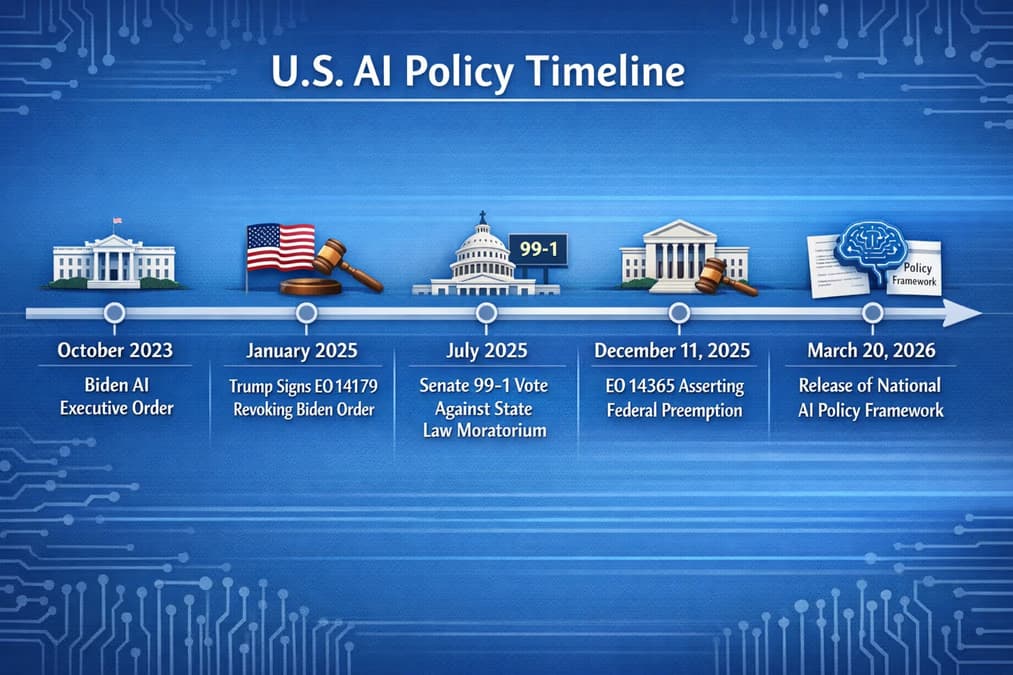
On March 20, 2026, the White House released its National Policy Framework for Artificial Intelligence, a four-page advisory document that urges Congress to establish a unified federal standard and preempt a rapidly expanding volume of state-level regulations. The move represents the Trump administration's most direct attempt yet to consolidate authority over the AI sector, arguing that a single national standard is essential for the United States to maintain its lead in the global technology race.
The Framework outlines legislative recommendations across seven thematic pillars: child safety, community protections, intellectual property (IP), free speech, innovation, workforce development, and federal preemption of state AI laws. While the document is non-binding and requires congressional action to carry the force of law, it serves as a definitive blueprint for the administration's vision of a "light-touch" regulatory environment that favors industry-led standards over centralized government oversight.
The Battle Over Federal Preemption
At the heart of the new Framework is a push for federal preemption, a move designed to nullify the growing "patchwork" of state laws that the administration claims stifles innovation. According to the document, "The Administration describes federal preemption as a central pillar of any effective national AI policy, arguing that a unified federal framework is necessary" to prevent compliance costs from ballooning for companies operating across state lines.
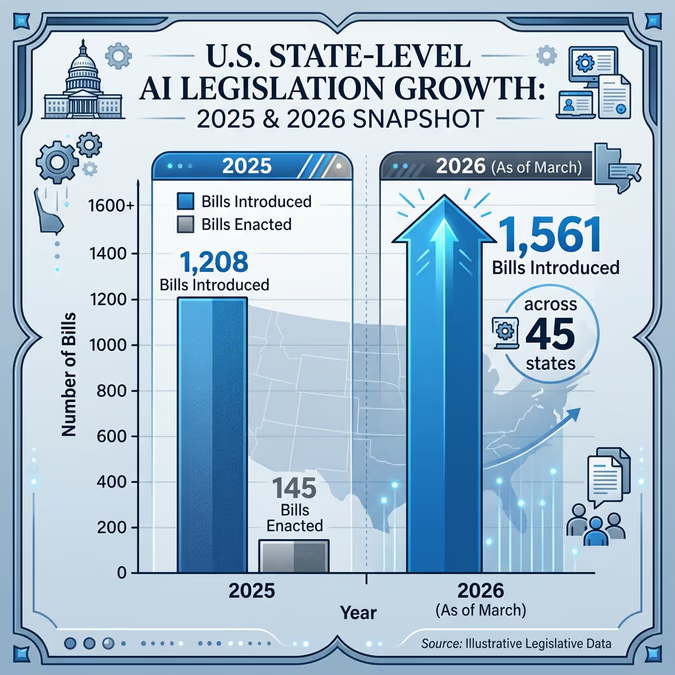
This push comes at a moment of unprecedented state-level activity. In 2025, all 50 U.S. states introduced a combined 1,208 AI-related bills, with 145 successfully enacted into law. The pace has only accelerated in 2026. As of March, lawmakers in 45 states have already introduced 1,561 AI-related bills, surpassing the total volume for all of 2024 in just the first quarter of the year. The White House has warned that "a fragmented patchwork of state AI laws would undermine innovation, increase compliance costs for companies operating across state lines, and weaken the United States' ability to compete in the global AI race."
Building on Executive Action
The March 2026 Framework is the latest step in a systematic overhaul of AI policy that began shortly after President Trump took office. In January 2025, Executive Order 14179 revoked the Biden administration’s October 2023 executive order, signaling a shift away from broader safety and equity mandates toward a focus on national security and economic competitiveness. This was followed by Executive Order 14365 in December 2025, which established an "AI Litigation Task Force" specifically tasked with challenging state AI laws on constitutional grounds.
Legal experts note that the administration is framing this as a matter of national survival. "The Trump administration is committed to winning the AI race to usher in a new era of human flourishing, economic competitiveness, and national security for the American people," the White House stated in its release. To achieve this, the Framework explicitly recommends that "Congress should preempt state AI laws that impose undue burdens to ensure a minimally burdensome national standard consistent with these recommendations, not fifty discordant ones."
Sector-Specific Oversight Instead of a New Regulator
Notably, the Framework rejects the creation of a new federal AI regulatory agency. Instead, it advocates for oversight through existing sector-specific agencies and industry-led standards. This approach is intended to foster a more flexible environment for developers but has drawn criticism from consumer advocacy groups.
Nat Purser of Public Knowledge expressed skepticism regarding the lack of new enforcement mechanisms. "While the Trump administration's National AI Framework offers some principles that sound sympathetic at a high level, it fails to offer any real mechanisms for accountability or oversight," Purser said.
On the contentious issue of intellectual property, the Framework takes a hands-off approach, deferring the resolution of AI training on copyrighted material to the courts. This stance creates a point of friction with some members of Congress, such as Senator Marsha Blackburn (R-TN), whose proposed TRUMP AMERICA AI Act suggests different paths for developer liability and copyright protection.
Legal and Legislative Hurdles Ahead
The path to a unified national standard remains fraught with difficulty. In July 2025, the Senate voted 99-1 to strike a 10-year moratorium on state AI laws from the "One Big Beautiful Bill Act," indicating that even a Republican-controlled Congress may be hesitant to strip states of their regulatory power entirely.
Meanwhile, the private sector has begun to take the matter to the courts. A federal lawsuit recently filed by xAI challenging Colorado’s AI Act—partly on dormant Commerce Clause grounds—illustrates the growing legal tension between tech giants and state legislatures. As the U.S. Department of Justice’s new Enforcement and Affirmative Litigation Branch begins its work to challenge obstructive local laws, the struggle between state-level consumer protections and federal innovation goals is likely to intensify.
For the AI industry, the Framework offers a vision of lower compliance barriers but leaves significant questions regarding liability and intellectual property unanswered. As public trust remains low—with a majority of Americans believing the government is not doing enough to regulate the technology—the administration's success will likely depend on whether it can convince both Congress and the public that federal uniformity is the best path toward safe and competitive AI.