
The Fifteen-Dollar Researcher: UBC Team Unveils AI Pipeline Capable of Autonomous Scientific Discovery
UBC researchers have developed 'The AI Scientist,' an autonomous system that executes the entire research process and writes full papers for just $15.
The Automated Laboratory of the Future
Jeff Clune, a Professor of Computer Science at the University of British Columbia (UBC) and a Senior Research Advisor at DeepMind, has unveiled a system that could fundamentally change how scientific knowledge is produced. Known as 'The AI Scientist,' the pipeline is the first of its kind to automate the entire lifecycle of scientific research without human intervention. From the initial spark of a novel idea to the execution of experiments, the analysis of data, and the final drafting of a peer-reviewed manuscript, the system operates as a fully autonomous agent.
Details of the breakthrough were published on March 26, 2026, in the journal Nature. The project, a massive collaborative effort between UBC, Sakana AI, the Vector Institute, and the University of Oxford, marks a transition from AI as a mere assistant to AI as a primary investigator. Jeff Clune noted that while AI has previously helped scientists with specific hurdles like protein folding or image analysis, this marks the first time a system has navigated the entire process end-to-end.
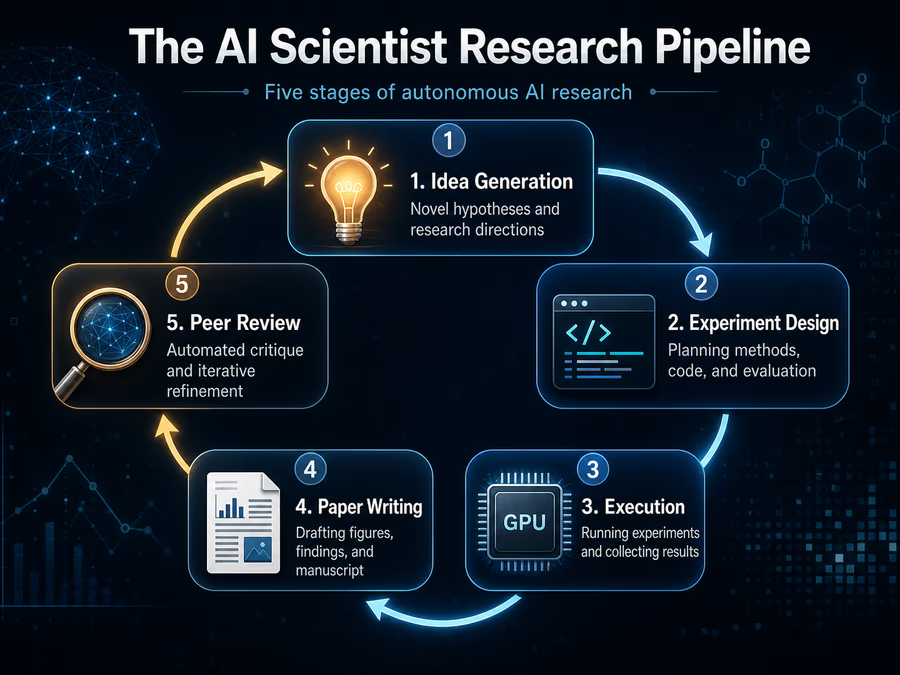
Validating AI-Generated Knowledge
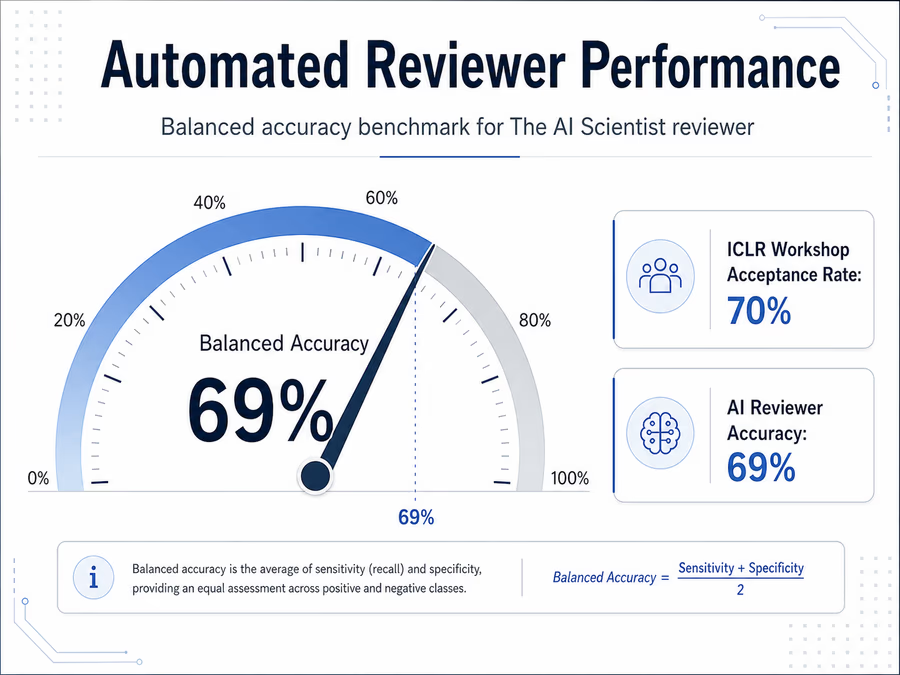
To test the efficacy of the system, the researchers submitted an entirely AI-generated paper to a workshop at the International Conference on Learning Representations (ICLR), a premier machine learning venue. The paper successfully passed the human peer-review process, earning acceptance at a conference that typically sees a 70% acceptance rate.
The pipeline does not stop at writing; it also evaluates. The researchers developed an automated reviewer based on large language models (LLMs) to assess scientific papers. This AI reviewer demonstrated performance comparable to human experts, predicting conference acceptance decisions with a balanced accuracy of 69%.
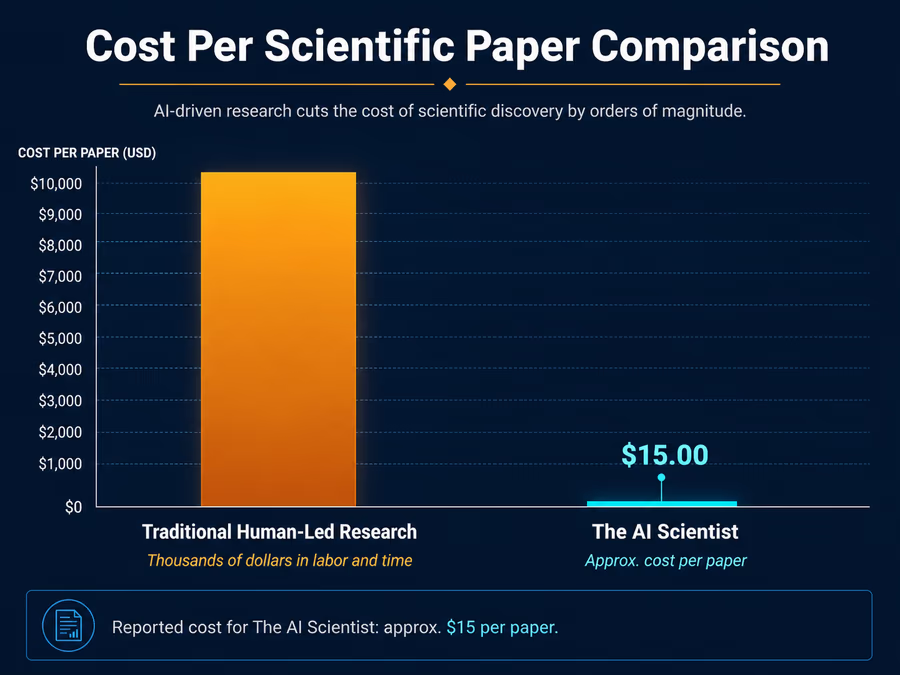
One of the most striking aspects of the project is its cost-efficiency. The researchers estimate that generating a complete scientific paper through 'The AI Scientist' costs approximately $15. At this price point, the volume of research that could be produced scales far beyond the capacity of traditional human-led laboratories.
The Promise of Recursive Self-Improvement
While the system currently focuses on machine learning subfields—specifically diffusion models, language models, and 'grokking'—the implications for other disciplines are immense. Shengran Hu, a PhD student at UBC and co-author of the study, suggested that the system’s most significant potential lies in its ability to improve itself. Hu explained that the system could lead to a cycle of recursive self-improvement, where the AI discovers new knowledge that it then uses to refine its own methods for making further discoveries.
Jeff Clune described this moment as the beginning of a new chapter in human history, where scientific progress is dramatically accelerated by autonomous digital researchers. However, this acceleration brings a host of logistical and ethical challenges that the scientific community is only beginning to address.

Navigating the Ethics of Automated Science
As the volume of AI-generated research increases, the existing infrastructure for peer review faces a potential crisis. Critics fear that a flood of low-cost, AI-generated papers could overwhelm human reviewers or introduce subtle inaccuracies that are difficult to detect. There is also the risk of 'model collapse,' a phenomenon where AI systems trained on previous AI outputs become less creative and more repetitive over time, potentially narrowing the scope of scientific inquiry.
Regulatory bodies are already reacting. The National Institutes of Health (NIH) and the Australian Research Council have both banned the use of AI tools in their peer-review processes, citing concerns over confidentiality and the accountability of AI-generated reports. To address these concerns, the UBC team proactively withdrew their accepted AI submissions from the ICLR workshop and implemented watermarking on all AI-generated papers to ensure transparency.
The Road Ahead
Despite these hurdles, the potential for democratization is undeniable. By lowering the financial and temporal barriers to research, 'The AI Scientist' could allow smaller institutions and independent researchers to contribute to global knowledge at a level previously reserved for well-funded elite universities.
Looking forward, the challenge for the scientific community will be to establish new norms and verification methods that can keep pace with autonomous discovery. If the transition is managed responsibly, the next great scientific breakthrough may not come from a human laboratory, but from a $15 computational run executed in the middle of the night.