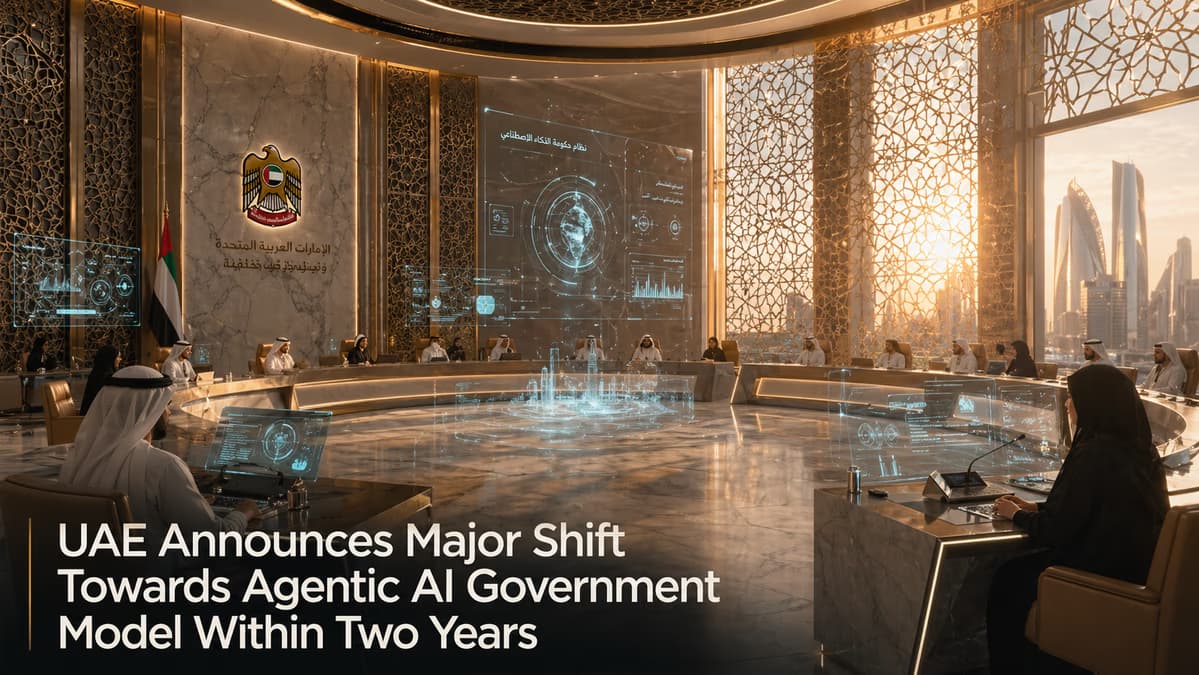
UAE Targets 50% Autonomous Government via Agentic AI by 2028
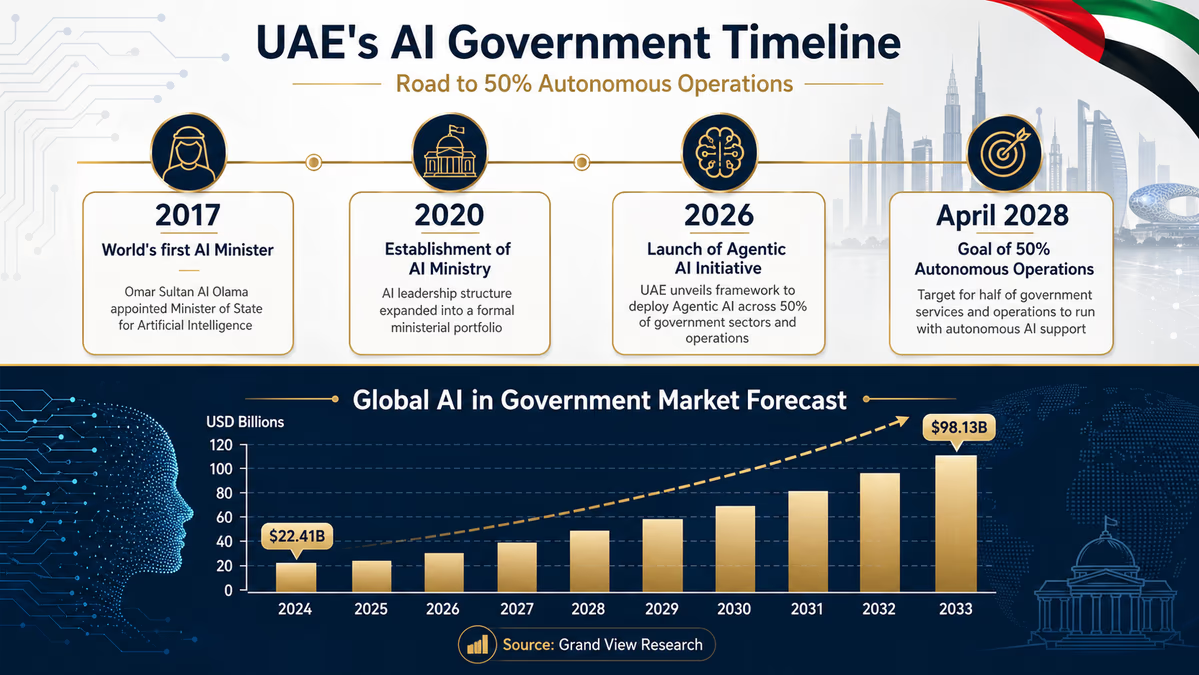
The UAE has launched a two-year initiative to integrate Agentic AI across 50% of its government operations and services by April 2028.
A New Era of Autonomous Governance
On April 23, 2026, Sheikh Mohammed bin Rashid Al Maktoum, Vice President and Prime Minister of the UAE and Ruler of Dubai, announced a structural shift in how the nation functions. Under the directives of President His Highness Sheikh Mohamed bin Zayed Al Nahyan, the United Arab Emirates has set a definitive two-year deadline to integrate Agentic AI into 50% of its government sectors, services, and operations. This pivot aims to complete a transition to autonomous governance by April 2028, positioning the UAE as the first nation globally to deploy such models at a state-wide scale.
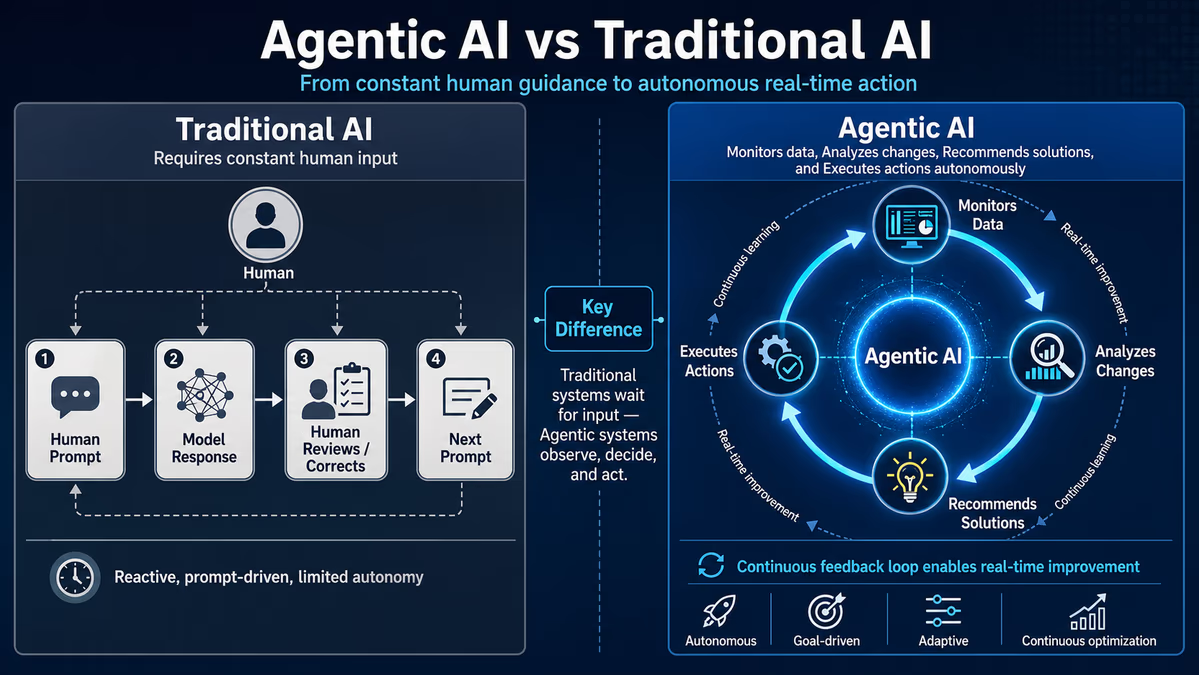
Unlike previous digital transformation efforts that focused on digitizing records or providing online portals, this initiative centers on "Agentic AI." These systems are defined by their ability to operate independently, executing tasks and managing processes without constant human intervention. According to Sheikh Mohammed bin Rashid, "The UAE will shift 50 per cent of government services to autonomous AI within two years."
Moving Beyond Generative Insights
The move marks a significant departure from traditional e-government models. While earlier AI applications in government focused on generating insights or responding to queries, Agentic AI models are designed for action. These systems can monitor shifts in data, provide real-time analysis, offer policy recommendations, and run an independent series of actions to solve problems as they arise.
Sheikh Mohammed bin Rashid highlighted the executive potential of these systems, stating, "Today, AI models can monitor changes, provide analyses, offer recommendations, manage operations, and run an independent series of actions without human intervention... AI will be our government executive partner to support decisions, enhance services, boost the efficiency of operations, and even evaluate results and introduce improvements in real time."
Structural Oversight and Accountability
The implementation of this transformation is not merely a technical suggestion but a mandate with strict oversight. Sheikh Mansour bin Zayed, Vice President, Deputy Prime Minister, and Chairman of the Presidential Court, will oversee the transition. A dedicated task force led by Mohammad Al Gergawi, Minister of Cabinet Affairs, has been charged with driving the execution across federal entities.
Performance metrics for government leadership have also been redesigned. Over the next 24 months, ministers, directors-general, and federal entities will be assessed specifically on their ability to keep pace with this transformation. Assessment criteria include the speed of adoption, the quality of technical implementation, and how effectively AI tools are used to redesign traditional workflows. Sheikh Mohammed noted, "This transformation has a clear timeline. Two years. Performance across government will be measured by speed of adoption, quality of implementation, and mastery of AI in redesigning government work."

The Human Factor in an Autonomous System
Despite the emphasis on autonomy, the UAE government maintains that this transition is inherently human-centric. The initiative includes a comprehensive plan to provide specialized training for every federal government employee. The goal is to evolve the civil service from a workforce of manual processors to a workforce of AI supervisors and strategists.
"The world is changing. Technology is accelerating. Our principle remains constant. People come first. Our goal is a government that is faster, more responsive, and more impactful," Sheikh Mohammed remarked. This philosophy suggests that by offloading administrative and operational burdens to agentic systems, the government can free up human capital to focus on more complex, empathetic, and strategic societal needs.
A Global Blueprint for Public Sector AI
This initiative builds on a long-standing digital strategy. The UAE appointed the world’s first Minister of State for Artificial Intelligence in 2017 and established the Ministry of Artificial Intelligence, Digital Economy and Remote Work Applications in 2020. This latest move signals a maturation of that vision, moving from research and development to large-scale operational deployment.
For the global AI industry, the UAE's commitment creates a massive testing ground for public sector autonomous systems. As the global AI in government market is projected to reach $98.13 billion by 2033, the UAE is positioning itself as a primary consumer and innovator in this space. Other nations, including the UK, China, and Japan, are watching closely as they develop their own national AI frameworks. If successful, the UAE’s model could serve as the primary blueprint for the future of the modern state, where the efficiency of a machine meets the oversight of human policy.