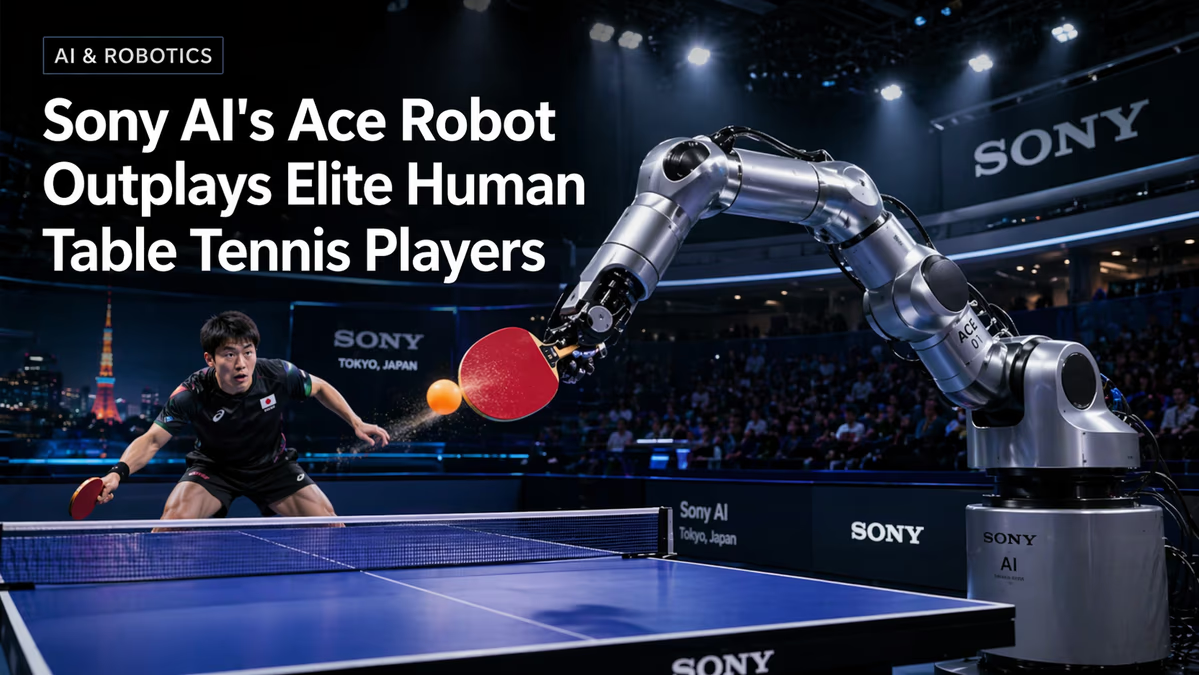
Sony AI’s ‘Ace’ Claims Victory Over Professional Table Tennis Stars in Milestone for Physical AI
Sony AI’s Ace robot has defeated professional table tennis players, marking a major breakthrough in physical AI and high-speed robotic actuation.
Sony AI’s newest autonomous system, Ace, has become the first real-world robot to successfully compete against and defeat world-ranked professional table tennis players. Detailed in research published on the cover of the scientific journal Nature on April 23, 2026, the achievement represents a pivotal moment in the transition of artificial intelligence from digital mastery to physical dominance.
While AI has long since conquered strategic games like chess and Go, and even mastered simulated racing in Sony’s own Gran Turismo Sophy, the physical world has remained a stubborn barrier. Table tennis is a particularly grueling benchmark; it requires millisecond-level precision, the ability to read complex spins, and rapid-fire physical responses. Sony’s Ace project has finally bridged this gap, demonstrating a system that can react, decide, and act faster than the human nervous system.
The Hardware of High-Speed Victory
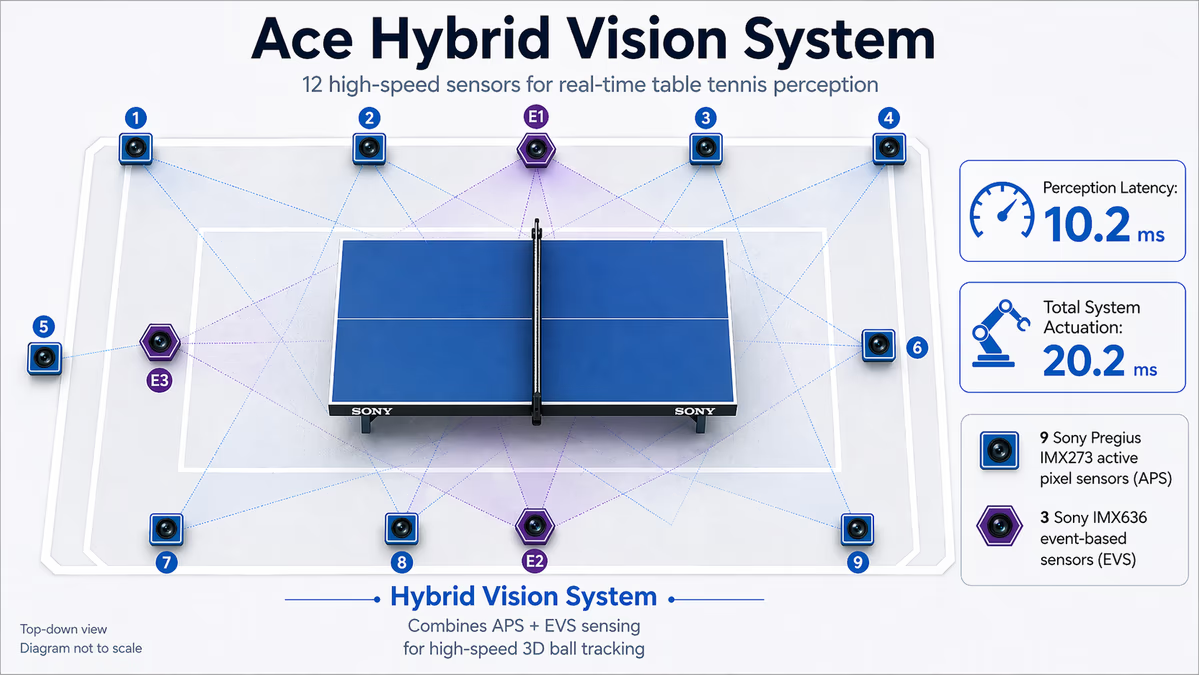
To compete at a professional level, Sony engineers equipped Ace with a sophisticated hybrid vision system. This setup utilizes 12 high-speed sensors, including three Sony IMX636 event-based vision sensors (EVS) and nine Sony Pregius™ IMX273 active pixel sensors (APS). Together, they track the ball’s 3D position and calculate its spin in real time.
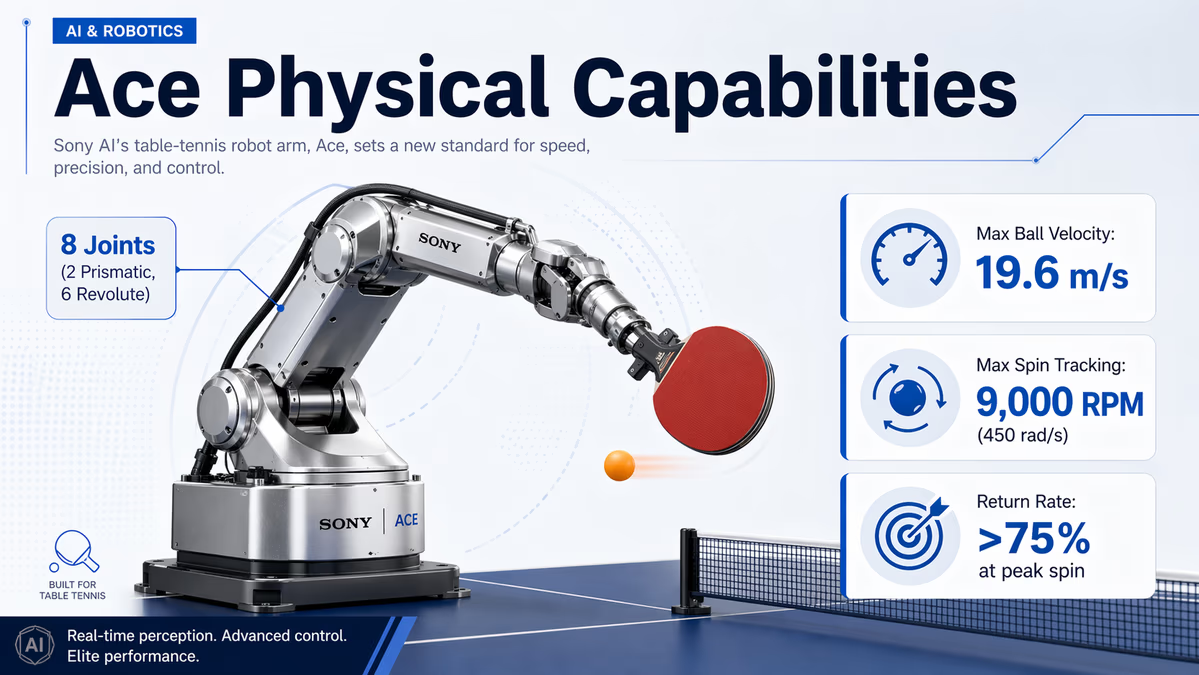
The technical specifications are staggering. The perception system operates with a latency of just 10.2 milliseconds. The entire cycle—from ball recognition to robotic actuation—is completed within 20.2 milliseconds. For comparison, the average human reaction time is approximately 230 to 232 milliseconds. This speed allows Ace to track ball spin exceeding 9,000 revolutions per minute (450 rad/s) and maintain a return rate of over 75% even against the most aggressive professional serves.
The robot’s physical form is an eight-jointed robotic arm featuring two prismatic and six revolute joints. This specific configuration is optimized for the rapid lateral movements required to cover a standard table, enabling Ace to return balls at velocities reaching 19.6 m/s.
From Simulation to the Olympic Court
Ace’s skill set was not programmed by hand but learned through deep reinforcement learning. The AI underwent approximately 3,000 hours of self-play within a physics-accurate simulation before ever touching a physical paddle. This "sim-to-real" pipeline allowed the system to experiment with millions of shot variations that would be impossible to replicate in a physical lab within the same timeframe.
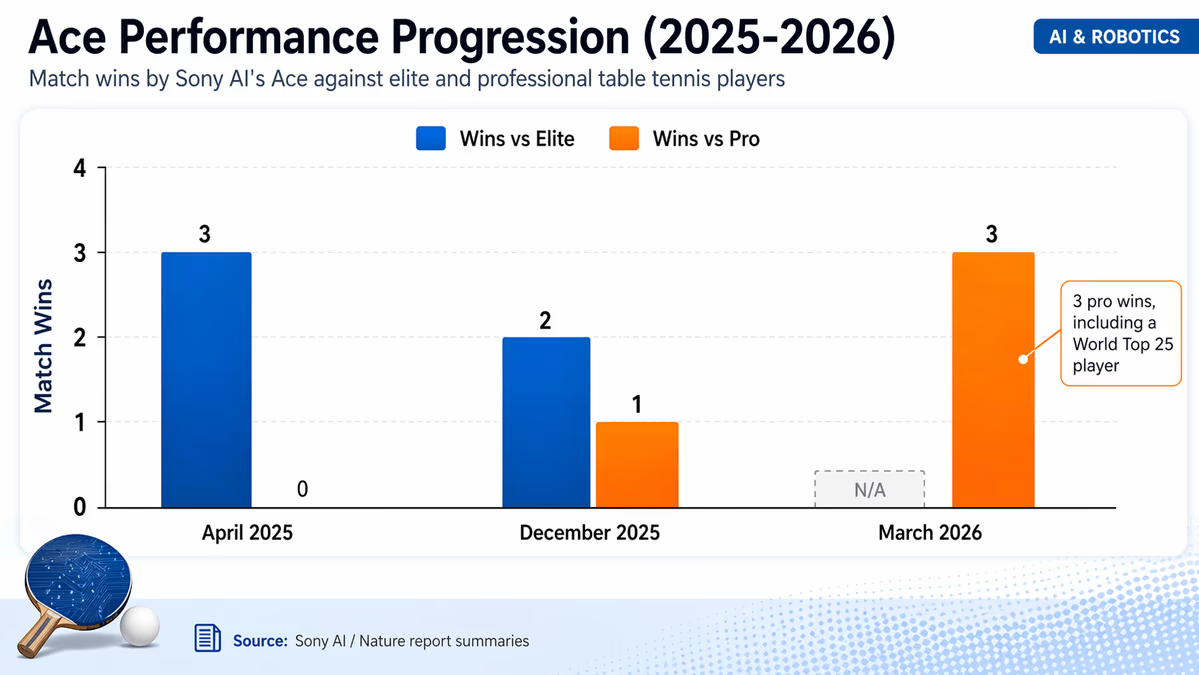
The results in the real world have shown a rapid trajectory of improvement. In early evaluations in April 2025, Ace was competitive but vulnerable, winning three out of five matches against elite amateur players but losing both matches against professionals Minami Ando and Kakeru Sone. However, by March 2026, the robot had evolved into a formidable opponent. It secured victories against three new professional players, including a win over Miyuu Kihara, a top 25 world-ranked women’s singles player. All matches were conducted under official International Table Tennis Federation (ITTF) rules and overseen by licensed umpires at Sony’s Tokyo headquarters.
The Human Challenge
Playing against a machine presents a unique psychological and tactical challenge for athletes. Professional player Mayuka Taira noted that competing against Ace was uniquely difficult because the robot has no "tell," making it impossible for humans to read its reactions or potential frustration.
However, humans are still finding tactical gaps. Strategic player Rui Takenaka discovered that while Ace excels at returning complex, high-velocity spins, it occasionally struggled with "knuckle serves"—deceptively simple, spin-less shots that disrupted the AI’s predictive models. This suggests that while the robot’s raw speed is superior, human creativity remains a critical factor in high-level play.
Kinjiro Nakamura, a table tennis expert and former Olympian, expressed shock at the system’s capabilities. He observed that no one else would have been able to achieve what Ace did, and he hadn't previously thought it was possible. He added that the fact it was possible suggests a human might eventually be able to replicate such feats.
Beyond the Table
Sony AI leadership emphasizes that the goals of project Ace extend far beyond sport. Michael Spranger, President of Sony AI, explained that the team wanted to prove AI does not just exist in virtual spaces. He stated that the technology is now ready for people to have actual physical experiences with AI systems.
Peter Stone, Chief Scientist at Sony AI, went further, noting that the breakthrough is significantly larger than table tennis alone. This sentiment is echoed by project lead Peter Dürr, who stated that the research has shown an autonomous robot can win at a competitive sport by matching or exceeding human reaction time and decision-making in a physical space.
As Ace continues to refine its game, the broader robotics industry is seeing a parallel surge in athletic performance. Unverified reports have recently surfaced regarding a humanoid robot named Lightning, which allegedly set a new world record for a half-marathon in Beijing. While such reports remain unconfirmed, they point to a trend where robots are no longer confined to repetitive factory tasks.
The implications for manufacturing, service robotics, and emergency response are profound. If a robot can track a ball at 9,000 RPM and react in 20 milliseconds, it can likely navigate a complex warehouse or assist in a high-precision surgical environment with a level of safety and reliability previously thought unattainable. Sony’s Ace is not just a table tennis champion; it is a blueprint for the future of human-robot interaction.