Snap Slashes Workforce by 16%, Betting on AI-Driven 'Tiny Teams'
Snap Inc. is cutting 1,000 jobs as CEO Evan Spiegel pivots to AI-driven efficiencies, with 65% of new code now generated by artificial intelligence.
A Decisive Shift in Santa Monica
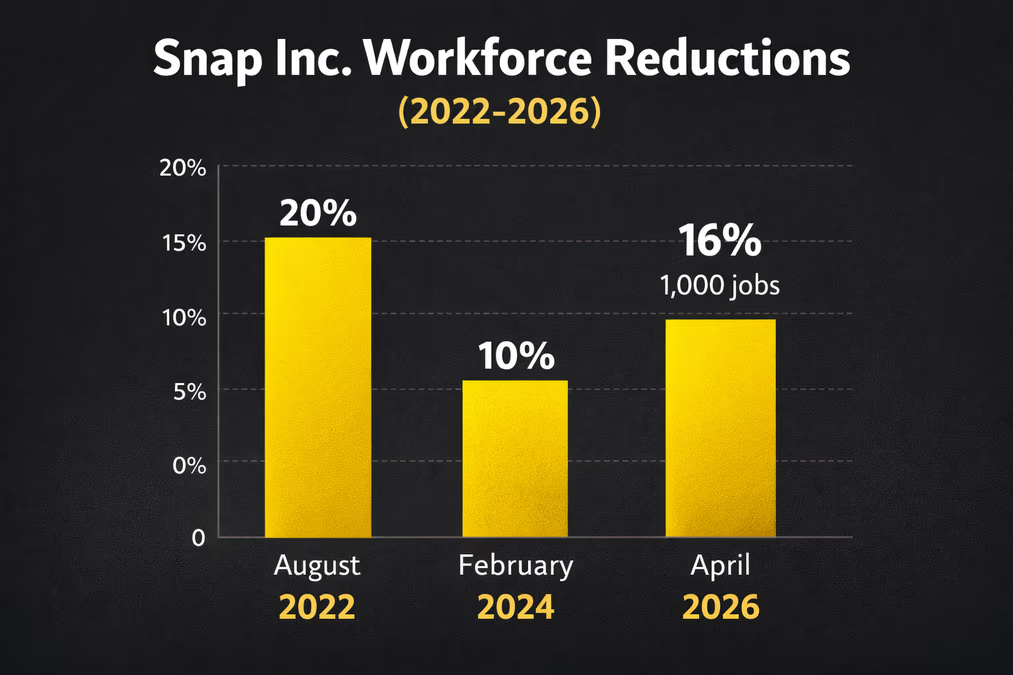
Snap Inc. announced a sweeping reduction of approximately 1,000 employees on Wednesday, April 15, 2026, signaling a fundamental shift in its business model where artificial intelligence increasingly takes the wheel of software development and customer support. The layoffs represent roughly 16% of the company’s global full-time workforce, which stood at 5,261 employees at the close of 2025. In addition to the personnel cuts, the company plans to eliminate more than 300 open roles, effectively streamlining its recruitment pipeline for the foreseeable future.
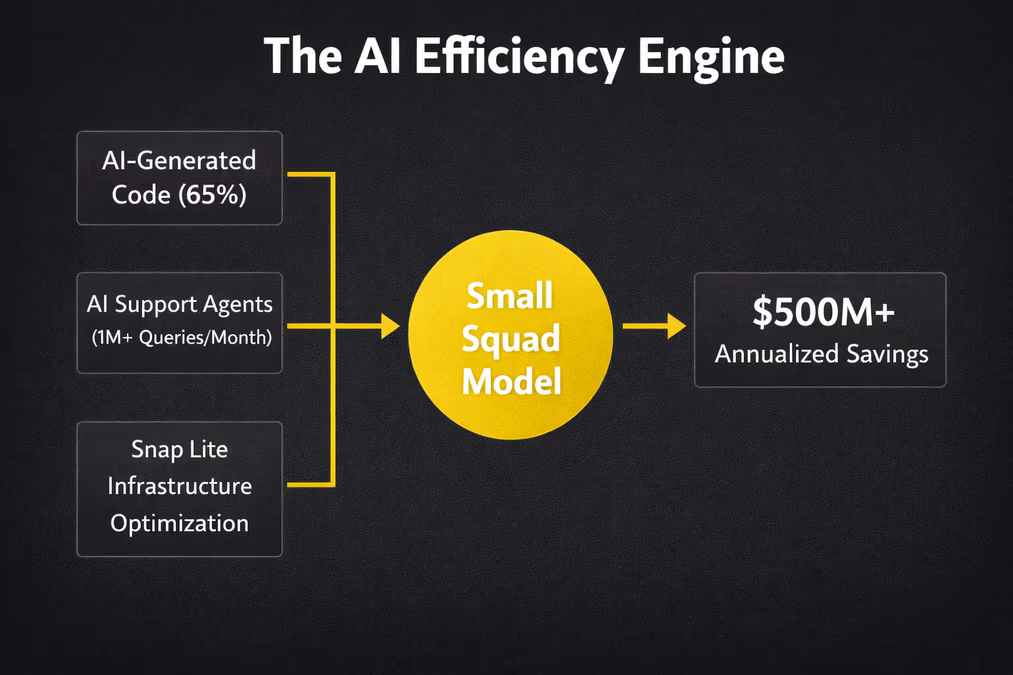
This restructuring is not merely a cost-cutting exercise but a structural transformation aimed at yielding over $500 million in annualized savings by the second half of 2026. While the company anticipates pre-tax restructuring charges between $95 million and $130 million—primarily earmarked for severance and healthcare benefits—the move reflects a broader industry-wide pivot toward lean, AI-orchestrated operations. Affected U.S.-based employees are slated to receive four months of severance, equity vesting, and career transition support.
The Activist Catalyst
The decision arrives after months of mounting pressure from activist investor Irenic Capital Management. Having acquired a significant stake in the social media firm, Irenic advocated for aggressive cost reductions and a more disciplined approach to headcount. CEO Evan Spiegel acknowledged the difficulty of the moment while framing it as a necessary step for the company's survival in an increasingly competitive advertising market dominated by giants like Meta and Google.
"Over the past several months, we have carefully reviewed the work required to best serve our community and partners," Spiegel said in a statement. "We made tough choices to prioritize the investments we believe are most likely to create long-term value."
AI at the Core of Operations
What distinguishes this round of layoffs from Snap's previous workforce reductions in 2022 and 2024 is the explicit role of artificial intelligence as a replacement for human labor. Snap revealed that more than 65% of its new code is now generated by AI, a staggering metric that has allowed the company to maintain its development velocity with a significantly smaller engineering footprint. Furthermore, AI agents are now handling over 1 million support questions per month, drastically reducing the need for large-scale customer service departments.
Spiegel noted that these advancements allow for a new organizational philosophy focused on "small squads" rather than massive hierarchies. "We have already witnessed small squads leveraging AI tools to drive meaningful progress across several important initiatives, including Snapchat+, enhanced ad platform performance, and efficiency improvements in our Snap Lite infrastructure," Spiegel added. He believes that rapid advancements in AI enable teams to "reduce repetitive work, increase velocity, and better support our community, partners, and advertisers."
The Industry-Wide 'Crucible Moment'
Snap’s pivot aligns with a trend observed across the tech sector throughout 2024 and 2025. Leaders at Meta, Amazon, and Block have all signaled that the era of headcount-heavy growth is over. Block CEO Jack Dorsey recently noted that intelligence tools have fundamentally changed what it means to build a company, suggesting that smaller, more specialized teams can now achieve what once required hundreds of staffers. Meta’s Mark Zuckerberg has echoed similar sentiments, stating that AI allows a single employee to perform the work of entire legacy teams.
For Snap, this transition is also about financial sustainability. By transforming its internal business model to integrate human teams with "increasingly capable AI agents," the company is attempting to outpace the competition through agility rather than brute force. The move is designed to satisfy investors while proving that a mid-sized tech firm can survive the "crucible moment" Spiegel described in late 2025.
Looking Ahead: The Future of Work at Snap
While the immediate impact is a leaner balance sheet, the long-term implications for the workforce are profound. The displacement of human roles by AI in coding and support suggests that the technical skill sets required at Snap are shifting away from execution and toward architectural thinking and AI orchestration.
For the AI industry, Snap's restructuring provides a high-profile case study in the tangible ROI of AI integration. If Snap successfully delivers on its $500 million savings target without sacrificing product quality or user growth, it will likely serve as a blueprint for other tech firms looking to shed legacy costs. However, the human cost remains high, and Spiegel was quick to offer a personal note of regret: "This is an incredibly difficult decision, and I am deeply sorry to the colleagues who will be leaving us."