SAP to Embed Agentic AI Across SuccessFactors, Promising Autonomous Workforce Management by 2026
SAP is integrating autonomous agentic AI into its SuccessFactors HCM suite to automate complex HR workflows and save employees 75 minutes daily.
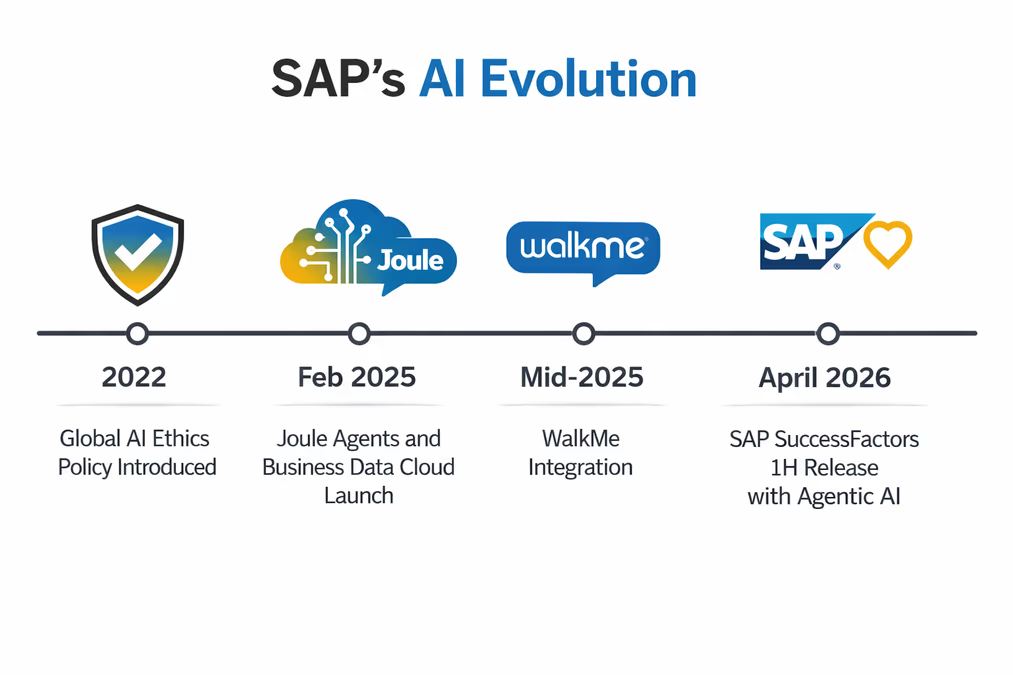
SAP is set to overhaul its Human Capital Management (HCM) ecosystem with the integration of agentic AI, a move slated for the 1H 2026 release of SAP SuccessFactors. Unlike traditional generative AI that responds to prompts, these new agentic capabilities are designed to act autonomously, monitoring system states and executing multi-step tasks across recruiting, payroll, and talent development without constant human intervention.
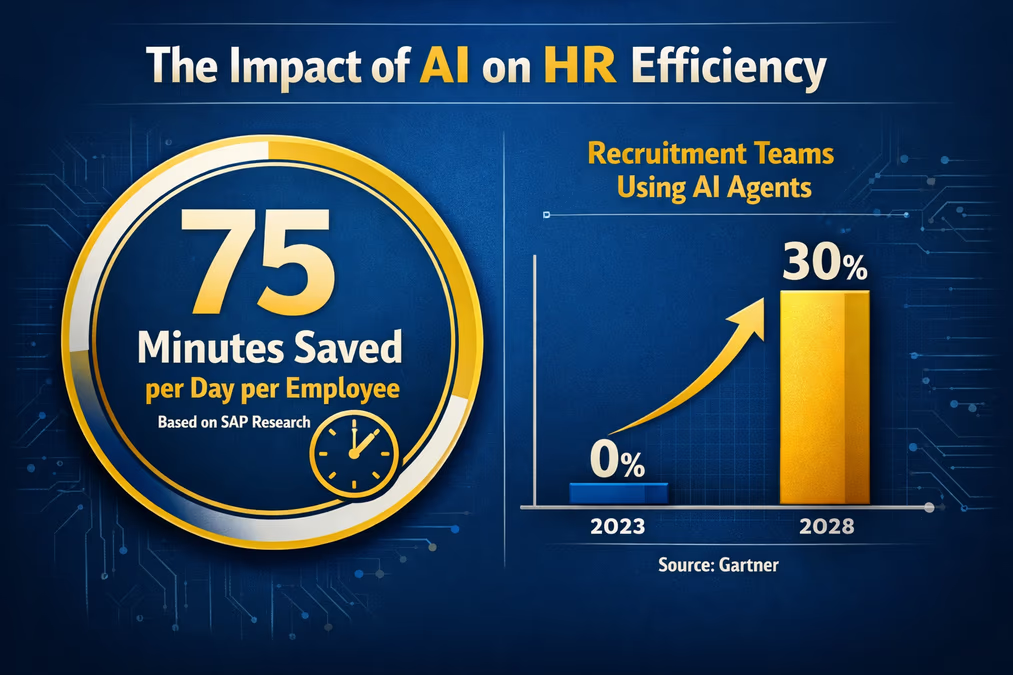
The initiative represents a pivot from reactive tools to proactive assistants. These AI agents will identify anomalies in workforce administration, suggest context-aware solutions for data synchronization failures, and provide instant, localized responses to employee queries by drawing from an organization’s specific learning content. According to SAP's internal research, the efficiency gains from existing AI implementations already save employees an average of 75 minutes per day, a figure the company expects to grow as autonomous agents take over more complex workflows.
The Architecture of Autonomy
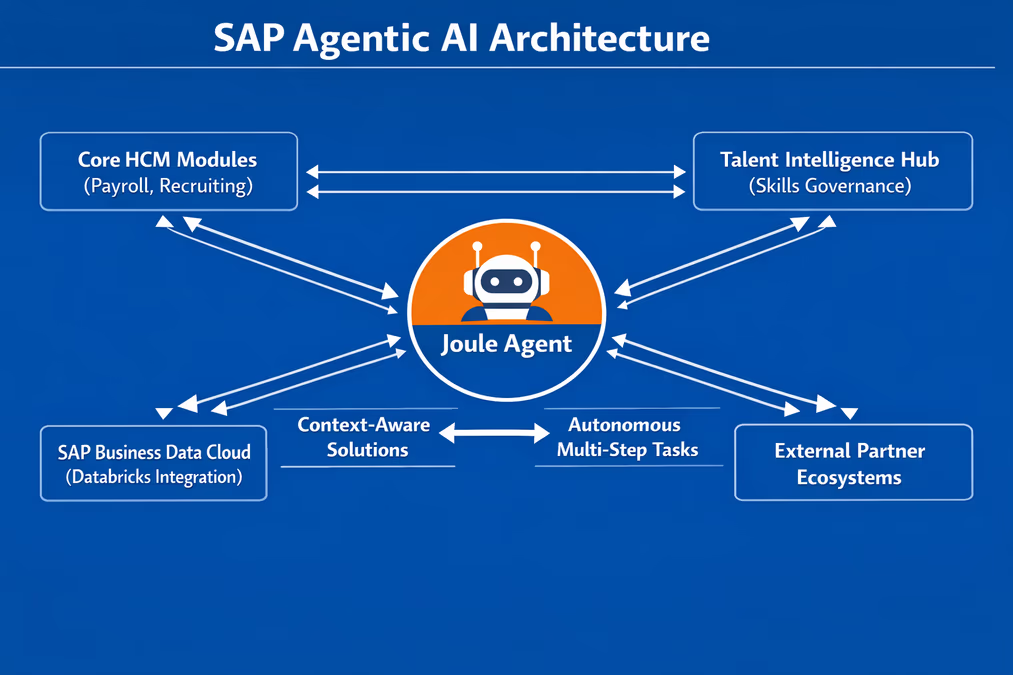
At the heart of this transformation are "Joule Agents," AI-powered assistants first introduced in February 2025. These agents are designed to handle cross-functional workflows that previously required manual coordination between departments. For example, an agent could identify a skill gap in a specific team, cross-reference internal talent data through the SAP Talent Intelligence Hub, and initiate a recruitment process or suggest a personalized learning path automatically.
To support this level of autonomy, SAP announced its Business Data Cloud on February 13, 2025, in partnership with Databricks. This platform unifies SAP and third-party data, providing the "harmonized data foundation" necessary for AI to make accurate decisions. Dan Beck, General Manager and Chief Product Officer at SAP SuccessFactors, emphasizes that this integration is the key differentiator for the company.
"SAP stands out because our AI is fully integrated across the SAP Business Suite, leveraging a harmonized data foundation that unifies SAP and non-SAP sources," Beck said. "We combine enterprise-grade AI embedded into the flow of work with extensive experience building responsible AI... The outcome is AI that is powerful, contextual, transparent, and enterprise ready."
Solving the Legacy Data Challenge
Implementing agentic AI within established enterprise environments is not without significant technical hurdles. One of the primary challenges for SAP’s engineering teams is the integration of modern semantic search mechanisms with highly structured legacy relational databases. This requires extensive middleware configuration to ensure that AI agents can "read" older data formats with the same fluidity as modern cloud-native information.
Furthermore, the compute requirements for these systems are substantial. Chief Information Officers must balance the significant cloud infrastructure costs associated with large language models (LLMs) continuously scanning millions of employee records against the projected operational savings. SAP aims to mitigate these costs by using analytical models to identify missing variables and peer-data discrepancies, effectively reducing the mean time to resolution for internal IT support tickets.
However, some industry observers suggest that the shift toward autonomous agents changes the nature of IT work itself. Fred Devoir, Global Head of Solution Architecture for Telecommunications at Nvidia, noted the shift in responsibility: "Instead of an HR for humans, now you have an IT department that's acting as HR for all these agents."
Skills Governance and Ethical Guardrails
The 1H 2026 release will also strengthen SAP’s talent intelligence hub by introducing enhanced skills governance. This provides administrators with a centralized interface to manage skill definitions, ensuring that data remains aligned across both internal applications and external partner ecosystems. This focus on a "skills-first" workforce is a central theme for SAP leadership.
"Three themes that are unmistakable... Excitement about AI. How do I adopt it? There's tension there," said Dan Beck, CEO of SAP SuccessFactors. "The second theme is data. [Customers] want to make better decisions... and thirdly is skills... We’re actually living into the promise of skills."
To navigate the ethical complexities of autonomous decision-making, SAP has aligned its Global AI Ethics Policy—originally introduced in 2022 and updated in 2024—with UNESCO human-rights standards. These guardrails are intended to prevent "hallucinations" or unauthorized alterations of critical financial and payroll data, ensuring that while the AI is autonomous, it remains within strict compliance boundaries such as GDPR.
The Future of the HR Professional
The long-term implications for the HR industry are profound. Gartner predicts that by 2028, 30% of recruitment teams will utilize AI agents to handle some recruitment activities. As routine tasks like resume screening, interview scheduling, and payroll processing become automated, the role of the HR professional is expected to evolve from administrative oversight to strategic workforce architecture.
SAP’s strategy, which includes integrating WalkMe content by mid-2025 to improve user adoption, aims to position HR leaders as "stewards of humanity" within the digital enterprise. By delegating the "operational bloat" to agentic AI, organizations can theoretically focus on the creative and strategic problem-solving that remains uniquely human.