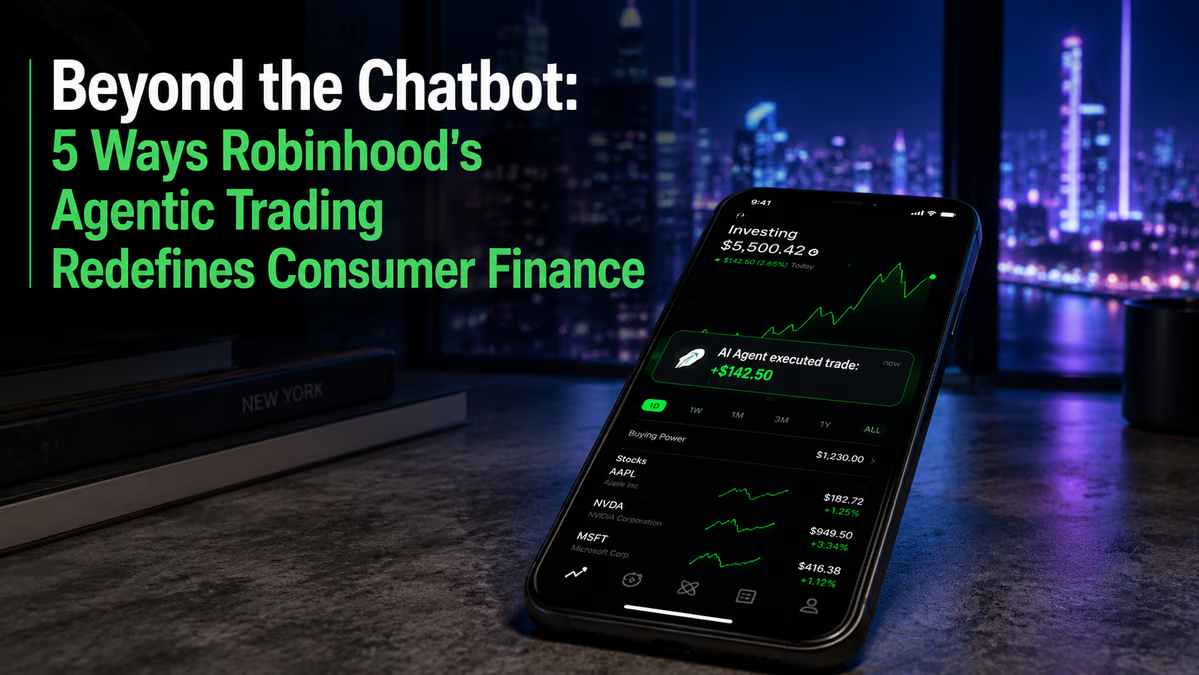
Beyond the Chatbot: 5 Ways Robinhood's Agentic Trading Redefines Consumer Finance
Robinhood's Agentic Trading launch shifts AI from a passive financial advisor to an autonomous actor, redefining risk and retail investing.
Stop talking to your money. It is time to let it run itself.
For the past two years, the technology industry has tried to convince us that the pinnacle of financial AI is a helpful chatbot—a conversational interface that summarizes your monthly spending, explains what an ETF is, or drafts a generic savings plan. But that was always a transitional phase. The real AI revolution in finance was never going to be about conversation; it was always going to be about agency.
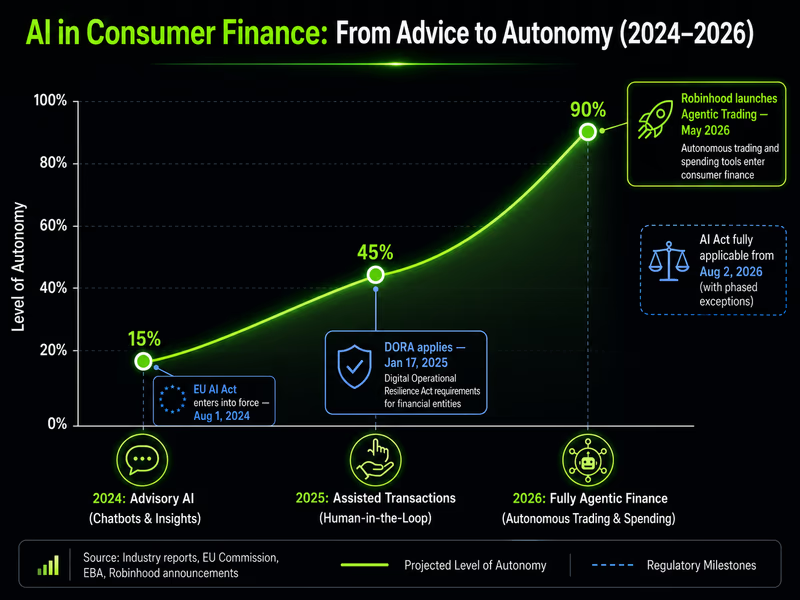
On May 27, 2026, Robinhood crossed that Rubicon. By launching "Agentic Trading" and the "Agentic Credit Card," the company bypassed the advisory assistant model entirely to unleash autonomous AI agents directly into the market on behalf of its 27.6 million users. This represents a monumental pivot in the fintech landscape: moving AI from a passive advisor to an active, autonomous financial actor.
As Vlad Tenev, CEO of Robinhood, put it: "Our mission has always been to democratize finance for all, and now, that mission extends to AI agents."
This is not a minor feature update; it is a fundamental restructuring of consumer finance. Here are five ways Robinhood's agentic platform is redefining how we interact with capital.
1. From Advice to Execution: The Death of the Chatbot
Until now, consumer financial AI has been safely bracketed behind a wall of human confirmation. You ask a chatbot for insights; you make the trade. Robinhood has shattered this barrier by deploying its AI-native Model Context Protocol (MCP) servers, allowing users to connect their own custom-built AI agents directly to their brokerage accounts.
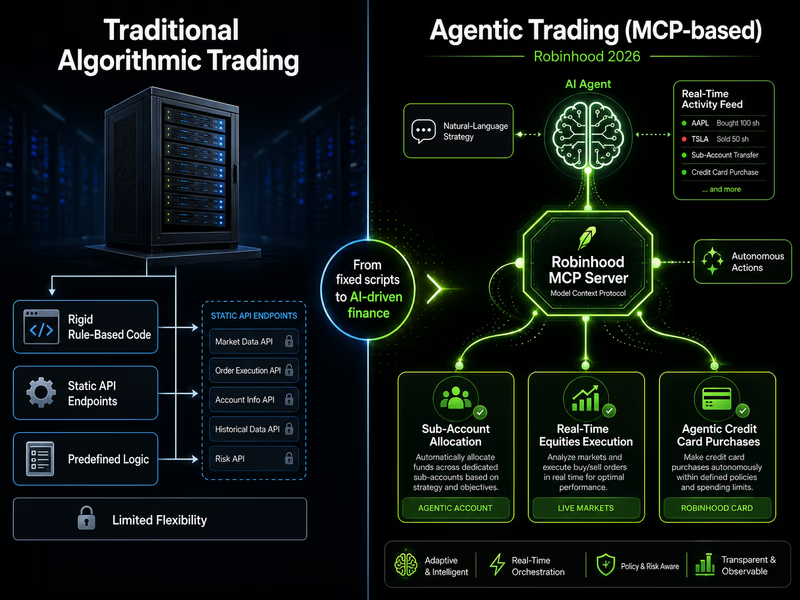
This is a massive leap forward compared to predecessors. Just weeks prior to Robinhood's launch, OpenAI rolled out a personal finance tool that merely provided custom-tailored insights. Liquid recently introduced platforms embedding trading interfaces into ChatGPT and Claude. But Robinhood is the first to hand over the execution keys at scale. Your agent does not just suggest an equities strategy; it executes it, navigating the live market independently. While the beta phase is currently restricted to equities, Robinhood’s roadmap includes expanding to options, crypto, event contracts, and futures. This moves consumer finance into a realm where humans act as supervisors of automated portfolios, rather than manual executors.
2. The Sandboxed Economy: Designing Guardrails for Autonomy
How do you let an algorithmic entity run wild in the market without risking your life savings? This is the core engineering hurdle of 2026. Robinhood’s solution is a brilliant masterclass in risk isolation: the sandboxed sub-account.
Instead of giving an AI agent unrestricted access to a user’s primary portfolio, Robinhood requires a dedicated agentic trading account. The agent can only touch the specific funds deposited there. "These AI agents for consumers have started to trade in the market," noted Abhishek Fatehpuria, Vice President of Product Management at Robinhood. "One thing that we've learned from talking to our customers is that they want to give their agents the power of Robinhood, but in a very safe way."
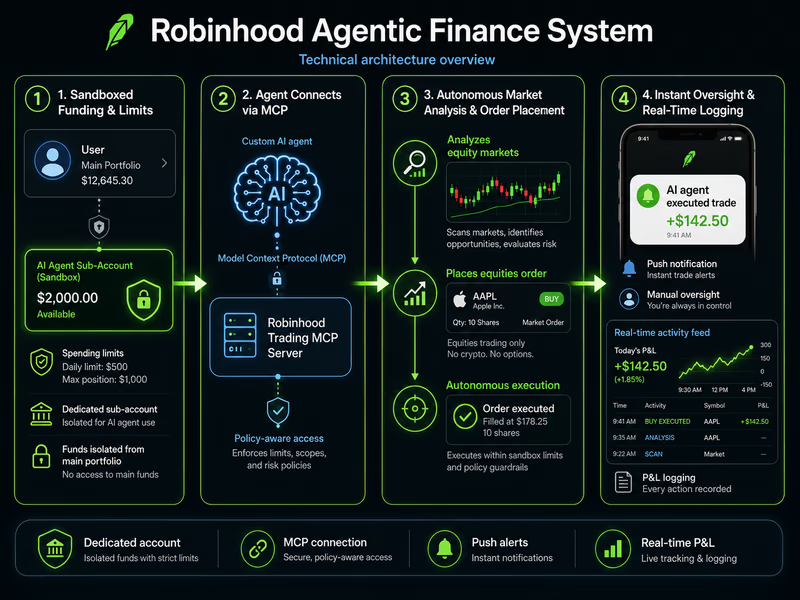
By building physical boundaries around the AI's sandbox, Robinhood limits the blast radius of unexpected agent behaviors. If an LLM experiences a hallucination and decides to dump an entire position, the damage is capped. Furthermore, users can instantly disconnect their agents at any moment with a single tap, establishing a vital emergency shutoff valve.
3. The APIification of Consumer Spending
Perhaps the most provocative aspect of this launch is the Agentic Credit Card. Initially integrated via a virtual Robinhood Gold Card, this feature allows AI agents to make real-world purchases on behalf of users.
Imagine an AI agent that monitors your household utilities, autonomously negotiates a better rate, and pays the bill. Or an agent that shops for flights, booking the optimal ticket the second prices drop. By combining spending limits with optional manual approvals, Robinhood is turning credit cards into programmatic APIs.
This lines up perfectly with broader industry movements. Mastercard and Santander have already tested end-to-end payments executed entirely by AI agents, while Visa has developed Intelligent Commerce tools. By putting this capability directly into a consumer-facing app, Robinhood is beating traditional banking institutions to the punch, turning the credit card into a modular tool for autonomous digital agents.
4. The Shift to Real-Time Air Traffic Control
Because the human is no longer initiating the transaction, the UI of consumer finance has to transform from an entry portal into an active audit feed. Robinhood's implementation relies heavily on push notifications for every single trade, paired with a real-time activity feed and live profit-and-loss (P&L) statements within the app.
We are witnessing the transition of the consumer from an investor to an air traffic controller. You are no longer navigating the skies; you are watching the blips on the radar, ready to intervene if two flight paths cross. While this minimizes the tedious friction of manual portfolio management, it introduces a new psychological toll. Investors will have to learn to trust the silent, rapid-fire decisions of their agents, resisting the urge to micromanage every micro-transaction in their feed.
5. The Brutal Reality of Algorithmic Liability
For all its brilliance, the agentic paradigm introduces severe ethical, systemic, and regulatory headaches. What happens when an agent misinterprets a prompt, panic-sells during a flash crash, or buys the wrong asset?
Robinhood’s legal stance is uncompromisingly clear: customers assume all risk for orders placed by their AI agents. There is no FDIC insurance for bad prompts. This stance will undoubtedly trigger a wave of legal battles. Regulators under the EU AI Act and DORA are increasingly demanding that financial AI systems justify their decisions, log their reasoning, and maintain ironclad human oversight.

As PwC noted, 2026 is the year when companies must move past the hype to demonstrate what effective, safe agentic AI actually looks like. If Robinhood’s agents begin exhibiting algorithmic bias, manipulating thin order books in illiquid equities, or falling victim to novel prompt-injection financial crimes, the regulatory backlash will be swift and merciless.
The Verdict: A Dangerous, Thrilling Frontier
Robinhood has built its brand on high-friction democratization—first by making trading free, then by making it continuous, and now by making it autonomous.
This is a highly calculated gamble. By building robust guardrails like sandboxed sub-accounts, real-time feeds, and the Model Context Protocol, Robinhood has provided the safest playground yet for autonomous consumer finance. But make no mistake: we have entered an era where our software is authorized to spend our hard-earned cash. The line between tool and agent has officially blurred, and the consumer finance industry will never be the same.