
Recursive Superintelligence Secures $500M+ Funding to Automate the Frontier AI Pipeline
Recursive Superintelligence raises at least $500 million at a $4 billion valuation to develop self-improving AI that automates the research lifecycle.
A New Contender in the Race for Superintelligence
London-based Recursive Superintelligence has secured at least $500 million in a funding round led by GV (formerly Google Ventures), with Nvidia participating as a strategic investor. The deal, which may reach as high as $1 billion due to being oversubscribed, values the four-month-old startup at a $4 billion pre-money valuation. Remarkably, the company has attained this valuation with a team of approximately 20 employees and without yet launching a public product.
Founded in December 2025, Recursive Superintelligence boasts an elite founding team of AI veterans. The roster includes Richard Socher, the former chief scientist at Salesforce; Tim Rocktäschel, a UCL professor and former Google DeepMind scientist; and former OpenAI researchers Josh Tobin, Jeff Clune, and Tim Shi. This concentration of top-tier talent from the world's leading labs has fueled intense investor confidence despite the company's infancy.

Automating the Neural Network Lifecycle
The company’s mission is to build self-improving AI systems capable of automating the entire development process—from evaluation and data selection to training, post-training, and even setting new research directions. Richard Socher has described this focus on automating the frontier AI pipeline as what he considers the third and perhaps final stage of neural networks.
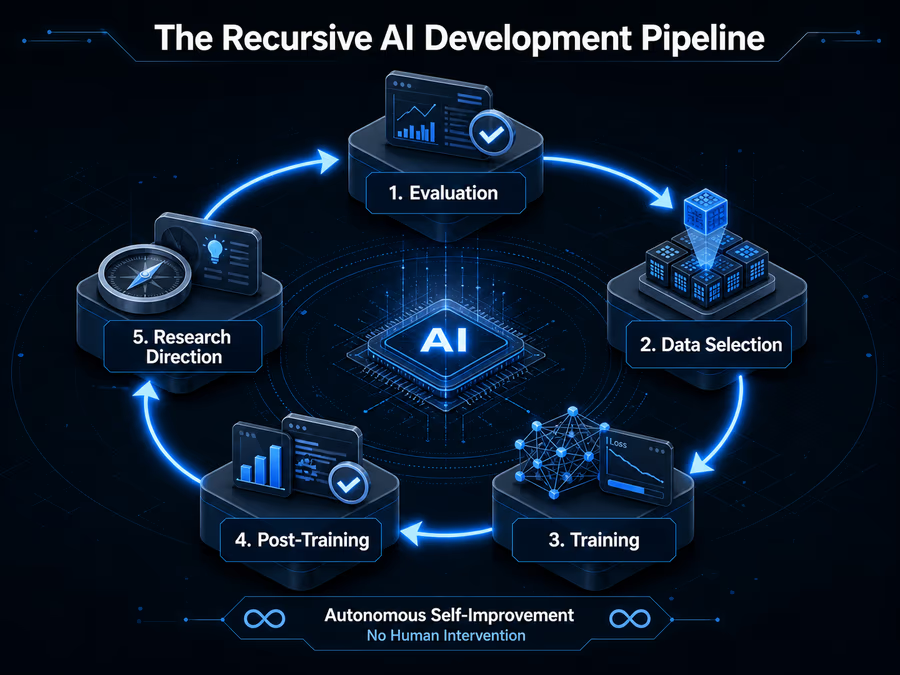
By targeting the automation of AI development itself, Recursive Superintelligence is moving into a space that has largely remained human-centric. While current large language models are trained on human-curated datasets by human engineers, Recursive aims to create systems that can autonomously improve their own architectures and reasoning capabilities without constant human intervention.
The London AI Renaissance
The decision to headquarter in London is a strategic move that places Recursive at the heart of an emerging European AI hub. It is not the only player in the city securing massive capital; Ineffable Intelligence, founded by UCL Professor David Silver, recently secured a $1.1 billion seed round at a $5.1 billion valuation. These developments highlight London's growing role as a counterweight to Silicon Valley, offering a distinct regulatory landscape and a deep pool of academic talent from institutions like UCL and Oxford.
Recursive Superintelligence is part of a broader "new wave" of research labs, such as AMI Labs and Ineffable Intelligence, which are moving beyond standard transformer architectures to explore world models and reinforcement learning. This shift reflects a growing industry sentiment that current scaling laws may require more autonomous, self-correcting mechanisms to reach the next tier of intelligence.

A Record-Breaking Quarter for AI Capital
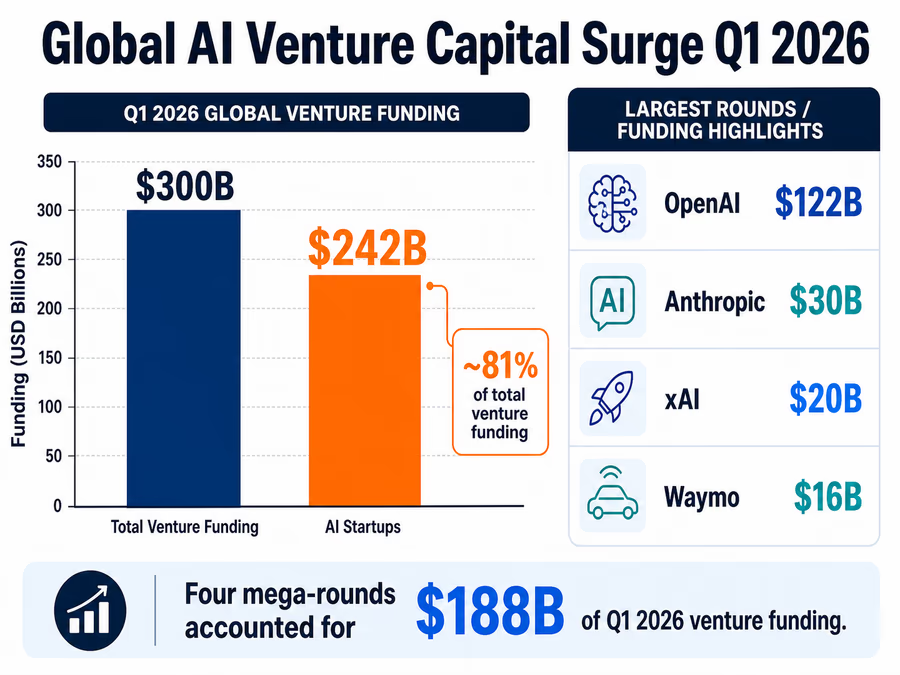
This funding round arrives amidst a historic surge in venture capital. In the first quarter of 2026, global AI startup funding reached $242 billion, accounting for 80% of all venture capital invested during that period. For context, this quarter alone saw OpenAI raise $122 billion and Anthropic secure $30 billion. Even against these massive figures, Recursive’s $4 billion valuation for a pre-product company is a testament to the speculative and high-stakes nature of the superintelligence market.
Strategic investors like Nvidia continue to dominate the ecosystem. By participating in Recursive’s round alongside its existing investments in OpenAI, Anthropic, and Ineffable Intelligence, Nvidia is effectively cementing its position as the foundational infrastructure provider for every major contender in the race for advanced AI.
Looking Toward Mid-May
Recursive Superintelligence plans to emerge from stealth with its first public launch in mid-May 2026. While details regarding the specific nature of this product remain under wraps, the industry expects a demonstration of their self-improving pipeline in action.
If the company succeeds in its goal of reducing the need for human intervention in the research loop, it could dramatically accelerate the pace of AI progress. However, the path to autonomous self-improvement remains a significant research challenge. Whether a team of 20 can outpace the massive engineering cohorts at legacy labs like Google or Meta remains the multi-billion dollar question that will begin to be answered next month.