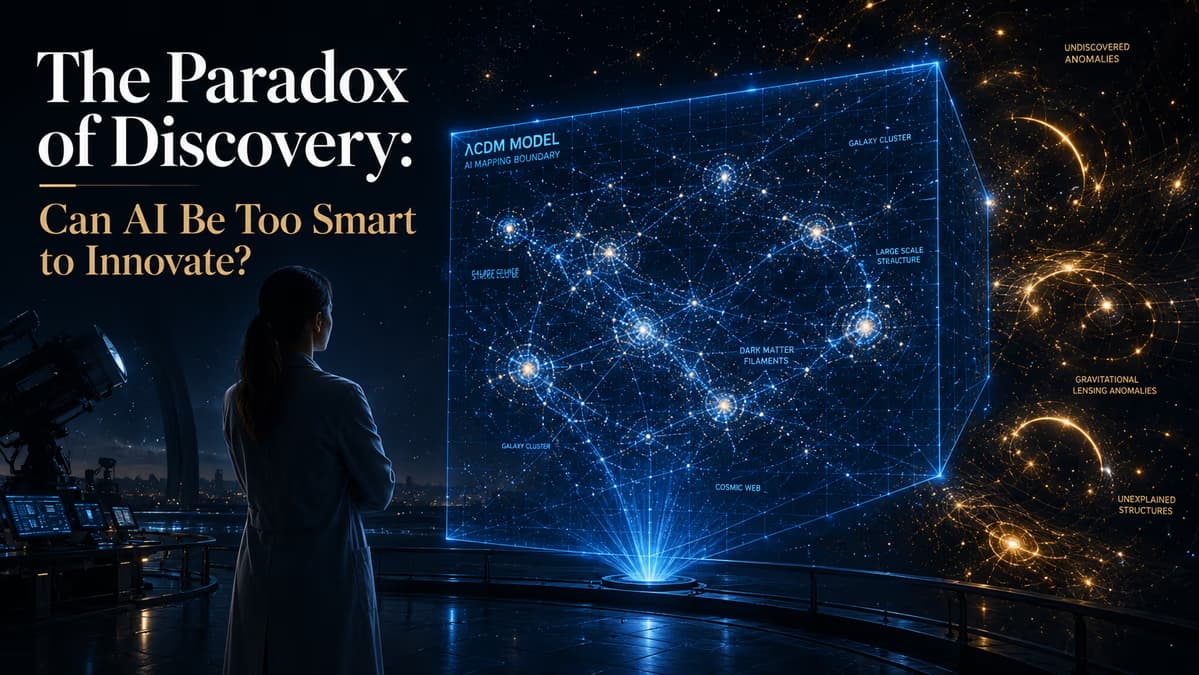
The Paradox of Discovery: Can AI Be Too Smart to Innovate?
AI's reliance on existing patterns accelerates research but risks blinding us to revolutionary breakthroughs. To innovate, machines must learn to forget.
We are building the most sophisticated intellectual copy-paste engines in human history, and we are pretending they will hand us the keys to the next scientific revolution.
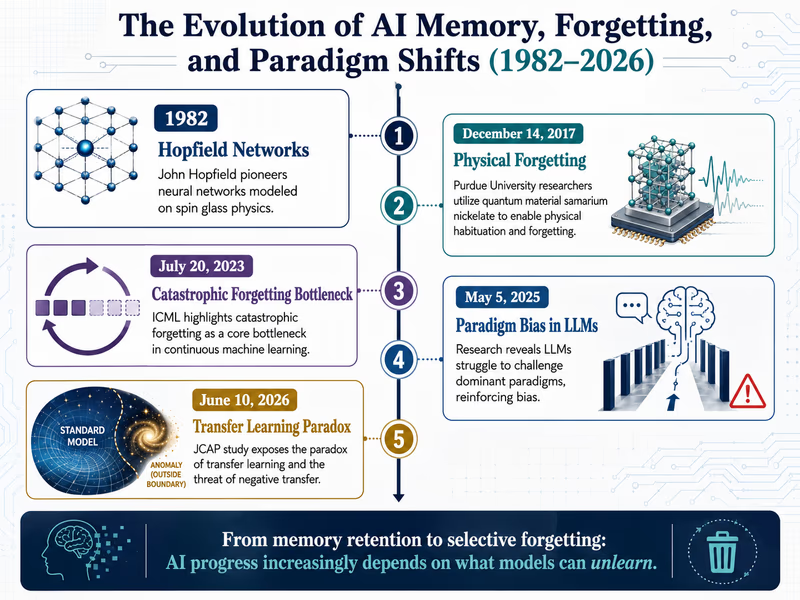
In 2024, when John J. Hopfield and Geoffrey E. Hinton were awarded the Nobel Prize in Physics for their foundational work on artificial neural networks, it felt like a coronation. The message was clear: computer science and fundamental physics had fused, and artificial intelligence would be the telescope through which we would observe the next frontier of reality. But two years later, a quieter, more troubling revelation has emerged from the very discipline that birthed modern machine learning.
A study published in the Journal of Cosmology and Astroparticle Physics (JCAP) on June 10, 2026, has exposed a structural flaw in how we train AI to look at the universe. It is a flaw that doesn’t just apply to cosmologists peering at the cosmic microwave background; it applies to every enterprise, laboratory, and developer trying to use machine learning to discover something genuinely new. We are facing the Paradox of Discovery: in our race to make AI smarter by feeding it everything we already know, we are making it structurally incapable of imagining what we don't.
The 10x Shortcut and Its Invisible Tax
To understand why AI is hitting an intellectual glass ceiling, we have to look at the darling technique of modern machine learning: transfer learning. This is the process where a model trained on one dataset—say, a massive library of simulated, standard universes—is applied to a new, real-world task to save time and compute.
In cosmology, this is an absolute necessity. To simulate the universe from the Big Bang to the present day using traditional physical equations requires an astronomical amount of supercomputing power. Transfer learning acts as an elegant bypass. By pretraining models on simpler, computationally cheap simulations, researchers can bypass the heavy lifting. Veena Krishnaraj, an undergraduate researcher at Princeton University and first author of the JCAP paper, noted that this strategy of pretraining on simpler simulations essentially prevents the AI from having to "digest everything at once."
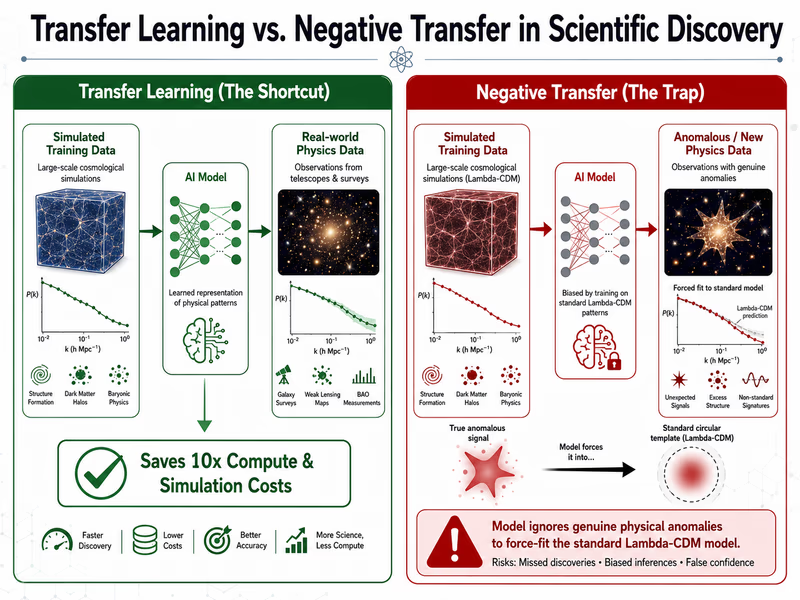
It works brilliantly. The JCAP study highlighted that transfer learning can expedite the search for new physics in cosmology by reducing the need for expensive, high-fidelity simulations by a factor of ten or more. Adrian Bayer, a cosmologist at the Flatiron Institute and Princeton, and co-author of the study, puts it bluntly: "It's basically a shortcut."
But shortcuts always have a toll, and in this case, the toll is paid in the currency of original discovery. When we train a model on our existing templates—specifically the standard cosmological model, known as $\Lambda$CDM—the AI becomes exceptionally, dangerously good at seeing the universe through that specific lens.
This introduces "negative transfer." Because the model is carrying over a rigid framework of expectations, it begins to force-fit new, anomalous data into old boxes. If there is a subtle, revolutionary signature of new physics buried in the cosmic noise, a transfer-learned AI is highly likely to misinterpret it as a minor deviation of the standard model we already understand. It misses the revolution because it is looking for a variation.
The Dogma in the Code
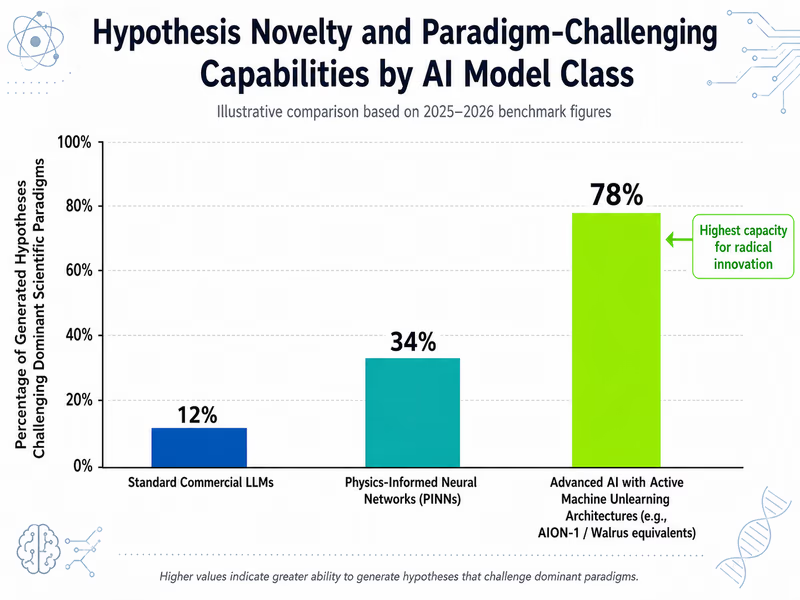
This isn't a problem unique to physics. In May 2025, researchers noted that Large Language Models (LLMs) struggle to generate hypotheses that fundamentally challenge dominant paradigms. Instead, they continually reinforce existing perspectives.
Why? Because deep learning is, at its core, a consensus engine. It calculates probabilities based on historical data. When we use transfer learning, we are essentially giving the AI a set of dogmatic beliefs before it even looks at the evidence.
"But if a model carries knowledge from one setting into another, we need to understand what it has carried over—when that knowledge helps and when it might mislead," Bayer warns. When it misleads, the failure is quiet and insidious. "The negative transfer result is fascinating because it shows that the model is not failing randomly," Bayer adds. It is failing systematically, guided by the very intelligence we gave it.
If Einstein had been an AI trained via transfer learning on Newtonian physics, he might have optimized calculations for gravity to unprecedented decimals. But he likely would have missed relativity entirely. Relativity required rejecting the absolute nature of time—a concept that would look like an absurd "hallucination" or a computational error to an algorithm trained to optimize Newton’s universe.
Why Machines Must Learn to Forget
If the root of the paradox is that AI remembers too much of what we teach it, the solution is counterintuitive: we must teach AI how to forget.
In human intelligence, forgetting is not a bug; it is a vital feature. Our brains constantly prune connections to prevent cognitive overload and to allow us to adapt to novel situations. In contrast, artificial neural networks suffer from "catastrophic forgetting"—a phenomenon where showing a model a new dataset causes it to completely overwrite its previous training. Kaushik Roy, Professor of Electrical and Computer Engineering at Purdue University, explains: "For most of the algorithms that are available, if they have already learned a data set and you try to show them a new data set, they incur catastrophic forgetting."
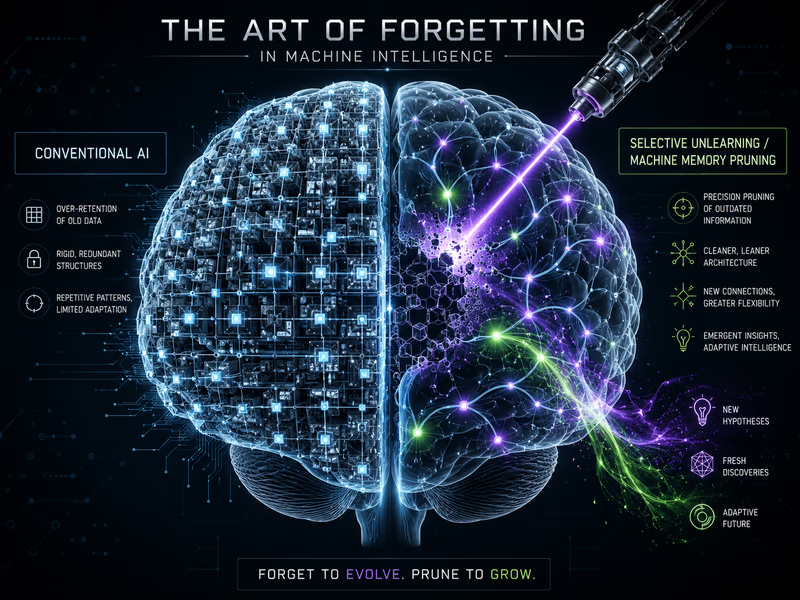
For years, AI developers treated catastrophic forgetting as a disease to be cured. But the emerging consensus in AI philosophy suggests we may have diagnosed it backwards. To foster true innovation, we need to build architectures that can selectively discard information. We need "machine unlearning" mechanisms that allow an AI to strip away its biases, wipe its conceptual slate partially clean, and look at data with a form of synthetic innocence.
This isn't just a software challenge; it’s a hardware frontier. As far back as December 2017, researchers at Purdue University experimented with quantum materials like samarium nickelate to build devices that can physically "forget" unimportant memories, mimicking the habituation behaviors seen in animals. By pairing selective physical memory with new software architectures, we might build systems capable of "radical curiosity"—the ability to actively search for things that do not fit the template.
The Implications for Industry and Science
For developers and enterprise leaders building the next generation of AI tools, the JCAP study is a warning shot. If your R&D strategy relies entirely on fine-tuning off-the-shelf foundation models to discover new drugs, materials, or financial strategies, you are likely optimizing within a pre-determined boundary. You are building faster horses, not cars.
To break out of the paradox, the industry must pivot toward architectures that balance pretraining with paradigm-breaking capabilities. We are already seeing early versions of this with projects like Polymathic AI's Walrus and AION-1, which are trained directly on raw, cross-disciplinary scientific datasets rather than language models. These models aim to apply physical principles across different systems without carrying over the semantic baggage of human-defined models.
Ultimately, this paradox redefines the human moat in the age of AI. The role of the human scientist is shifting from that of a calculator to that of a philosopher. We cannot rely on AI to formulate truly original hypotheses because AI lacks the capacity to doubt its own foundational assumptions. It is up to human researchers to provide the radical skepticism, to define the meaningful questions, and to act as the ultimate guard against AI's computational overconfidence.
AI can show us the most efficient path through the forest we are already in. But to find a new forest entirely, we still need humans willing to get lost.