The Great Agent Pivot: OpenClaw and Hermes Agent Battle for the Future of Autonomous Systems
OpenClaw’s massive popularity faces a security-driven challenge from Hermes Agent as the AI market moves toward self-improving autonomy.
The Meteoric Rise and Star-Studded Records
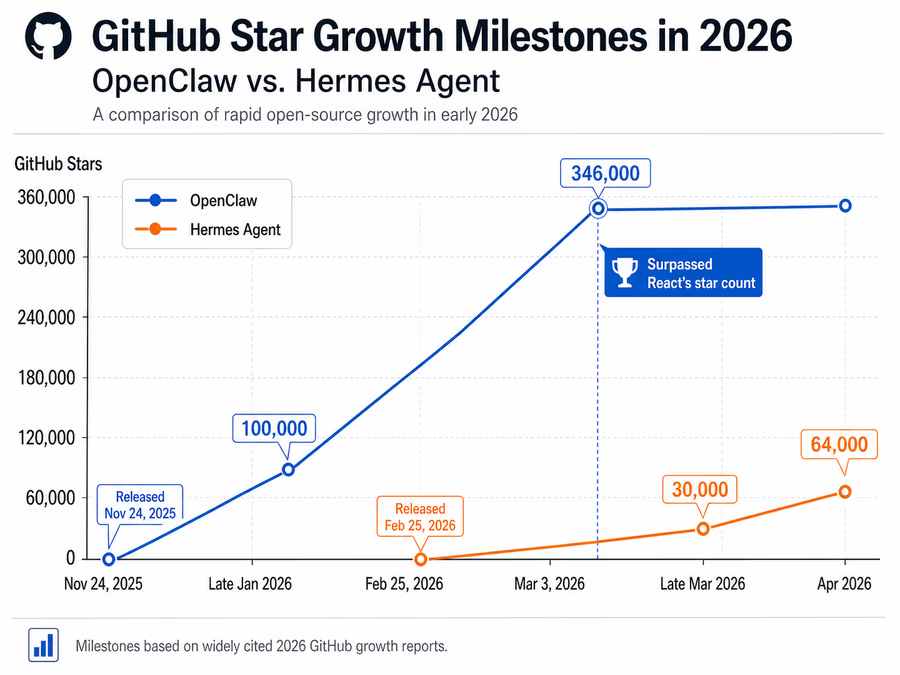
OpenClaw, the project formerly known as Clawdbot and Moltbot, secured its place in software history on March 3, 2026, when it officially surpassed React to become the most starred software project in GitHub’s existence. Achieving 346,000 stars in a breakneck 33-day sprint, the project—released by Peter Steinberger in late 2025—captured the industry’s imagination by offering a robust, gateway-first assistant architecture. By late January 2026, OpenClaw had already crossed the 100,000-star threshold, fueled by a massive ecosystem of over 5,700 human-authored skills on its ClawHub marketplace.
However, the project reached a critical turning point on February 14, 2026, when Steinberger announced his departure for OpenAI. As the project transitioned to an open-source foundation, the initial shine began to wear off under the weight of severe security disclosures. While OpenClaw established the "industrial standard" for multi-channel integrations—linking seamlessly with Telegram, Discord, Slack, and WhatsApp—it did so with a design that relies on static, human-defined skills, a philosophy now being challenged by newer, more adaptive competitors.
Security Cracks in the Gateway Foundation
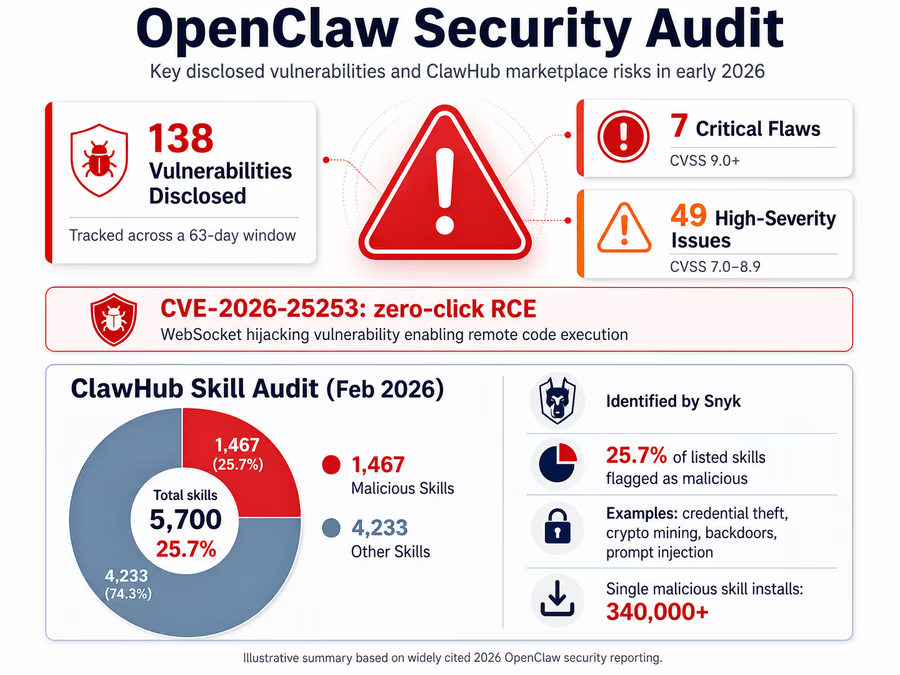
As OpenClaw’s adoption skyrocketed, so did its attack surface. Over a 63-day period, security researchers disclosed 138 vulnerabilities, including seven critical and 49 high-severity issues. The most alarming of these, CVE-2026-25253, was identified as a zero-click remote code execution flaw. By February 2026, a census of the public internet revealed over 42,000 exposed OpenClaw instances, with 63% of them operating without any gateway authentication.
The marketplace itself, ClawHub, became a vector for risk. A February 2026 audit by the Snyk security team discovered that nearly 26% of the 5,700 available community skills—1,467 in total—were malicious. These systemic failures led to a "market where trust is collapsing," prompting the Chinese government in March 2026 to restrict state agencies, state-owned enterprises, and banks from utilizing the platform. This atmosphere of uncertainty provided the perfect opening for Nous Research to introduce a more secure, autonomous alternative.
The Hermes Alternative: Learning Over Static Skills
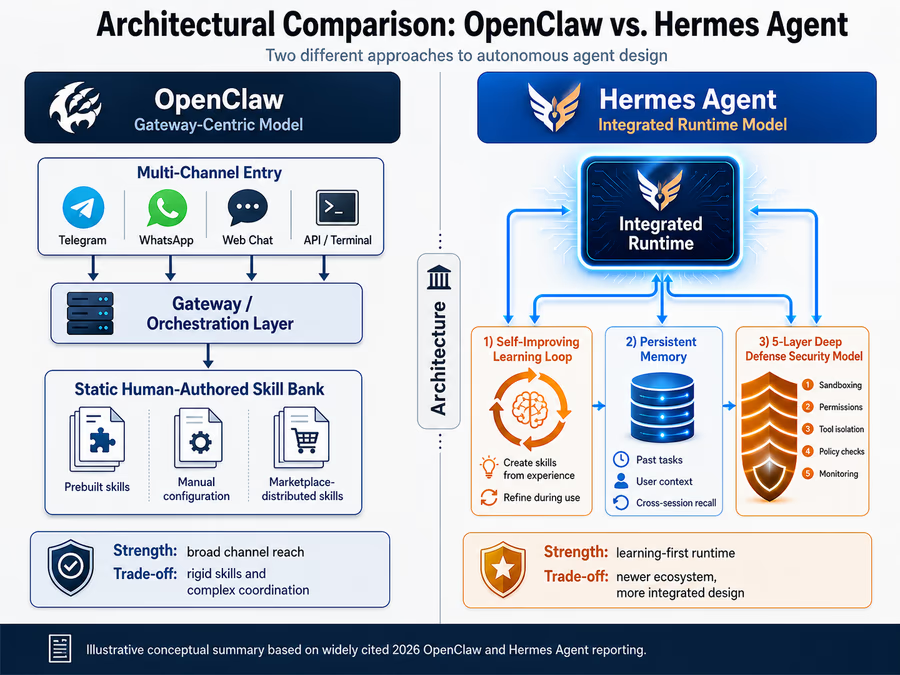
Enter Hermes Agent. Released as v0.1.0 on February 25, 2026, the project took a fundamentally different approach to agentic design. While OpenClaw focuses on being a "gateway-centric assistant control plane," as described by a recent Deep Analysis of Runtime report, Hermes Agent is an integrated runtime designed for capability accumulation. It reached 64,000 GitHub stars by April 2026, signaling a shift in developer interest toward more sophisticated architectures.
The core of Hermes Agent is its self-improving learning loop. Unlike OpenClaw’s reliance on static skill-writing, Hermes Agent autonomously creates and refines its own skills based on session experience. This is paired with a persistent memory system and a five-layer deep defense security model intended to prevent the kind of mass exposures that plagued the early OpenClaw ecosystem. According to a developer active in both communities, as reported by AB Newswire, "The agents that will succeed in 2026 are those that can genuinely improve themselves rather than relying solely on static human-defined skills."
A Tale of Two Architectures
The choice between these two platforms often comes down to the intended "system boundary." Userorbit noted on April 3, 2026, that OpenClaw is easier to understand as a gateway-first assistant because its documentation prioritizes routing, session keys, and channel behavior. It is built to deliver tools across diverse platforms quickly. In contrast, Hermes Agent is designed to be a personalized "AI avatar" that grows more intelligent with use.
Writing on Binance Square, the commentator known as 大漠哥 summarized the current market split: "If you need a mature, all-purpose, and quickly deployable multi-channel assistant... OpenClaw is still the current industrial standard. If you pursue personalization and long-term growth... then the Hermes Agent is definitely worth your effort to train." This distinction highlights the evolution from simple task execution to continuous, autonomous operation.
Industrial Standards vs. Autonomous Growth
The competition has even birthed hybrid strategies. Some organizations are now using OpenClaw as an orchestrator for multi-agent setups while delegating focused execution tasks to Hermes Agent. The broader landscape remains crowded with frameworks like AutoGPT, LangChain, and CrewAI, but the specific rivalry between OpenClaw and Hermes highlights the industry's struggle with the trade-off between connectivity and security.
Related developments like NVIDIA’s NemoClaw reference stack suggest that the industry is trying to patch OpenClaw's reputation by providing secure, on-premises deployment options. Meanwhile, the rapid iteration of Hermes Agent—which reached version 0.8.0 by April 8, 2026—shows no signs of slowing down. As we move deeper into 2026, the market is no longer satisfied with bots that just follow instructions; it demands agents that can learn from their mistakes and defend their own perimeters. The path forward for autonomous AI will likely be paved by whichever project can bridge the gap between OpenClaw's massive scale and Hermes' architectural intelligence.