OpenAI Shifts to Agentic Intelligence with Launch of GPT-5.5
OpenAI launches GPT-5.5 and GPT-5.5 Pro, featuring advanced agentic capabilities for autonomous task completion and superior technical benchmarks.
OpenAI officially released GPT-5.5 on Thursday, April 23, 2026, marking a strategic pivot toward "agentic" AI designed to operate software and complete multi-step professional tasks independently. Positioned as the company’s most capable system to date, the model arrives in two variants: a standard GPT-5.5 and a higher-accuracy GPT-5.5 Pro. Both are currently rolling out to Plus, Pro, Business, and Enterprise subscribers via ChatGPT and the Codex development environment.
Moving Beyond the Chatbox
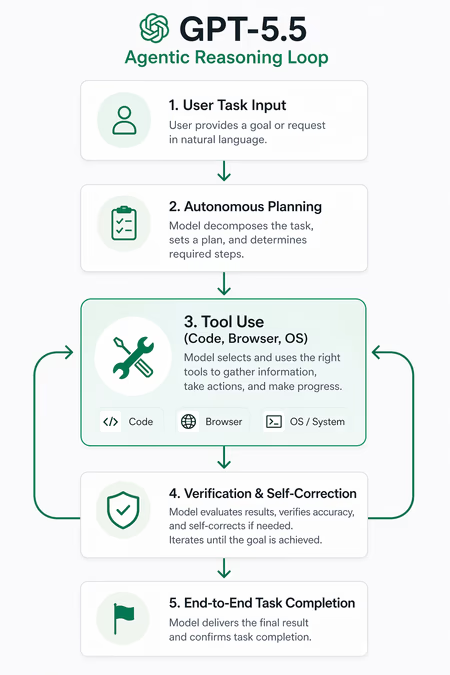
The release signals a fundamental change in how OpenAI expects users to interact with artificial intelligence. While previous models functioned primarily as reactive conversationalists, GPT-5.5 is built for complex, real-world work. The model can write and debug code, perform deep online research, manage data analysis, and create complex documents or spreadsheets. Crucially, it can move across multiple software tools to finish tasks autonomously.
In a blog post accompanying the release, OpenAI stated that GPT-5.5 “represents a step toward AI systems that can complete complex, multistep tasks on a computer without human guidance.” The company emphasized that users no longer need to carefully manage every individual step of a process. Instead, they can provide a "messy, multi-part task" and trust the model to plan, utilize tools, verify its own work, and navigate through ambiguity independently.
Dominating Technical Benchmarks
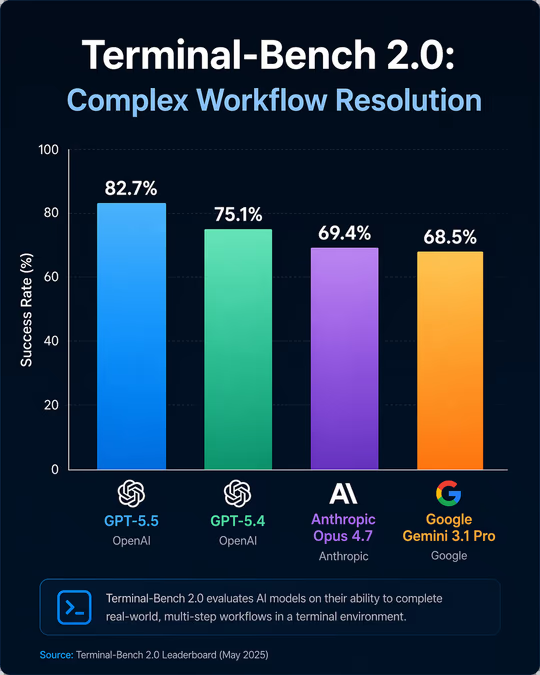
To support its claims of superior agency, OpenAI released a suite of benchmark results comparing GPT-5.5 against its predecessors and industry rivals. On Terminal-Bench 2.0, which measures the ability to handle complex command-line workflows, GPT-5.5 scored 82.7%. This performance comfortably surpassed GPT-5.4 (75.1%), Anthropic’s Opus 4.7 (69.4%), and Google’s Gemini 3.1 Pro (68.5%).
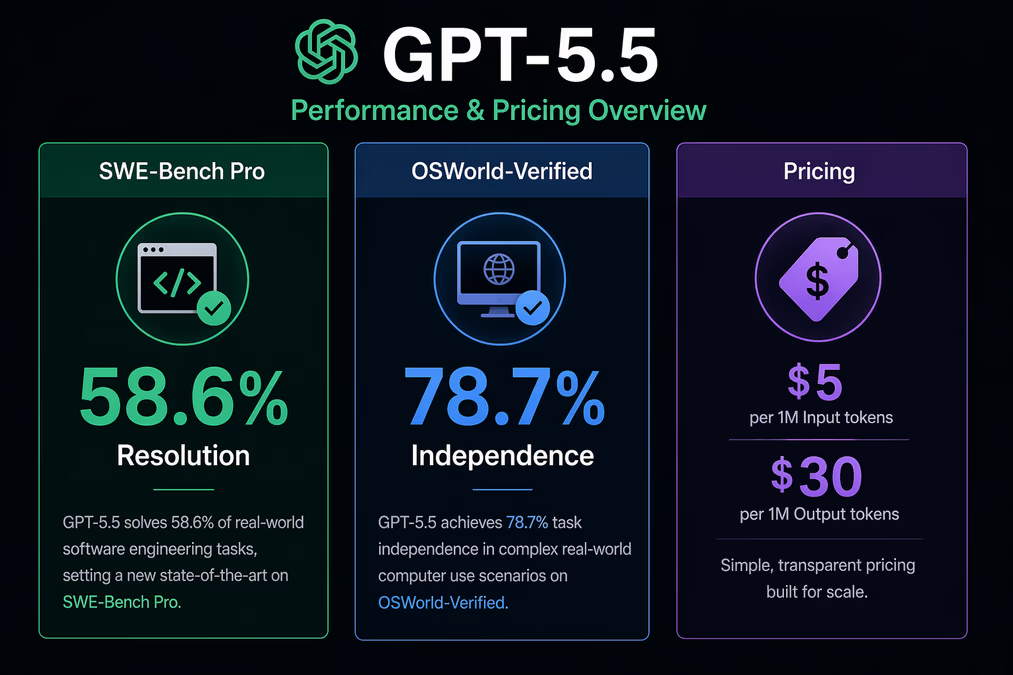
Perhaps more impressive for the enterprise sector is the model's performance on SWE-Bench Pro, a benchmark for resolving real-world GitHub issues. GPT-5.5 resolved 58.6% of tasks end-to-end in a single pass. Furthermore, on OSWorld-Verified—a test measuring independent computer operation—the model achieved a 78.7% success rate. Despite these increased capabilities, OpenAI claims the model matches the per-token latency of GPT-5.4 while being more token-efficient, requiring fewer tokens to complete equivalent tasks in Codex.
The Competitive Landscape and "Spud"
The release of GPT-5.5 comes at a time of intense pressure for OpenAI. While the company has led the market for years, rivals have recently made significant gains. Anthropic's Claude Opus 4.7, released just one week prior, also targeted multi-step task planning. Furthermore, unverified reports suggested OpenAI had been in a "Code Red" state since December 2025 due to Anthropic’s rapid expansion into the enterprise market.
Internally codenamed "Spud," GPT-5.5 is widely viewed as OpenAI’s defensive wall against its competitors. During a press call, OpenAI President Greg Brockman noted that the model would enable Codex to produce polished code with the "judgment of a senior software engineer." While Brockman declined to comment on rumors of a 10 trillion parameter count, the impact of the model is already being felt by early testers. One engineer at NVIDIA who had early access to the model remarked that losing access to GPT-5.5 felt like having a "limb amputated."
Safety, Pricing, and the Road Ahead
OpenAI has implemented extensive predeployment safety evaluations for the new model. This included targeted red-teaming focused on advanced cybersecurity and biological capabilities. The company also integrated feedback from nearly 200 early-access partners to refine the model's behavior in professional environments.
For developers, API access is expected to arrive "very soon." Initial pricing has been set at $5 per million input tokens and $30 per million output tokens. This positioning targets the high-end enterprise market where reliability and autonomy justify the premium cost.
As the AI industry moves toward standardization protocols like the Model Context Protocol (MCP), GPT-5.5 appears to be the vanguard of a new class of "super apps." By unifying chat, coding, and browsing into a single autonomous platform, OpenAI is betting that the future of AI lies not in talking to a machine, but in delegating entire workflows to an agent that can see the job through to completion.