
OpenAI Targets Public Listing in Landmark $852 Billion IPO Push
OpenAI is preparing a confidential IPO filing for a public debut as early as September 2026, targeting an $852 billion valuation.
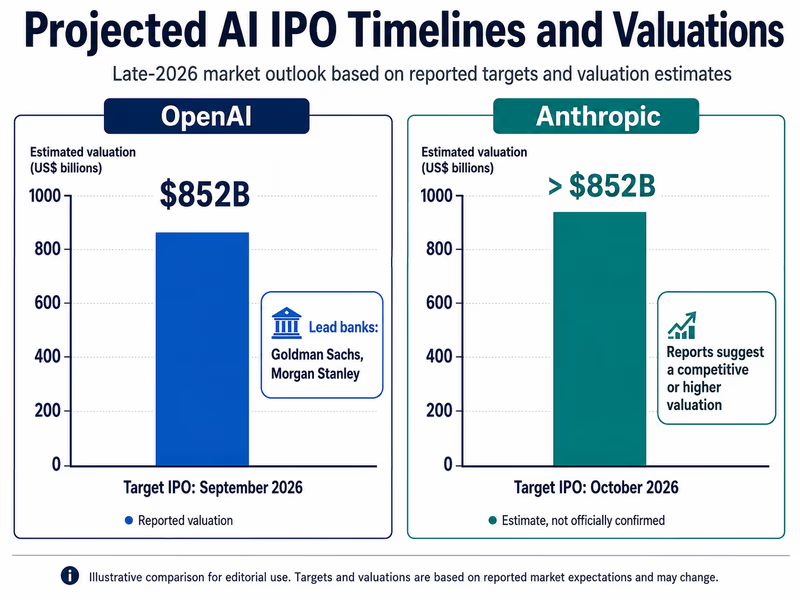
OpenAI is preparing to confidentially file for an Initial Public Offering (IPO) that could value the artificial intelligence pioneer at $852 billion or more. The San Francisco-based company has reportedly tapped investment banking giants Goldman Sachs and Morgan Stanley to lead the offering as underwriters, with a target public debut scheduled as early as September 2026.
The move, which reports suggest could begin rolling out as early as the week of September 05, 2026, follows a meteoric rise in private valuations. OpenAI's most recent funding round, which closed in March 2026, secured an unprecedented $122 billion in committed capital, valuing the company at $852 billion. That round was anchored by major tech players Amazon, Nvidia, and SoftBank, alongside continued substantial backing from Microsoft.
The Path to a Public Listing
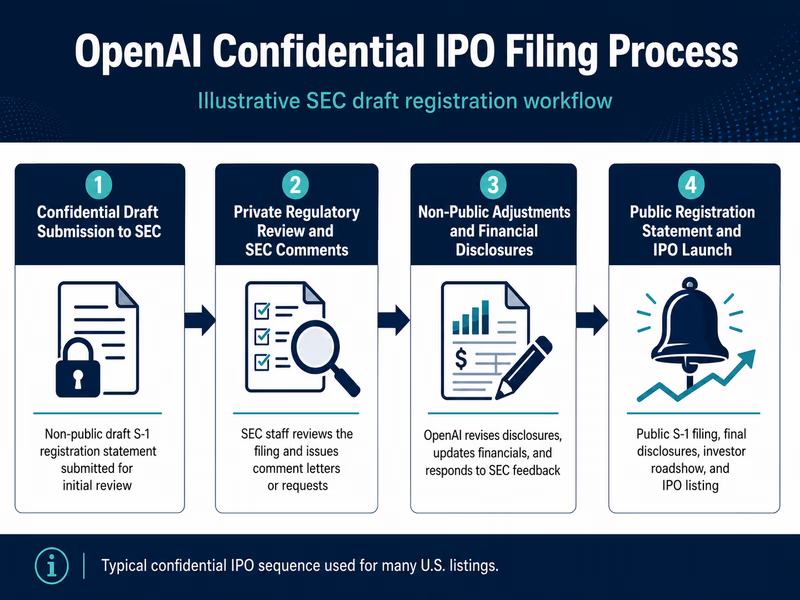
Opting for a confidential filing allows OpenAI to submit draft registration documents to the U.S. Securities and Exchange Commission (SEC) privately. This approach enables the company to resolve regulatory issues and refine its disclosures away from public view before launching a formal roadshow.
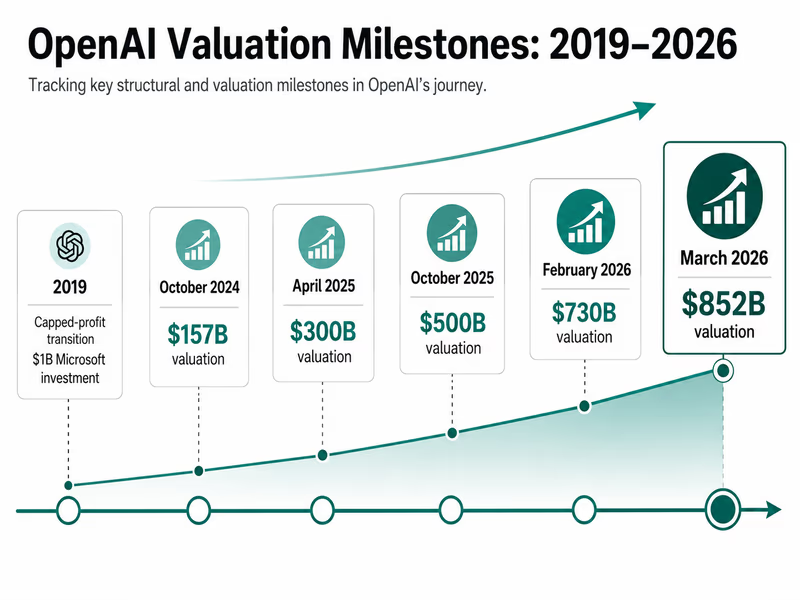
This IPO represents the culmination of a dramatic evolution for OpenAI. Founded as a non-profit research lab in 2015, the organization transitioned to a capped-profit structure in 2019 to attract the massive capital required for advanced AI training. Microsoft made an initial $1 billion investment during that transition, followed by an additional $10 billion in January 2023. By April 2025, OpenAI raised $40 billion at a $300 billion post-money valuation, climbing to $500 billion in October 2025, and $730 billion by February 2026, before reaching its current $852 billion valuation in March 2026.
Financial Stature and Heavy Infrastructure Demands
While an OpenAI spokesperson has stated that the organization's focus remains on execution rather than financial speculation, the company is increasingly operating with the discipline of a listed firm. OpenAI Chief Financial Officer Sarah Friar recently noted that behaving like a public company is simply good hygiene for an organization of OpenAI's massive scale.

Financially, the scale is indeed staggering. By March 2026, OpenAI's revenue reached $2 billion per month. However, the company faces enormous capital requirements. OpenAI currently carries an estimated $600 billion in future spending commitments dedicated to semiconductors and data centers. Furthermore, unverified reports suggest that cash flow losses could persist until 2030, which may test public market investors' tolerance for long-term capital intensity.
Legal Hurdles Cleared and Competitive Pressures
The timing of the IPO push is bolstered by a major legal victory. On May 19, 2026, a California jury dismissed Elon Musk’s lawsuit against OpenAI, ruling that Musk had waited too long to file his challenge against the company's transition to a for-profit model. This ruling effectively removes a persistent legal cloud that had hovered over the firm since its corporate restructuring.
Meanwhile, competitive pressures in the AI sector are intensifying. OpenAI’s chief rival, Anthropic, is reportedly planning its own IPO as early as October 2026, with some unconfirmed reports suggesting its valuation could rival or even surpass OpenAI's. Other major private firms, such as SpaceX, are also expected to target public debuts in the summer of 2026, setting up a highly active period for mega-cap tech listings.
Amid these corporate developments, OpenAI continues to push its core technology forward. The company recently released GPT-5.4, its most capable model to date, demonstrating substantial gains in benchmark intelligence and workflow performance. Additionally, the company has begun securing lucrative government partnerships, recently being named a recipient of a $200 million United States Department of Defense contract for military AI applications.
Forward-Looking Implications
Going public will irrevocably alter OpenAI. While listing will unlock vast public capital markets and allow employees and early investors to monetize their stakes, it will also expose the company to intense regulatory scrutiny and the pressure of quarterly earnings.
The ultimate success of OpenAI's IPO will serve as a definitive bellwether for the entire artificial intelligence industry. If Wall Street embraces OpenAI's high-expenditure, high-revenue model, it could solidify the current AI boom; if investors balk at the projected timeline for profitability, it could trigger a broader reality check for technology valuations worldwide.