
OpenAI Launches 'Dreaming V3' to Overhaul ChatGPT's Memory System
OpenAI has launched Dreaming V3, a new ChatGPT memory architecture that dramatically improves performance while reducing compute costs.
OpenAI launched 'Dreaming V3' on June 4, 2026, introducing a completely redesigned memory architecture for ChatGPT that automates how the conversational assistant retains and updates information over time. The rollout began immediately for ChatGPT Plus and Pro subscribers in the United States, with a free tier deployment and expansion to additional countries and Go users expected in the coming weeks.
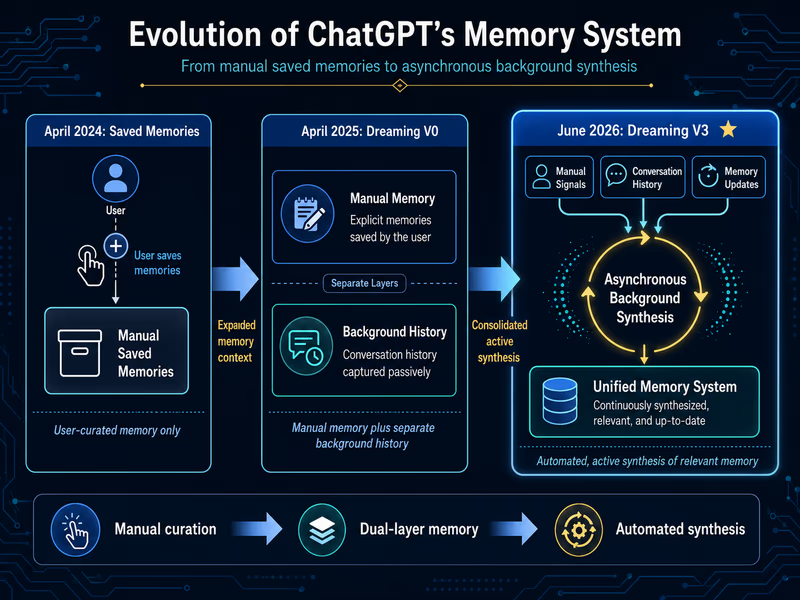
Historically, large language models (LLMs) have struggled with finite context windows, leading to repetitive interactions and a lack of ongoing personalization. Dreaming V3 addresses these limitations by consolidating previous multi-layered memory systems into a single, asynchronous background synthesis process. This system automatically curates and updates user preferences, active projects, and recurring context after each conversation, mimicking human long-term memory consolidation.
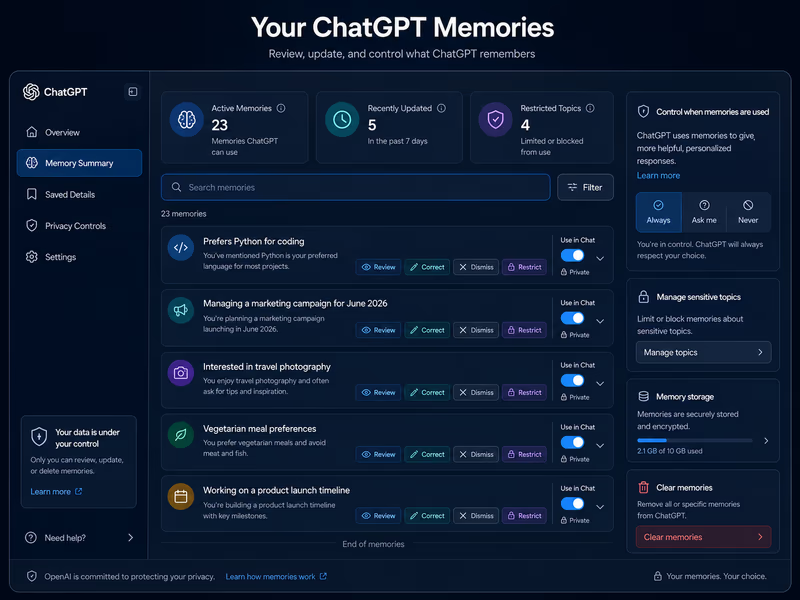
According to an official OpenAI blog post, "Today, we are launching a significantly more capable and compute-efficient memory architecture built on top of dreaming. The memories synthesized by dreaming are reviewable through a summary of them made visible in the memory summary page. From the memory summary, you can quickly glean the highlights of what ChatGPT knows about you, add or update information about yourself, and provide instructions on what topics ChatGPT should bring up and when."
Dramatic Performance Gains and Compute Efficiency
The technological leap behind Dreaming V3 lies in its computational efficiency. The new system requires approximately five times less compute to serve "dreaming" to Free tier users compared to its predecessor. This dramatic reduction in computational overhead makes a broader, free-tier memory rollout economically viable for OpenAI. For premium Plus and Pro users, these same efficiency gains translate directly into a twofold expansion in memory capacity.

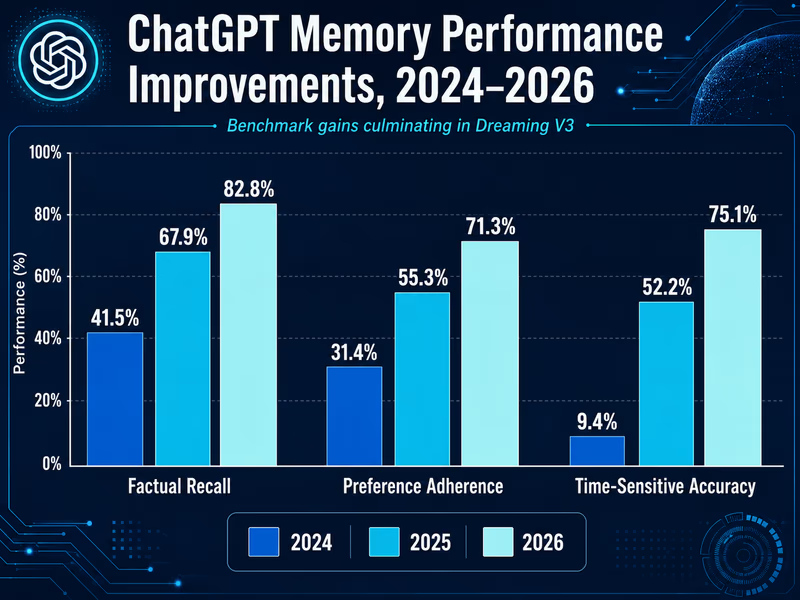
Alongside efficiency, the architectural overhaul has delivered substantial performance improvements across key benchmarks. OpenAI's internal evaluations show a rapid upward trajectory in capability over the past three years:
* Factual Recall: Reached 82.8% in 2026, up from 67.9% in 2025 and 41.5% in 2024.
* Preference Adherence: Improved to 71.3% in 2026, up from 55.3% in 2025 and 31.4% in 2024.
* Time-Sensitive Accuracy (Staying Current): Reached 75.1% in 2026, a massive leap from 52.2% in 2025 and just 9.4% in 2024.
This evolution marks a shift from the explicit "saved memories" feature launched in April 2024—which required users to manually tell ChatGPT what to remember—and the transitional "Dreaming V0" released in April 2025, which introduced background context referencing but lacked unified, active synthesis.
Balance Between Automation and Privacy Control
While Dreaming V3 promises a highly intuitive, personalized user experience, the automation of memory generation introduces new challenges. A February 2026 study published on arXiv suggested that up to 96% of memories created by these kinds of automated background systems are generated unilaterally without direct user prompting.
To balance this autonomy, OpenAI has introduced a new Memory Summary Page. This interface serves as a dashboard where users can review, correct, dismiss, or restrict specific topics ChatGPT has committed to memory.
"Memory is what helps ChatGPT learn your preferences, projects, and constraints, allowing future conversations to start from shared context rather than from scratch," OpenAI noted in its announcement, emphasizing that persistent memory has become critical for helping users accomplish meaningful, long-term goals.
However, the unilateral nature of these background processes could invite regulatory scrutiny. The EU AI Act, which is expected to take effect in August, mandates high standards of transparency for AI decision-making. Similar legislative hurdles exist in the United States, including the Colorado AI Act (effective June 30) and the draft of the Great American AI Act.
Industry Context and Future Implications
The launch of Dreaming V3 places OpenAI at the forefront of a highly competitive push toward persistent memory for LLM agents. Anthropic has similarly introduced memory features on its free tier for Claude, indicating that long-term contextual continuity is becoming a baseline consumer expectation.
On a technical level, these memory architectures are heavily reliant on hardware advancements. High Bandwidth Memory (HBM) and Compute Express Link (CXL) are crucial to support the faster data access speeds and larger context windows needed to make asynchronous memory synthesis scalable.
Ultimately, as ChatGPT becomes more deeply integrated into its users' workflows and daily lives, Dreaming V3 may create a high switching barrier. A highly personalized AI assistant that understands a user's long-term habits, professional projects, and personal constraints makes migrating to competitors like Claude or Gemini increasingly difficult. As memory becomes the foundation of true agentic AI, the platform that remembers its users best may very well win their long-term loyalty.