OpenAI Broadens Financial Ambitions with Acquisition of AI Personal Finance Startup Hiro Finance
OpenAI has acquired Hiro Finance, an AI personal finance startup, to integrate its expert team and enhance ChatGPT's financial planning capabilities.
OpenAI Secures Specialized Fintech Talent in Hiro Finance Acquisition
OpenAI has confirmed the acquisition of Hiro Finance, a consumer-focused startup specializing in AI-driven financial planning, marking a significant step in the AI giant's effort to move beyond general-purpose conversation and into high-trust, math-intensive domains. The deal, largely characterized as an "acqui-hire," will see Hiro’s core team of approximately 10 employees transition to OpenAI to bolster its internal expertise in financial modeling and deterministic calculations.
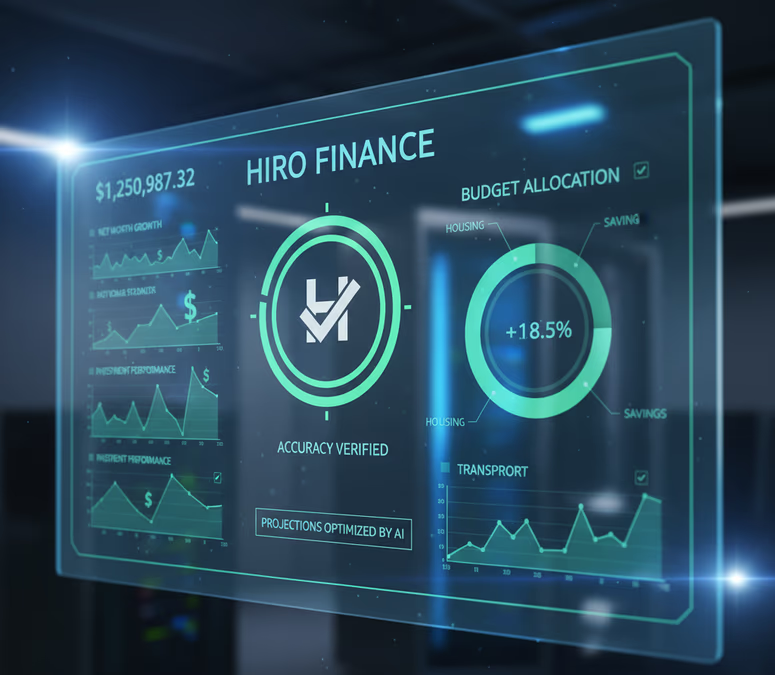
Founded in 2023 by serial entrepreneur Ethan Bloch, Hiro Finance positioned itself as an "AI personal CFO." The startup’s flagship tool, which launched in late 2025, allowed users to input complex financial data—including salaries, debts, and varying expense categories—to model long-term financial scenarios. While many large language models (LLMs) struggle with precise arithmetic, Hiro Finance distinguished itself by focusing on the accuracy of financial mathematics, even offering a feature for users to verify the underlying calculations of the AI’s suggestions.

A Strategic Talent Grab
The acquisition is less about Hiro Finance’s existing product and more about the human capital behind it. The startup will cease all operations on April 20, 2026, with a commitment to delete all user data by May 13, 2026. This hard sunset indicates that OpenAI intends to integrate the team’s expertise directly into its own product ecosystem, likely ChatGPT, rather than maintaining a standalone personal finance application.
Ethan Bloch, the founder of Hiro Finance, brings a high-profile track record in the fintech sector. He previously founded Digit, an automated savings and digital banking service that was acquired by Oportun in 2021 for more than $200 million. Bloch’s experience in navigating the intersection of consumer finance and regulated products is a valuable asset for OpenAI as it seeks to make ChatGPT a more reliable tool for sensitive financial tasks.
"We started Hiro with the vision of building an AI personal CFO, and we worked relentlessly to make it real," Bloch stated following the announcement. "Since then, we've helped clients plan for and manage more than $1 billion in assets, and we're incredibly [excited for the next chapter]."
Bridging the Gap Between Language and Logic
A persistent challenge for LLMs like GPT-4 is the tendency to "hallucinate" numbers or fail at complex multi-step arithmetic. For a general chatbot, a minor math error might be trivial; for a financial assistant advising on debt repayment or retirement planning, it is a liability.
By bringing the Hiro Finance team in-house, OpenAI is signaling a commitment to developing "high-trust" functionalities. Hiro’s focus on auditability and reproducible calculations aligns with OpenAI’s broader strategy to position ChatGPT as a tool for business finance teams and individual consumers alike. The acquisition suggests that future iterations of ChatGPT may feature more robust "what-if" scenario modeling and deterministic engines that bypass the typical reasoning flaws of pure transformer-based models.
Industry analysts view this move as part of a wider trend where AI vendors are seeking to "verticalize" their offerings. Rather than providing a broad tool that is mediocre at everything, the goal is to embed deep, expert-level performance in specific sectors like finance, law, and medicine. Hiro’s backing by prominent venture capital firms—including Ribbit Capital, General Catalyst, and Restive—further underscores the quality of the team and technology OpenAI has secured.
The Path Forward: Regulation and Privacy
As OpenAI deepens its involvement in the financial sector, it faces a complex landscape of regulatory compliance and data security. Providing financial advice is a heavily regulated activity, and the integration of Hiro’s expertise will likely involve navigating the legal nuances of algorithmic financial guidance.
The decision to delete all Hiro Finance user data by mid-May 2026 is a clear nod to the sensitivity of the information involved. It sets a precedent for how the company might handle the transition of high-stakes personal data during future acquisitions, emphasizing privacy and clear data provenance.
While the financial terms of the deal remain undisclosed, the impact will likely be felt in upcoming ChatGPT updates. Users can expect a more mathematically grounded assistant capable of handling the nuances of personal balance sheets with the precision of a human financial planner, but at the scale and speed of generative AI.