NVIDIA Targets Quantum Bottlenecks with Launch of Open-Source ‘Ising’ AI Models
NVIDIA releases Ising, a family of open-source AI models designed to automate quantum calibration and accelerate real-time error correction.
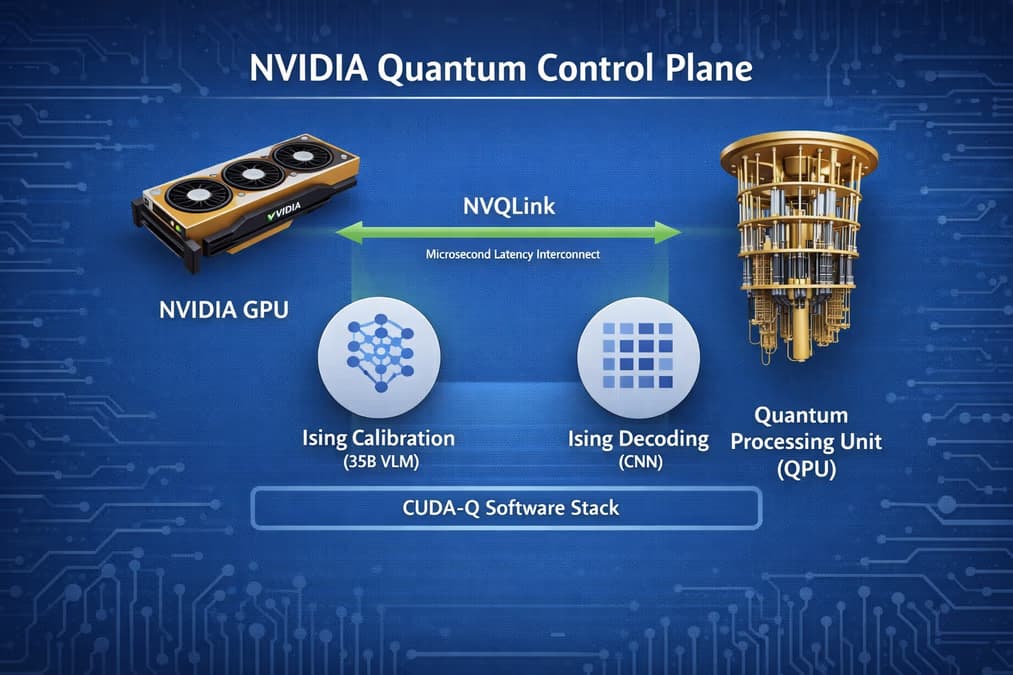
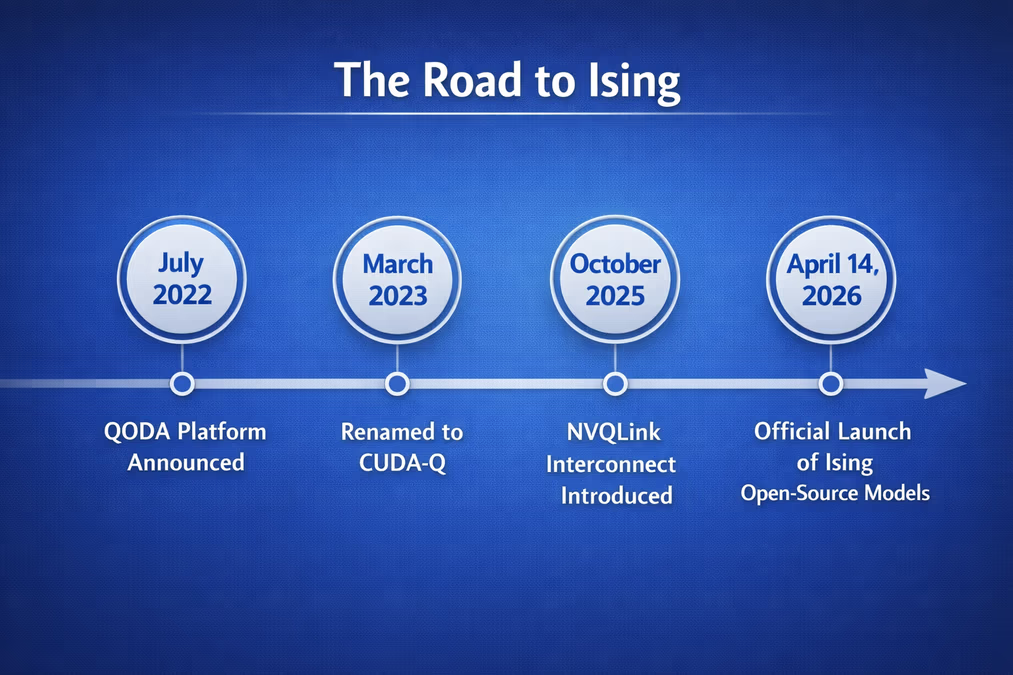
On April 14, 2026, NVIDIA released the Ising family of open-source AI models, a strategic move designed to tackle the persistent hardware instabilities that have long hindered the progress of quantum computing. By introducing specialized models for processor calibration and error correction, NVIDIA is positioning its artificial intelligence infrastructure as the essential "control plane" for the next generation of quantum machines.
Quantum computing has long promised to solve complex problems in chemistry, physics, and cryptography that are beyond the reach of classical supercomputers. However, the field remains trapped in the "noisy" era. Qubits, the fundamental units of quantum information, are notoriously fragile and sensitive to environmental heat or electromagnetic interference. Currently, these systems suffer from high error rates—roughly one error for every 100 to 1,000 operations. To reach a state of "fault-tolerant" computing, these errors must be corrected in real-time faster than they can accumulate, and the hardware itself must be meticulously tuned through a process known as calibration.
The Ising Family: Calibration and Decoding
The newly launched Ising family consists of two distinct components designed to handle these specific challenges. The first, Ising Calibration, is a 35-billion-parameter vision-language model (VLM). This model is engineered to automate the tuning of quantum processors. Historically, calibrating a quantum machine to ensure qubits are performing optimally could take days of manual work by specialized physicists. When paired with an AI agent, Ising Calibration reduces this timeline from days to mere hours.
“NVIDIA Ising brings open, state of the art AI models to key workloads in quantum computing such as quantum processor calibration,” said Sam Stanwyck, Director of Quantum Product at NVIDIA. By automating this process, the model frees up valuable time on Quantum Processing Units (QPUs), allowing researchers to focus on computation rather than maintenance.
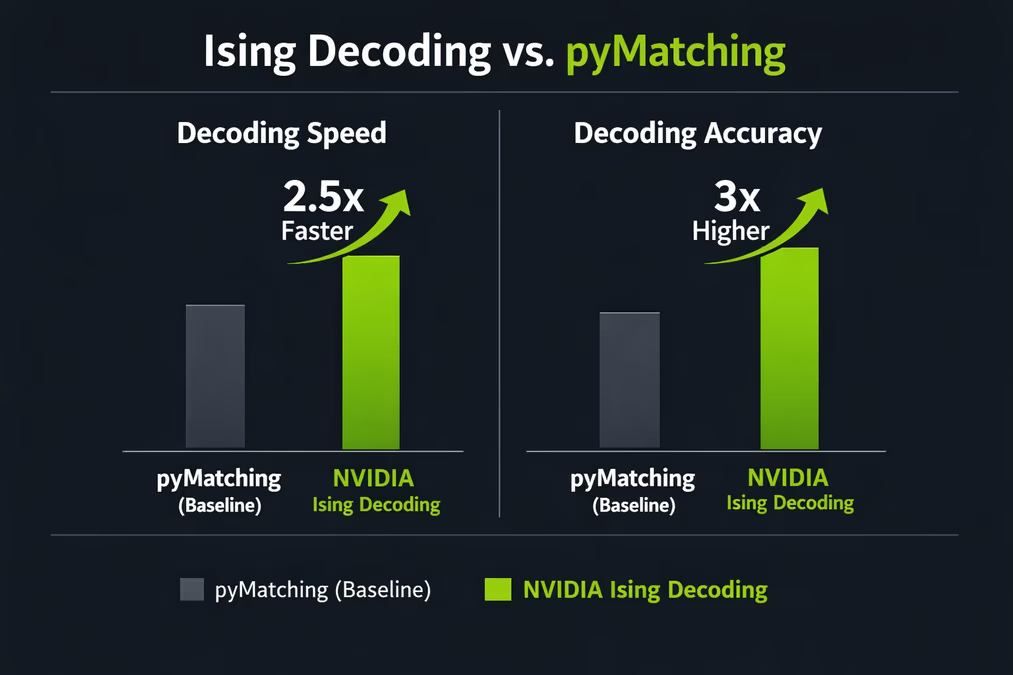
The second component, Ising Decoding, targets the critical task of Quantum Error Correction (QEC). This suite includes two 3D convolutional neural network (CNN) models, sized at 0.9 million and 1.8 million parameters. These models are optimized for either extreme speed or high accuracy in decoding the parity checks required to identify and fix qubit errors. According to NVIDIA's research data, Ising Decoding models offer up to 2.5 times faster performance and 3 times higher accuracy compared to traditional open-source decoding methods like pyMatching.
Building the Quantum Operating System
NVIDIA’s broader strategy does not involve building its own quantum hardware. Instead, the company is doubling down on the software and interconnects that allow classical GPUs to manage quantum systems. The Ising models are deeply integrated with NVIDIA’s CUDA-Q platform and the NVQLink QPU-GPU interconnect, which was introduced in late 2025 to facilitate microsecond-speed communication between AI chips and quantum processors.
“AI is essential to making quantum computing practical,” said Jensen Huang, Founder and CEO of NVIDIA. “With Ising, AI becomes the control plane — the operating system of quantum machines — transforming fragile qubits to scalable and reliable quantum-GPU systems.”
This sentiment is echoed by hardware developers who see AI as the only viable path to scale. “Building a scalable quantum computer demands speed, and AI is one of the most powerful tools we have to get there,” noted Nick Farina, Co-founder and CEO of EeroQ.
Open Source and Industry Adoption
In a move to foster ecosystem-wide innovation, NVIDIA has released the Ising Decoding training framework and the agentic workflow for Ising Calibration on GitHub under the Apache 2.0 license. This transparency allows researchers to customize the models for various quantum architectures, whether they are based on superconducting loops, trapped ions, or neutral atoms.
The industry response has been immediate. A wide array of leading institutions and commercial players have already begun adopting the Ising framework, including Harvard’s John A. Paulson School of Engineering and Applied Sciences, Fermi National Accelerator Laboratory, and Lawrence Berkeley National Laboratory’s Advanced Quantum Testbed. Private sector partners include IonQ, Atom Computing, IQM Quantum Computers, and Infleqtion, among others.
Economic and Scientific Implications
The release comes as the quantum computing market is projected to exceed $11 billion by 2030, according to analyst firm Resonance. By lowering the barrier to error correction and calibration, NVIDIA is effectively accelerating the timeline for commercial quantum advantage.
Beyond the balance sheet, the impact on scientific research could be profound. Fault-tolerant quantum systems are expected to lead to breakthroughs in medical research, specifically in molecular simulation for drug discovery, and in energy efficiency through the development of new battery chemistries. By providing the high-performance AI tools needed to stabilize these systems, NVIDIA is ensuring that when the hardware is ready, the software control plane will already be in place to drive it.