Nvidia Injects $5 Billion into Intel to Forge New Era of AI Computing
Nvidia’s $5 billion investment in Intel merges AI dominance with x86 architecture to transform data centers and personal computing infrastructure.
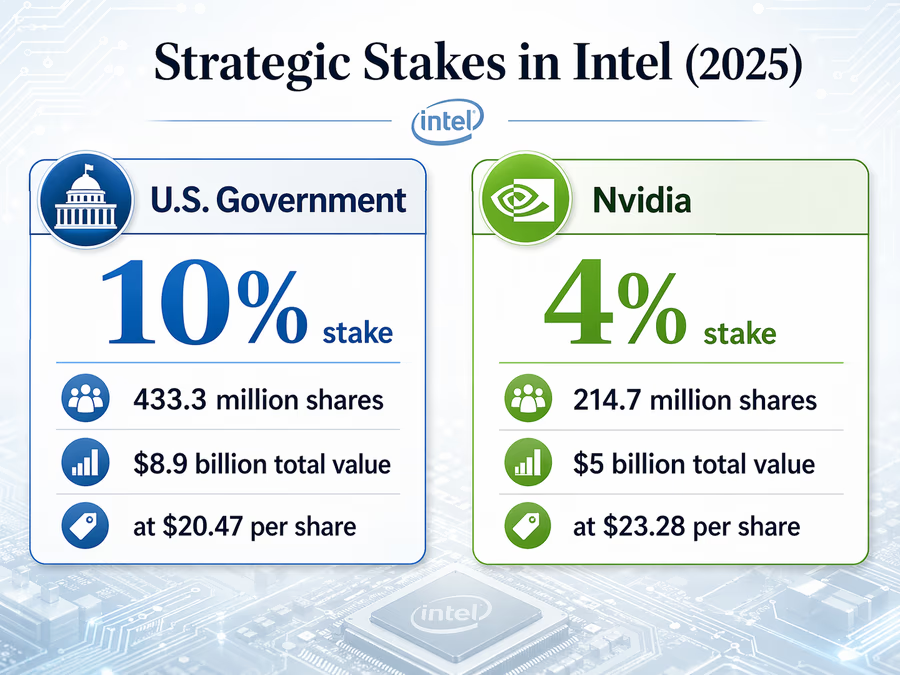
Nvidia has finalized a $5 billion strategic investment in Intel, securing a roughly 4% stake in the legacy chipmaker and launching a collaborative roadmap that merges Nvidia's AI dominance with Intel's foundational x86 architecture. The transaction, which officially closed on December 26, 2025, followed regulatory clearance from the U.S. Federal Trade Commission earlier that month. By purchasing approximately 214.7 million shares of Intel common stock at $23.28 per share, Nvidia has moved from being a purely competitive force to a primary stakeholder in Intel’s long-term recovery.
A Strategic Marriage of Architectures
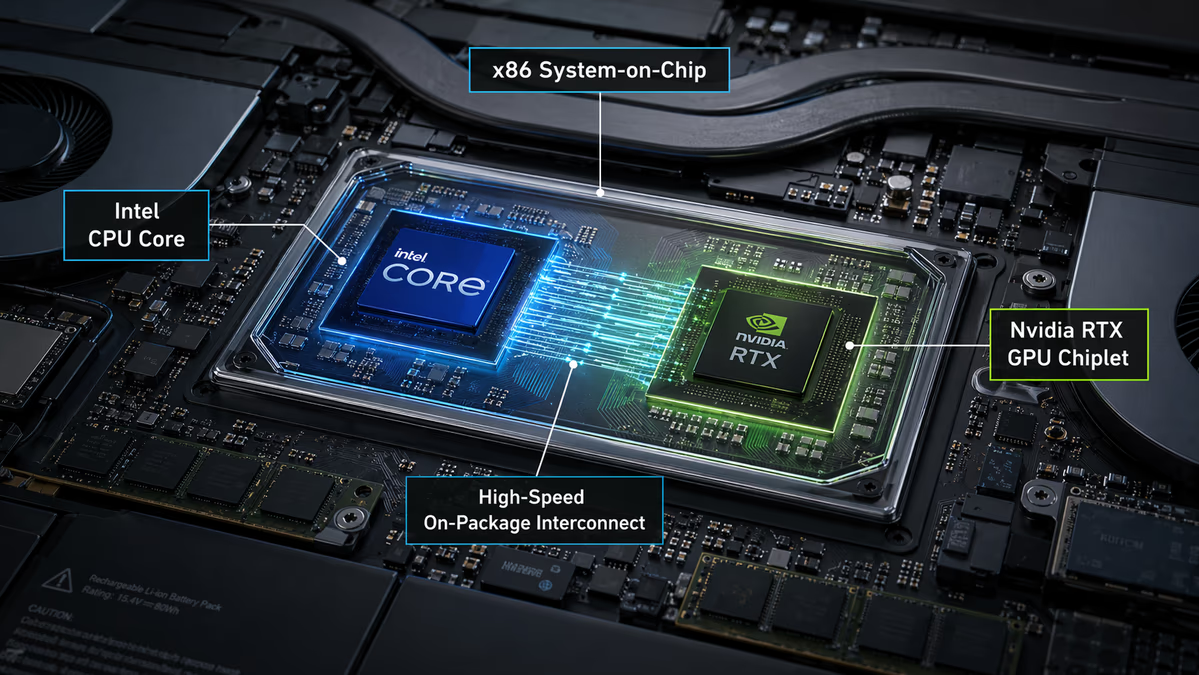
This partnership marks a significant shift in Nvidia's hardware strategy. While Nvidia has historically relied on ARM architecture for its custom server processors, such as the Grace CPU, this collaboration allows the company to integrate its AI and graphics technology directly into the vast x86 ecosystem. The two companies are co-developing custom data center CPUs for Nvidia’s AI infrastructure and x86 system-on-chips (SOCs) for personal computers that will feature Nvidia RTX GPU chiplets.
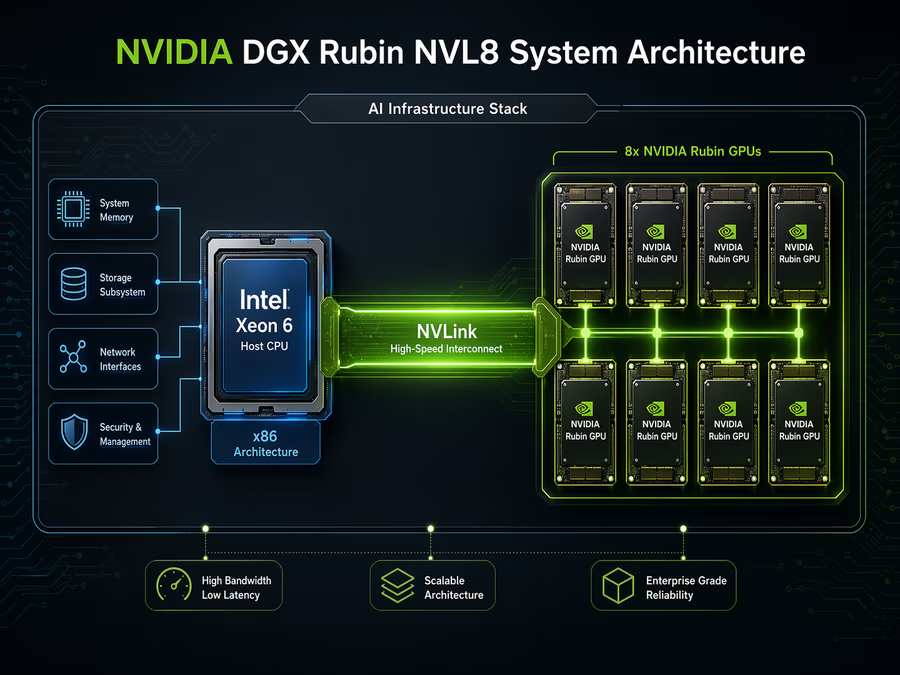
A critical component of this technical integration is Nvidia’s NVLink technology. By utilizing this high-speed interconnect, the companies intend to enable seamless communication between Intel’s CPUs and Nvidia’s accelerators, potentially removing the bottlenecks that have historically plagued heterogeneous computing environments.
“This historic collaboration tightly couples NVIDIA's AI and accelerated computing stack with Intel's CPUs and the vast x86 ecosystem — a fusion of two world-class platforms,” said Jensen Huang, CEO of Nvidia. “Together, we will expand our ecosystems and lay the foundation for the next era of computing.”
Navigating Geopolitical Waters
The deal comes during a turbulent period for Intel, which has struggled with manufacturing delays and market share losses. Just weeks before Nvidia’s announcement, the U.S. government acquired a 10% stake in Intel for $8.9 billion. This intervention, totaling 433.3 million shares at $20.47 per share, was widely viewed as a move to secure domestic technology manufacturing.
According to Brad Gastwirth, global head of research at Circular Technology, partnering with a U.S.-backed Intel strengthens Nvidia's alignment with Washington's industrial policy. Gastwirth noted that this alignment could potentially reduce regulatory scrutiny regarding Nvidia’s exposure to the Chinese market. This is particularly relevant given prior concerns raised by U.S. officials, including President Donald Trump, regarding Intel CEO Lip-Bu Tan’s historical connections to China.
Lip-Bu Tan, who took the helm at Intel in March 2025, expressed gratitude for the partnership. He noted that Intel’s leading platforms and manufacturing capabilities would complement Nvidia’s leadership to enable industry breakthroughs, adding that Intel appreciates the confidence shown by the Nvidia team.
Impact on the Global Semiconductor Market
For Intel, the $5 billion infusion is more than a financial lifeline; it is a massive vote of confidence that has already begun to stabilize the company's market position. Following the investment and a strong Q1 2026 earnings report in April, Intel’s stock surged as demand for its CPUs from AI service providers saw a significant resurgence.
The collaboration also presents a potential challenge to the dominance of Taiwan Semiconductor Manufacturing Company (TSMC). While the current agreement does not include a contract manufacturing deal for Intel’s foundry business to produce Nvidia’s high-end GPUs, analysts suggest that such a move may be inevitable. For Intel’s foundry business to remain viable in the long term, it likely requires a high-volume customer with the scale of Nvidia.
Future Prospects and Rumors
Rumors regarding the depth of this partnership began circulating in early March 2026, with unconfirmed reports suggesting that Nvidia might unveil a standalone x86 CPU at its GTC conference. While Intel initially dismissed these claims, the conference revealed a deeper level of integration than many expected. Intel confirmed that its Intel Xeon 6 processors are now serving as the host CPUs for Nvidia’s high-end DGX Rubin NVL8 systems.
This integration is expected to accelerate the development of AI infrastructure by creating a tighter bond between the processor and the accelerator. Furthermore, the move into x86 SOCs for the PC market puts the duo in direct competition with companies like Apple and Qualcomm, who have been pushing ARM-based solutions for laptops and workstations.
As Nvidia continues to expand its own CPU offerings—including the recently introduced Vera CPU with its custom Olympus core—the Intel partnership ensures that Nvidia remains a central player in every major computing architecture. For Intel, the collaboration provides a clear path back to relevance in the AI era, leveraging Nvidia's momentum to fuel its own manufacturing and design resurgence.