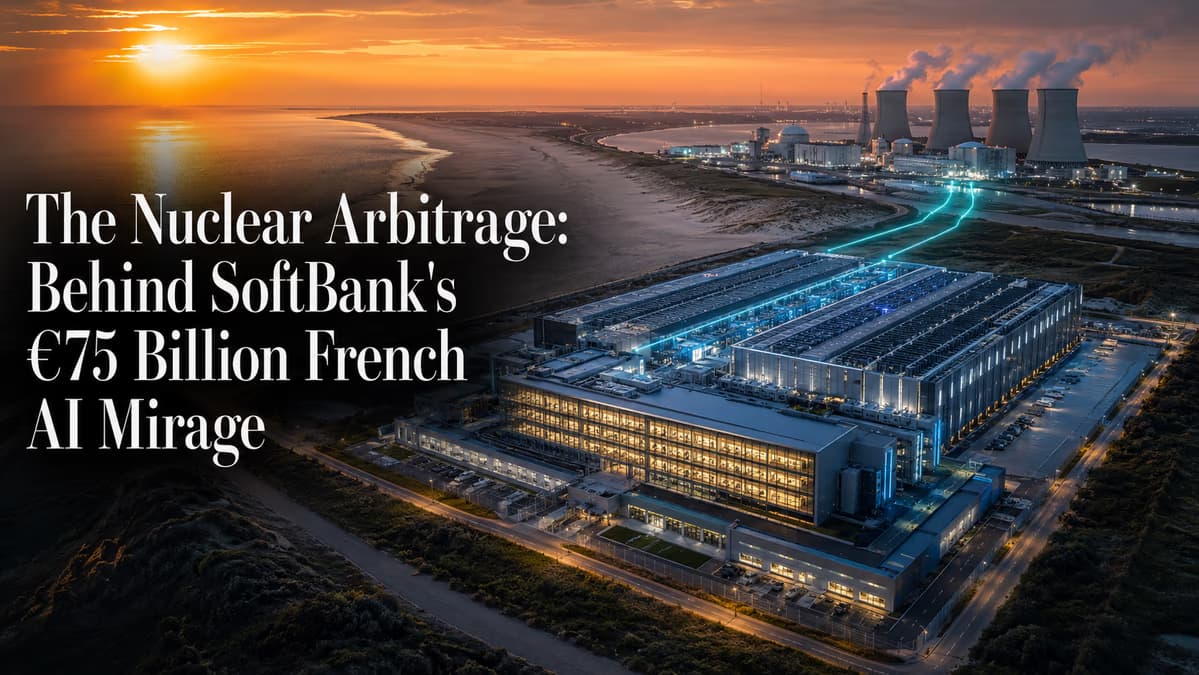
The Nuclear Arbitrage: Behind SoftBank’s €75 Billion French AI Mirage
A deep dive into SoftBank's €75B French AI data center play, examining the realities of European sovereignty and the power-grid gold rush.
Sovereignty is the most expensive word in modern technology, and Masayoshi Son is more than happy to lease it back to Europe at a premium.
SoftBank’s jaw-dropping announcement at the 2026 Choose France summit—a commitment to build and operate up to 5 gigawatts (GW) of AI data center capacity for an eye-watering €75 billion—is being heralded in Paris as a historic triumph for European technological independence. French President Emmanuel Macron has spent years positioning France as the premier destination for global capital, and capturing more than half of the summit's total €93 billion in foreign investment commitments feels like a definitive validation of his strategy.

But behind the celebratory handshakes and the carefully stage-managed press conferences lies a more complex, high-stakes reality. What SoftBank is actually executing is a brilliant piece of energy arbitrage. They are trading paper commitments for France’s crown jewel: its highly reliable, low-carbon, nuclear-heavy electrical grid. For Europe, however, this deal exposes a harsh truth. True technological sovereignty cannot simply be imported or bought on credit; it is a long, slow grind, and the timeline of this massive deal might just leave France waiting in the dust.
The Math Behind the Mirage
Whenever SoftBank's Masayoshi Son is involved, the first rule of analysis is to separate the headline-grabbing numbers from the binding contracts. The €75 billion figure is a classic "soft commitment."
When we look at the actual mechanics of the deal, the firm commitment is a €45 billion allocation for Phase 1. This phase is designed to deliver 3.1 GW of capacity in the Hauts-de-France region—specifically Dunkirk (Loon-Plage), Bosquel, and Bouchain—by 2031. The remaining €30 billion and 1.9 GW are, for now, strategic options and future plans rather than immediate construction orders.
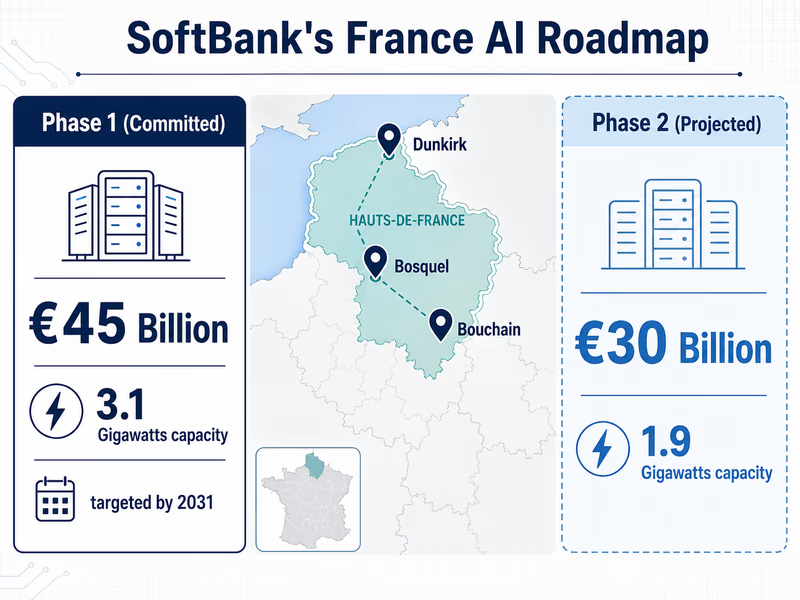
This distinction is crucial. SoftBank is carrying significant net debt, and Son’s appetite for massive capital expenditure is legendary but highly volatile. While Son teased to CNBC that the broader ecosystem costs could eventually balloon to a staggering $750 billion, the reality on the ground is a much more measured, multi-phase buildout.
By locking in France’s commitments today, SoftBank secures the real estate, the political goodwill, and, most importantly, the grid connections. In return, France gets the promise of 2031 infrastructure. In the hyper-accelerated timeline of generative AI, where a week feels like a month and a year is an epoch, a five-year construction window is an eternity.
The Nuclear Magnet
To understand why SoftBank chose France for its largest-ever European infrastructure play, you have to look past the political speeches and focus entirely on the physics of power.
AI models do not run on code alone; they run on massive amounts of electricity. The global AI data center market is experiencing an unprecedented crunch, valued at $147 billion in 2025 and projected to reach $811 billion by 2033. In this environment, the ultimate bottleneck for AI scale is no longer GPU availability—it is the power grid.
This is France’s unfair advantage. Thanks to its historical embrace of nuclear energy, France boasts one of the most reliable, stable, and low-carbon electricity grids in the world. As Masayoshi Son himself noted, "The fact that the country is a producer and exporter of energy is absolutely decisive for investments in AI infrastructure."
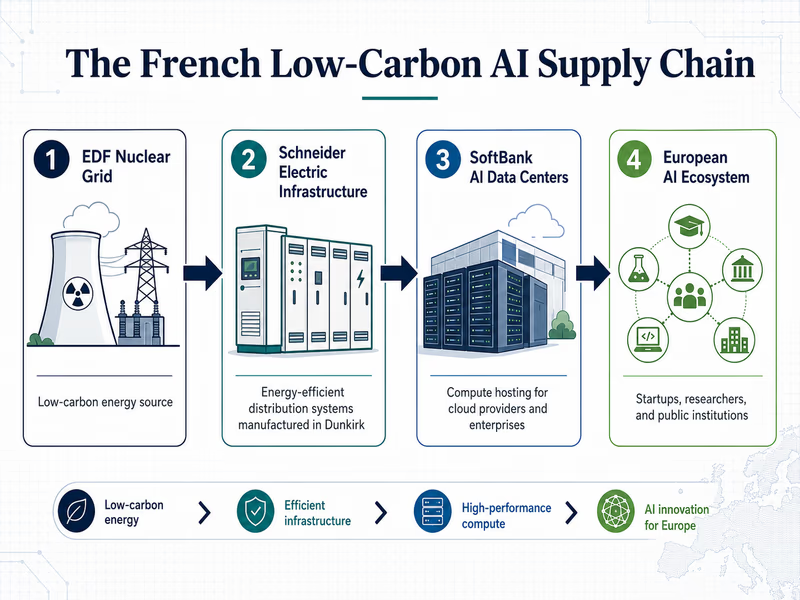
In a world where hyperscalers are desperate to meet net-zero carbon targets while simultaneously scaling up power-hungry clusters, France's nuclear energy acts as an irresistible magnet. While Germany struggles with its industrial energy transition and the UK grapples with grid connection backlogs, France is ready to plug in.
SoftBank’s partnerships with EDF and Schneider Electric are designed to capitalize on this. By localizing manufacturing for data center components in Dunkirk, SoftBank isn’t just building data centers; it is embedding itself into the physical supply chain of European energy.
The 2031 Hangover
But here is the catch: what happens to the European AI ecosystem while we wait for 2031?
Compare SoftBank’s timeline with the competitive landscape. NVIDIA is already moving rapidly, partnering with Mistral AI, Bpifrance, and MGX to build a 1.4 GW AI campus in the Paris region on a much faster track. In the United States, the scale of development is even more aggressive, with projects like the Microsoft/OpenAI-linked "Stargate" targeting up to 10 GW of capacity.
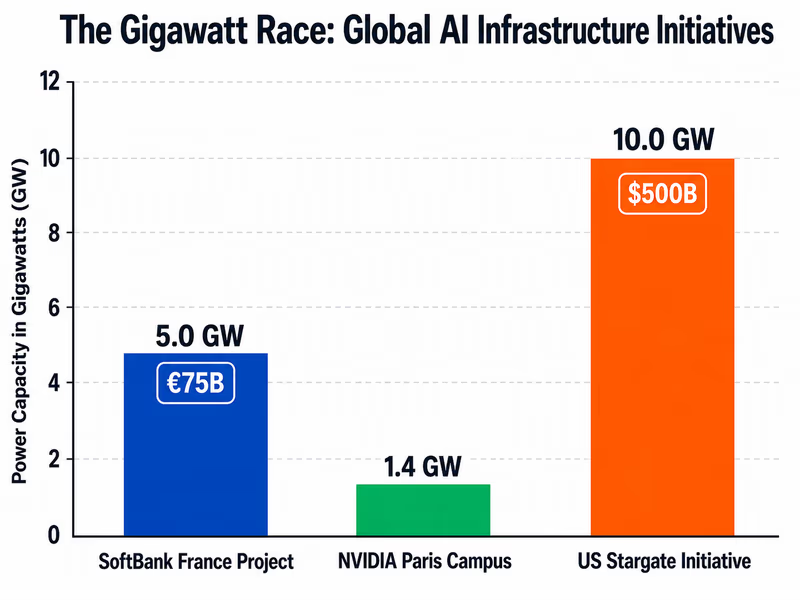
If France's premier AI infrastructure project will not hit its first major capacity milestone of 3.1 GW until 2031, European AI companies will remain structurally dependent on American hyperscalers for their immediate compute needs. French champions like Mistral AI cannot afford to wait five years for domestic compute to scale; they must train their next-generation models today on clusters located in Iowa, Oregon, or Dublin.
As Olivier Blum, CEO of Schneider Electric, rightly pointed out, "The challenge of AI is to deliver both speed and energy efficiency at scale." By pushing the delivery of this capacity out to the next decade, the deal risks delivering efficiency without the necessary speed.
Sovereign Infrastructure, Foreign Landlords
The broader strategic question is one of ownership. Does hosting 5 GW of data centers on your soil actually equal "technological sovereignty" if the physical infrastructure is owned by a Japanese conglomerate, powered by American-designed chips, and largely monetized by global hyperscalers?
Roland Lescure, France's Minister of Economy, Finance, and Industrial Sovereignty, argued that the deal is a testament to the country's ambition "to position France as a leading destination all along the AI value chain."
There is truth to this. Securing the physical layer of the AI stack is a necessary first step. Having the physical data centers in Dunkirk and Bosquel ensures that European data stays within European jurisdictions, satisfying GDPR and local sovereign cloud mandates. It also creates a highly skilled domestic workforce in advanced engineering, robotics, and energy systems—especially when coupled with SoftBank's recent $5.375 billion acquisition of ABB's robotics business.
However, we must not mistake being the landlord for being the architect. The real high-value intellectual property of the AI era—the proprietary algorithms, the foundational models, and the silicon designs—remains concentrated elsewhere. France is successfully pitching itself as the ideal factory floor for AI, but it has not yet secured its place in the executive suite.
The Long Horizon
Ultimately, SoftBank's €75 billion play is a monumental bet on the physical reality of the cognitive revolution. Masayoshi Son has recognized that the software layer of AI is meaningless without the concrete, steel, and copper required to run it.
For France, the deal is a massive economic coup that validates its pro-business, pro-nuclear posture. But French policymakers must not let the scale of this headline obscure the work that remains. Building the physical shells of data centers is easy if you have the land and the power; building a self-sustaining, native European AI ecosystem that doesn't rely on foreign capital and foreign technology to survive is the real challenge.
If France cannot bridge the gap between today's compute drought and the promised land of 2031, it may find itself possessing the world's most advanced AI infrastructure—built entirely for the benefit of foreign tenants.