Microsoft Unveils Seven In-House 'MAI' Models at Build 2026, Reducing OpenAI Dependency
Microsoft debuted its own MAI models at Build 2026, including Project Polaris to replace OpenAI's GPT-4 Turbo as the default for GitHub Copilot.
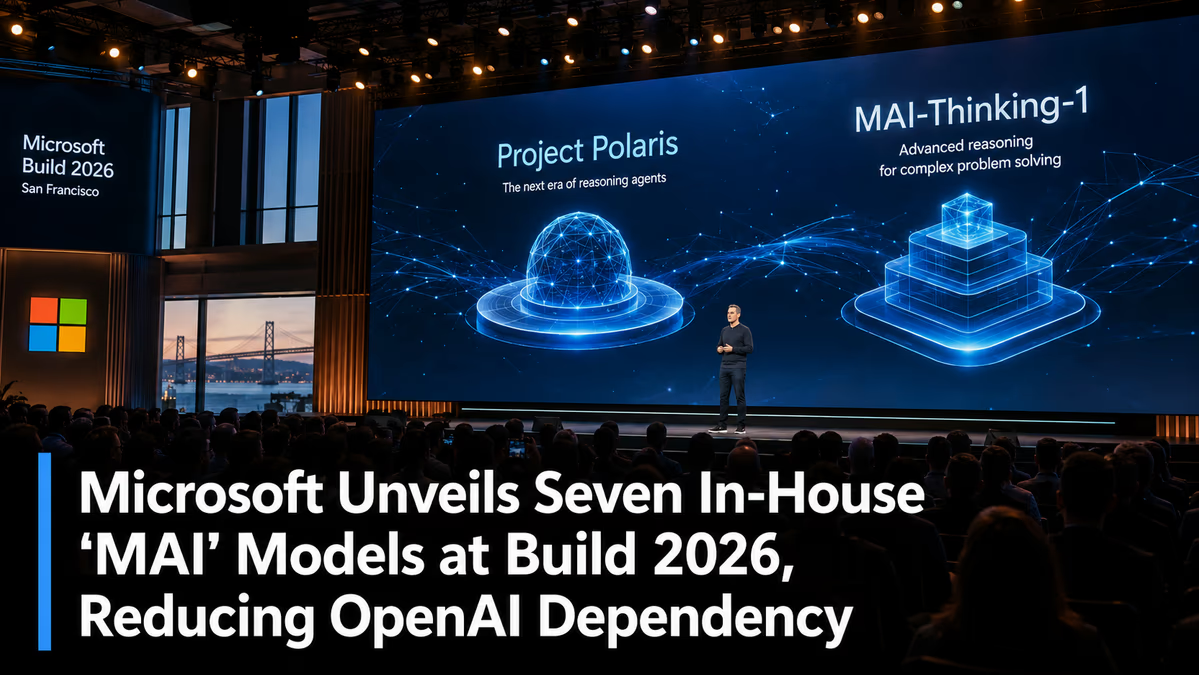
At its Build 2026 developer conference in San Francisco, Microsoft announced a major shift in its AI strategy by introducing its first fully in-house AI coding model, Project Polaris, alongside its new flagship reasoning model, MAI-Thinking-1. The announcement, delivered on June 2-3, marks the beginning of a transition away from Microsoft's exclusive reliance on OpenAI to power its core developer and enterprise tools.
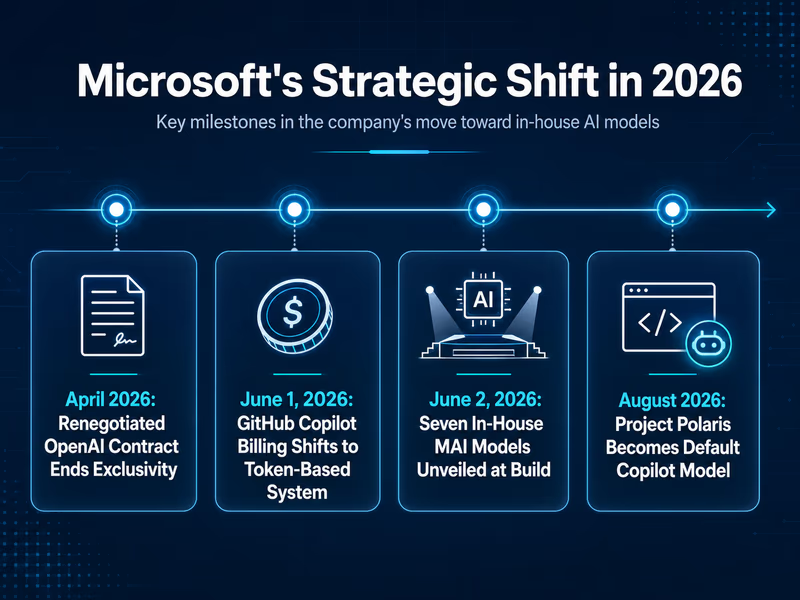
Project Polaris is slated to replace OpenAI's GPT-4 Turbo as the default model for GitHub Copilot, with the migration scheduled to commence in August 2026. To ease developers into this new era, Microsoft is already rolling out MAI-Code-1-Flash, an inference-efficient variant, across all GitHub Copilot plans. While some early post-keynote reports from attendees attempted to link the MAI-Code-1-Flash rollout timeline to the broader Polaris migration, Microsoft's official Build documentation remained conservative, leaving those specific integration timelines separate for now.
MAI-Thinking-1: Reasoning Built from Scratch
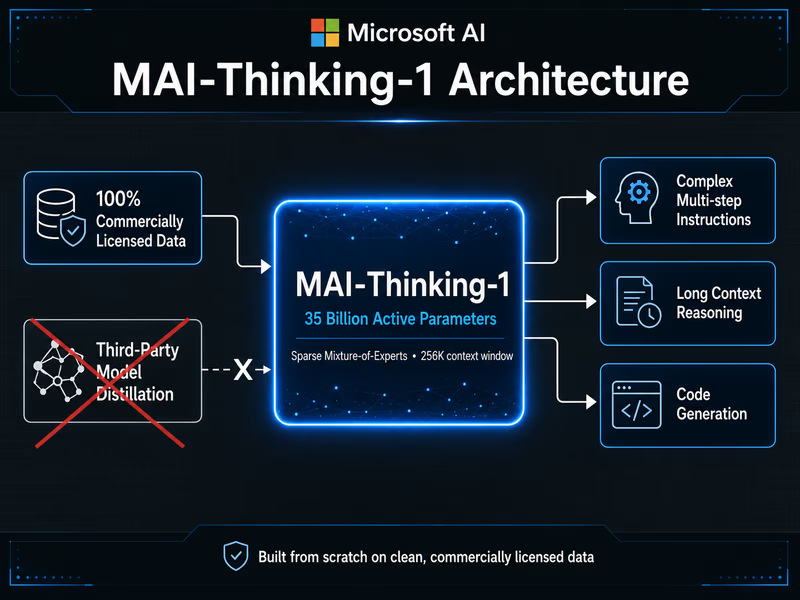
Alongside its new coding engine, Microsoft introduced MAI-Thinking-1, a mid-sized flagship reasoning model containing 35 billion active parameters. Unlike many contemporary models that rely on knowledge distillation from larger, pre-existing systems, Microsoft developed MAI-Thinking-1 entirely from scratch. The training process relied exclusively on clean, commercially licensed data, protecting enterprise users from potential copyright liabilities.
Kyle Daigle, Microsoft Developer CMO and COO of GitHub, emphasized the specialized capabilities of the new reasoning model, stating, "MAI-Thinking-1 was designed to be good at complex multi-step instructions, long context reasoning, and code generation."
The focus on clean data training aligns with growing regulatory pressures, notably the impending enforcement of the European Union AI Act, which is scheduled to begin on August 2, 2026. By utilizing models trained on fully auditable data pipelines, Microsoft can offer European enterprise customers better data residency assurances and structural compliance that third-party infrastructure often struggles to guarantee.
A Strategy of Self-Sufficiency
This aggressive pivot toward first-party models was made possible by a renegotiated partnership agreement with OpenAI in April 2026. The revised contract dismantled previous exclusivity clauses and revenue-sharing structures, freeing Microsoft to invest heavily in its own foundational AI.
Mustafa Suleyman, head of Microsoft AI, addressed the company's long-term goals during the conference. He explained that these MAI launches are part of a deliberate effort to achieve long-term self-sufficiency, framing the initiative as a strategic measure to reduce Microsoft's dependency on OpenAI.
This self-sufficiency is expected to translate directly to cost savings. By hosting its own models on its own terms, Microsoft can lower operating expenses for Azure enterprise customers. This efficiency is particularly critical given recent friction in the developer community; on June 1, 2026, GitHub Copilot transitioned to a token-based billing system, which has reportedly driven up costs for high-volume users.
Satya Nadella's 'Agent Computer' Vision
Microsoft CEO Satya Nadella opened the Build keynote by explaining that modern developer conferences are fundamentally about understanding massive technology shifts and navigating a changing computing stack. He outlined this new stack as consisting of six core layers: compute, models, context, tools, runtime, and security.
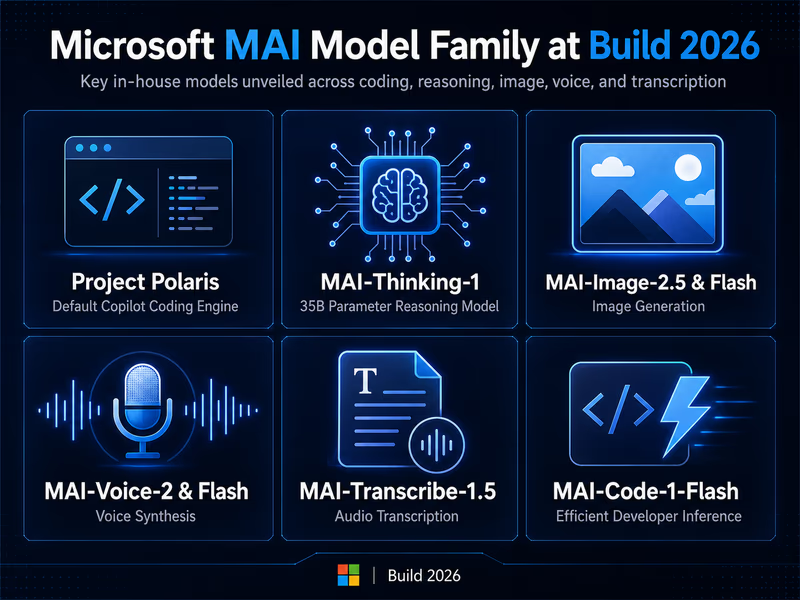
To fill out the "models" layer of this stack, Microsoft unveiled an entire suite of consumer- and enterprise-facing MAI models. Beyond the flagship reasoning and coding tools, the lineup includes MAI-Image-2.5 (accompanied by a high-speed Flash variant), MAI-Transcribe-1.5, and MAI-Voice-2 (also with a Flash variant).
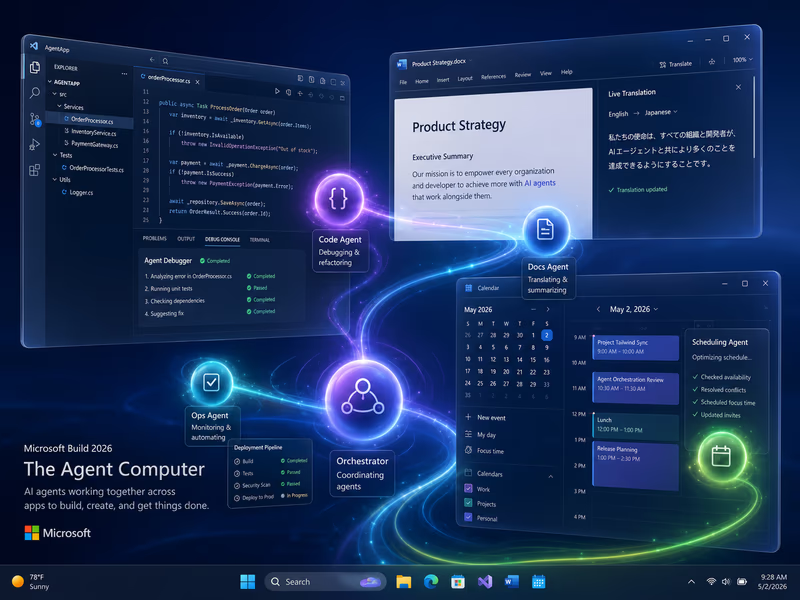
These models are designed to work cohesively to support Microsoft's ultimate vision: the "agent computer." Under this paradigm, Windows is being redesigned to treat autonomous AI agents as first-class citizens. Rather than acting as simple chatbots, these agents are built to execute complex, multi-step workflows across applications with minimal human intervention. To accelerate this transition, Microsoft open-sourced its Windows Agent Framework 1.0, introduced Azure Agent Mesh, and launched a dedicated Windows Agent Store.
Local Hardware and a Fierce Market
To support these models locally, Microsoft collaborated with NVIDIA to showcase the RTX Spark Superchip, designed to accelerate local AI processing on Windows PCs. On the cloud side, Microsoft introduced its custom Maia 200 and Cobalt 200 silicon to optimize Azure workloads for the MAI model family.
Microsoft’s pivot comes amid intense competition in the industry. Just days before Build, on May 28, Anthropic released its Claude Opus 4.8 model. Anthropic also reportedly filed for an Initial Public Offering around the start of the Build conference, aiming to become the first major pure-play AI startup to go public. Meanwhile, Google has continued to upgrade its Gemini 3.1 Pro engine, and Meta’s Llama family continues to dominate the open-source sector.
By establishing its own family of highly capable, commercially clean models, Microsoft is preparing for a future where it controls every layer of its intellectual property, from the silicon up to the autonomous agents running on consumer desktops.