Meta Pivot: Muse Spark Debuts as Proprietary Flagship After Massive AI Stack Rebuild
Meta launches Muse Spark, a proprietary multimodal AI model signaling a major shift away from its open-source roots toward 'personal superintelligence.'
Meta’s Strategic Pivot: From Open Source to Proprietary Power
Meta officially launched Muse Spark on April 8, 2026, marking the debut of its new Muse model family and a definitive departure from the company’s long-standing commitment to open-source AI. Developed by the newly formed Meta Superintelligence Labs, Muse Spark is a natively multimodal reasoning model designed to power the company’s entire ecosystem of apps and hardware. The launch follows a high-stakes, nine-month technical overhaul that saw Meta discard its previous developmental framework in favor of a ground-up rebuild of its entire AI infrastructure.
This shift comes as Meta seeks to distance itself from the mixed reception of its Llama 4 series. While the Llama models were once the darlings of the open-source community, Llama 4 Maverick reportedly struggled with coding tasks and faced scrutiny over benchmark reproducibility. These challenges prompted Meta CEO Mark Zuckerberg to initiate a radical course correction in mid-2025, moving toward a proprietary model structure that allows for tighter control over the company’s most advanced intellectual property.
The Rebuild: Scale AI and the Wang Era
The foundation of Muse Spark was laid in June 2025, when Meta finalized a strategic $14.3 billion to $14.8 billion investment to acquire a 49% stake in Scale AI. As part of the deal, Scale AI co-founder and CEO Alexandr Wang joined Meta as its first-ever Chief AI Officer to lead Meta Superintelligence Labs.
"Nine months ago we rebuilt our AI stack from scratch," Wang said regarding the launch. "New infrastructure, new architecture, new data pipelines. Muse Spark is the result of that work, and now it powers Meta AI."
The model, which was internally codenamed "Avocado," represents a significant leap in efficiency. Meta claims that Muse Spark achieves reasoning and multimodal capabilities comparable to the Llama 4 Maverick model while requiring over an order of magnitude less computational power. This efficiency is critical as Meta’s AI-related capital expenditure for 2026 is projected to reach a staggering $115 billion to $135 billion.
Multimodal Reasoning and the Three Modes of Thought
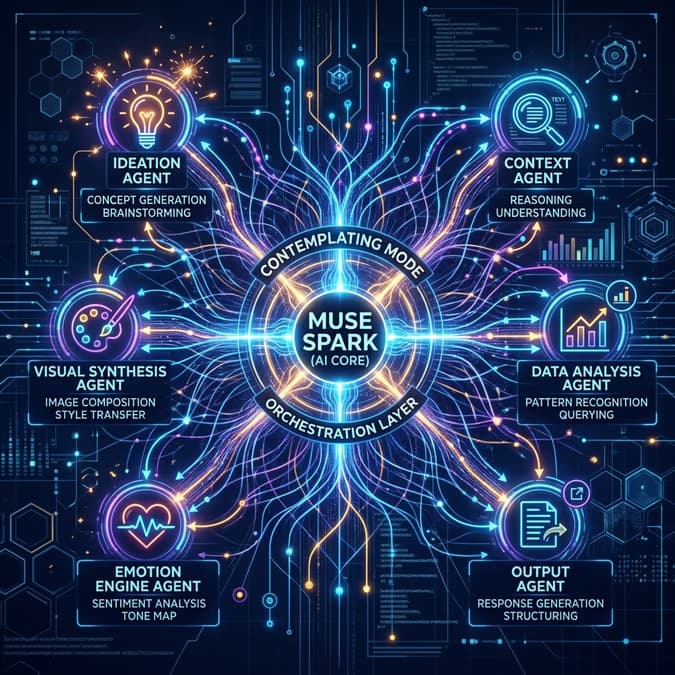
Muse Spark is designed as a natively multimodal model, meaning it does not simply translate text to image or vice versa through separate modules, but processes different data types within a single architectural framework. It supports complex tool-use, visual chain-of-thought processing, and multi-agent orchestration. To cater to different user needs, Meta has introduced three distinct reasoning modes:
* Instant Mode: Optimized for speed and quick queries.
* Thinking Mode: Designed for extended reasoning and deeper problem-solving.
* Contemplating Mode: A high-level orchestration mode that deployes multiple parallel subagents to tackle multifaceted, complex tasks.
This tiered approach is intended to position Muse Spark as a direct competitor to other frontier models like Google’s Gemini Deep Think and OpenAI’s GPT Pro. Meta is also making a significant push into specialized domains; the company collaborated with over 1,000 physicians to curate health reasoning training data, giving Muse Spark a competitive edge in medical and wellness-related queries.
Integration Across the Physical and Digital Worlds
Beyond the screen, Muse Spark is the engine behind Meta’s push into wearable AI. The model is designed to interact with the physical world via cameras and Meta’s Ray-Ban AI glasses, enabling features such as real-time environment analysis, location-based context, and visual coding.
In an official blog post, the company stated, "Muse Spark is the first step toward a personal superintelligence that understands your world. It currently powers the Meta AI app and website, and will be rolling out to WhatsApp, Instagram, Facebook, Messenger, and AI glasses in the coming weeks."
Despite the polished rollout, the journey to Muse Spark was reportedly fraught with internal friction. Unverified reports previously suggested that the model faced delays due to initial performance shortfalls in internal testing against rival models. Rumors also circulated regarding tensions within Meta’s AI division concerning the massive allocation of resources toward the Scale AI partnership and the recruitment of external talent to lead the Superintelligence Labs.

Industry Implications: The End of the Open-Source Era?
The proprietary nature of Muse Spark signals a profound change in the AI landscape. For years, Meta was the primary champion of open-source development among the big tech giants. By closing off its most powerful model yet, Meta may influence other players to reconsider their own open-source commitments, potentially leading to a more fractured and siloed research environment.
However, Meta’s leadership has hinted that this may not be a permanent state. While Zuckerberg has indicated that models capable of "superintelligence" will likely remain closed for safety and competitive reasons, the company has expressed a hope to open-source certain versions of the Muse family in the future. For now, the focus remains on dominance through integration, using Muse Spark to create a highly personalized, context-aware user experience that rivals cannot easily replicate.