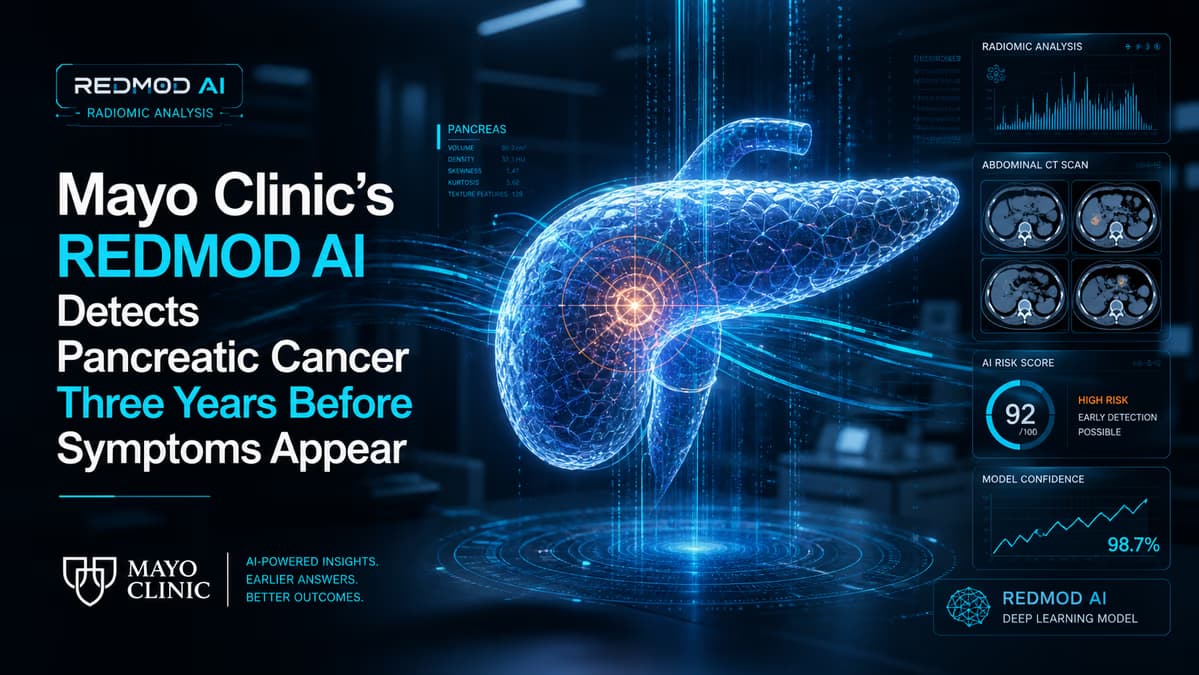
Mayo Clinic’s REDMOD AI Detects Pancreatic Cancer Three Years Before Symptoms Appear
Mayo Clinic researchers developed REDMOD, an AI that identifies pancreatic cancer on routine CT scans up to three years before clinical diagnosis.
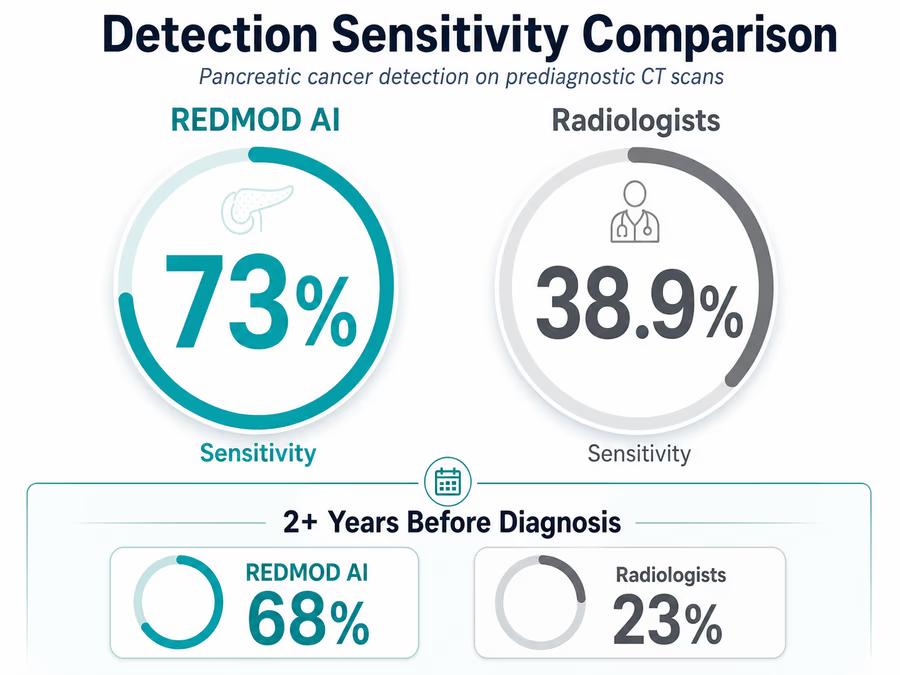
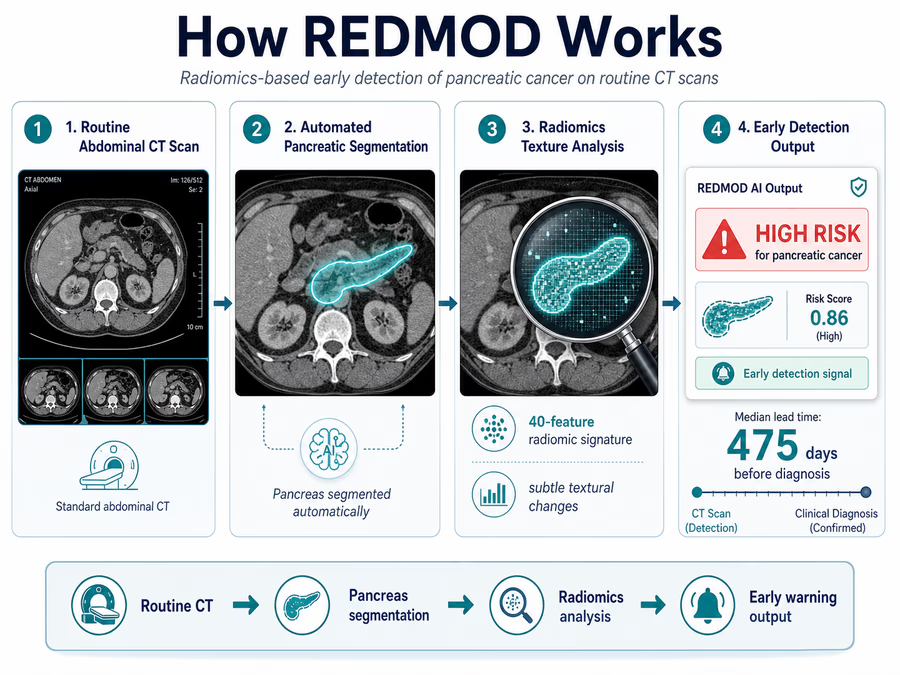
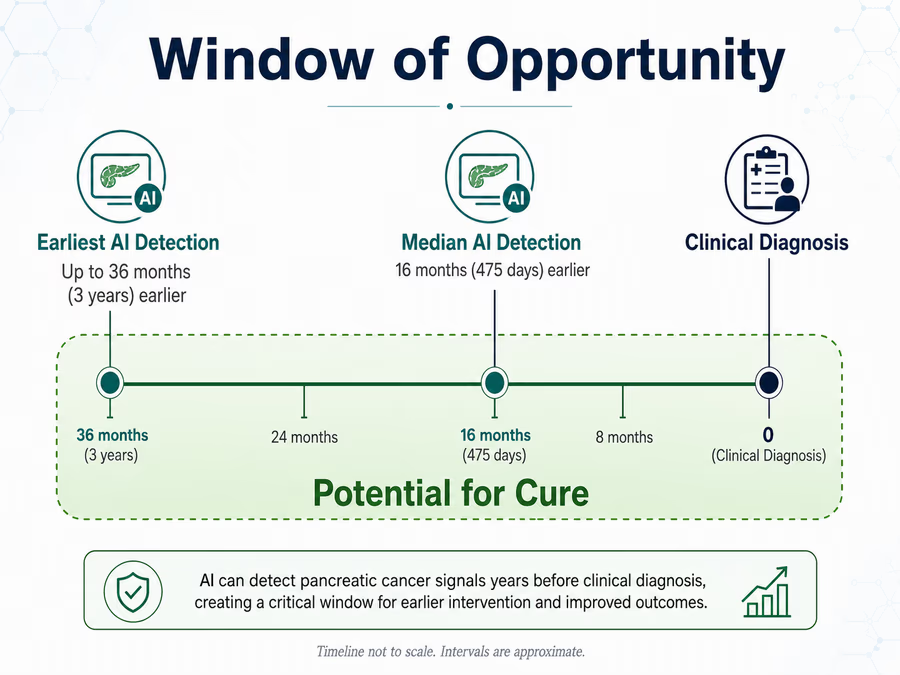
Mayo Clinic researchers have unveiled a new artificial intelligence model capable of identifying pancreatic cancer on routine abdominal CT scans up to three years before a clinical diagnosis is made. The model, named REDMOD (Radiomics-based Early Detection Model), successfully identified 73% of prediagnostic cases of pancreatic ductal adenocarcinoma (PDA) at a median lead time of 475 days—approximately 16 months—before patients showed symptoms or received a formal diagnosis.
Detailed in the medical journal Gut on April 28, 2026, the study demonstrates a significant leap in diagnostic capability. When reviewing the same set of scans, specialized radiologists without AI assistance achieved a sensitivity of only 38.9%, meaning the AI was nearly twice as effective as human experts. The disparity became even more pronounced for scans taken more than two years prior to diagnosis; in these cases, REDMOD maintained a 68% accuracy rate, nearly triple the 23% achieved by radiologists.
Solving the Challenge of Visually Occult Cancer
Pancreatic ductal adenocarcinoma is notoriously difficult to treat because it is rarely detected in its early, curable stages. Current five-year survival rates hover below 15%, primarily because the disease is often asymptomatic until it has metastasized. Projections suggest that by 2030, pancreatic cancer will become the second-leading cause of cancer-related deaths in the United States.
Dr. Ajit Goenka, a radiologist and nuclear medicine specialist at the Mayo Clinic and senior author of the study, noted that the greatest barrier to saving lives has been the inability to see the disease when it is still curable. "What AI is really good at is quantifying very subtle changes that happen on the images that human beings cannot pick up due to the inherent limitations of their eyesight," Dr. Goenka stated. He further explained that the AI can identify the unique "signature" of cancer within a pancreas that appears entirely normal to the human eye.
REDMOD utilizes a technique known as radiomics to analyze tissue texture patterns. While a human radiologist might see a uniform organ, the AI detects microscopic variations in pixel intensity and distribution that signal the presence of early-stage tumors. The system also features automated pancreatic segmentation, which precisely outlines the organ to ensure consistent analysis regardless of which technician or imaging system captured the scan.
Training and Validation Protocols
Led by Dr. Sovanlal Mukherjee, the Mayo Clinic research team trained REDMOD on a diverse multi-institutional cohort of 969 CT scans. This training set included 156 pre-diagnostic scans and 813 controls. To ensure the model's reliability across different clinical environments, it was then validated on an independent test set of 493 scans. These scans were originally interpreted as normal by radiologists in real-world clinical settings before the patients later developed confirmed cases of PDA.
By including scans from multiple institutions and imaging protocols, the researchers aimed to create a tool that could be integrated into standard hospital workflows without requiring new, specialized equipment. However, the study authors did acknowledge a limitation regarding a lack of ethnic diversity among the participant data, which will be a focus for future validation efforts.
Shifting Toward Stage 0 Detection
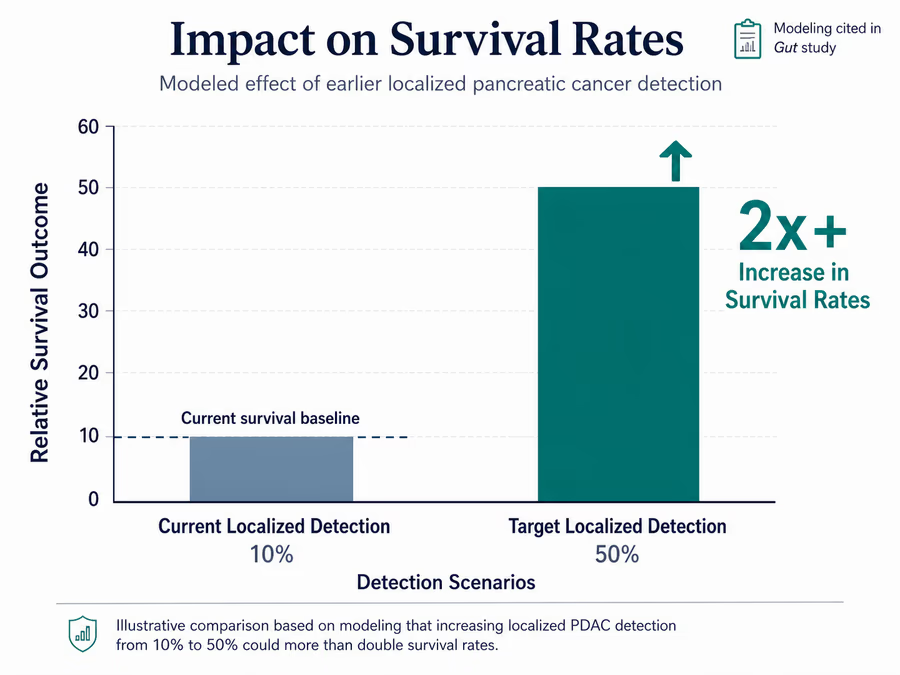
The implications for patient outcomes are substantial. Researchers indicated that according to modeling studies, increasing the proportion of detected localized pancreatic carcinomas from 10% to 50% could more than double current survival rates. This shift from late-stage diagnosis to an early, potentially curable window—often referred to as Stage 0—represents a critical determinant of survival.
One of the most promising aspects of REDMOD is its potential for "opportunistic screening." Because the AI works on routine abdominal CT scans already being performed for unrelated reasons—such as kidney stones or general abdominal pain—it can search for signs of cancer without the need for a dedicated screening program.
The Growing Ecosystem of AI Diagnostics
REDMOD is part of an accelerating trend in AI-driven oncology. In early 2026, another model titled PANORAMA demonstrated similar success, achieving a high AUROC of 0.92 in detecting pancreatic cancer. Furthermore, the NIH is currently funding the "PRECISE" project, which aims to combine imaging data with non-imaging information from patient records to create a multimodal prediction tool.
As these tools move toward prospective validation in high-risk patient groups, the medical community is eyeing a future where AI serves as a permanent "second set of eyes" for every radiologist. For pancreatic cancer, a disease where time is the most precious resource, those three years of advanced warning could mean the difference between a terminal prognosis and a successful surgical cure.