Google's Gambit: How Gemini Agents and Generative Search Could Redefine Its Core Business (and Risk It All)
Google's massive push into Gemini agents and generative Search risks cannibalizing the open web to defend its search monopoly.
Google has spent a quarter of a century acting as the world’s ultimate digital tour guide, directing traffic to every corner of the open web. At I/O 2026, Sundar Pichai effectively announced that the tour is over. Google no longer wants to show you the destination; it wants to be the destination.
This is not a slow, cautious product iteration. The sweeping integration of Gemini 3.5 Flash, Gemini Omni, and the autonomous Gemini Spark agent represents a massive, high-stakes gamble to shift Google Search from an information indexer to an all-encompassing transactional layer. By attempting to solve the platform shift to artificial intelligence, Google is systematically absorbing the web it was built to catalog. The risks of this strategy are existential, threatening to destroy the economic engine of digital publishing while forcing Google to reinvent its multi-billion-dollar advertising machine overnight.
The Sovereign Web is Dead. Long Live the Agent.
At Google I/O 2026, the company unveiled its most radical search overhaul in twenty-five years. Liz Reid, Google's Vice President and Head of Search, proudly described it as “the biggest upgrade to our iconic search box since its debut over 25 years ago.” For users, this manifests as an "intelligent search box" powered by Gemini 3.5 Flash that accepts diverse media types and delivers real-time generative UI experiences.
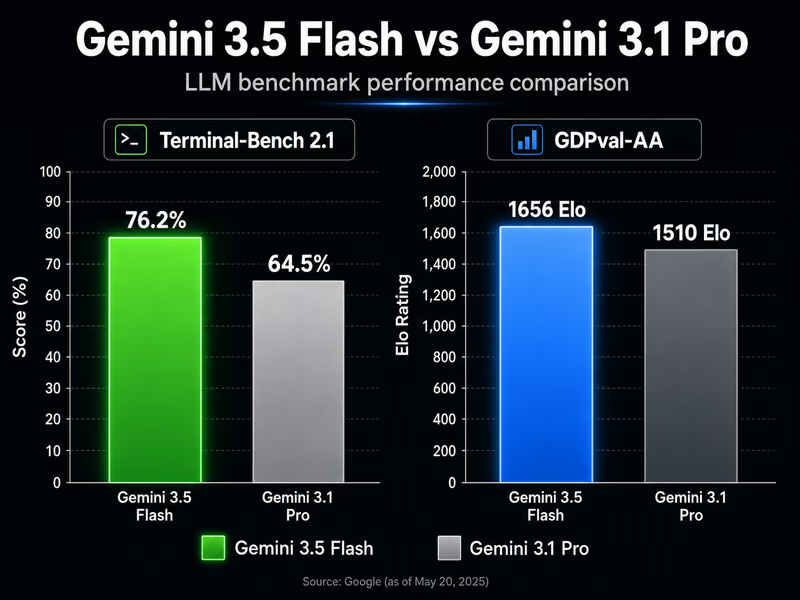
But the real tectonic shift lies in autonomous agents. Gemini Spark, a background personal assistant running 24/7, is designed to organize inboxes, draft emails, and manage calendars for premium Google AI Pro and Ultra subscribers. This agentic intelligence is powered by Gemini 3.5 Flash, Google's leanest high-performance model, which boasts a 76.2% score on Terminal-Bench 2.1 and a GDPval-AA score of 1656 Elo. Operating four times faster than previous generations, Flash enables continuous, low-latency background computation.
Google is also pushing this ambient agentic layer to mobile ecosystems globally through a blockbuster, multi-year partnership with Apple. Announced in early 2026, future Apple Foundation Models—including a highly personalized Siri—will rely on Gemini models and Google Cloud. The demo of Gemini Spark operating natively on an iPhone 17 Pro at I/O was a clear warning shot to OpenAI, whose ChatGPT hit 900 million weekly active users in February 2026. Google is moving aggressively to lock down distribution, but the backend cost of this scaling is astronomical. The company is now processing a mind-boggling 3.2 quadrillion AI tokens per month, a sevenfold increase from the 480 trillion tokens reported just a year prior.
The Mathematical Tragedy of "Google Zero"
For a generation, the contract of the web was simple: creators publish high-quality content, Google indexes it, and in exchange, Google sends highly monetizable referral traffic. Generative search overviews have systematically shredded this agreement.
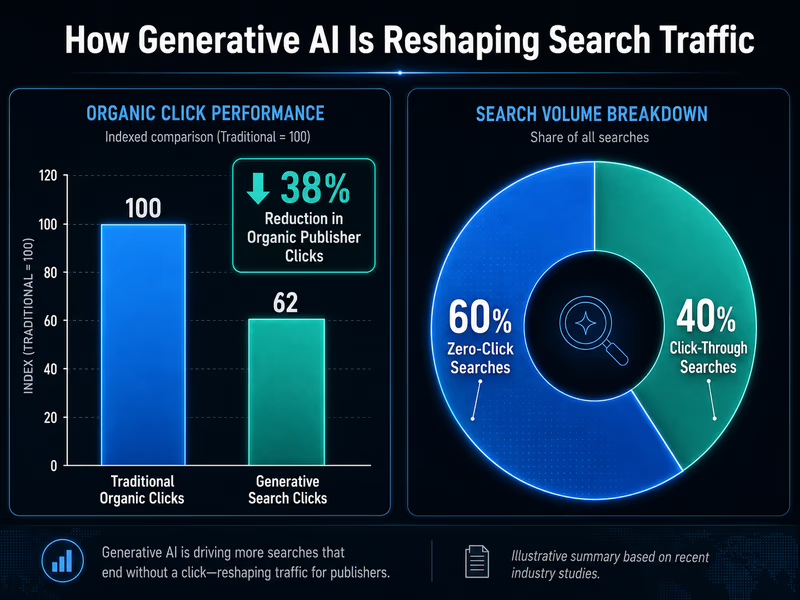
AI Overviews, which now reach over 2.5 billion users globally, have reportedly reduced organic clicks to publishers by 38% for queries that trigger them. Zero-click searches now account for approximately 60% of all Google queries. When an LLM synthesizes a complete answer directly within the search results, the incentive for a user to click through to an external site vanishes. As Andrew Holland, CEO of JBH, astutely summarized, the real threat to publishers and SEO professionals is not the absence of links, but the reduced necessity for users to click them.
This dynamic has triggered panic across the media landscape, culminating in what Condé Nast CEO Roger Lynch has called the "Google Zero" effect. Lynch has reportedly instructed his leadership teams to plan for an operational future in which Google sends their properties effectively zero referral traffic. Lily Ray, VP of SEO strategy at Amsive, was even more direct, warning that these changes would have a “devastating impact on the Internet.”

This creates a profound intellectual paradox. If Google starves publishers of traffic and ad revenue, those publishers will stop producing the high-quality content that feeds Google's models. Google is essentially burning its own library to keep its search interface warm.
The Monetization Dilemma
To offset the massive capital expenditures of processing quadrillions of tokens, Google must monetize this zero-click paradigm. Traditional text-based search ads do not work when a user is chatting with an agent. To solve this, Google is testing highly integrated, AI-powered ad formats, such as Conversational Discovery ads and Highlighted Answers. Built with Gemini, these formats provide real-time product guidance and "transparent explanations" directly within the conversational interface.
This represents an attempt to transition Google’s business model from search-and-referral to transaction-and-commission. Through features like the new "Universal Cart" for integrated shopping experiences, Google wants to handle the entire user journey—from initial curiosity to checkout—without the user ever leaving its ecosystem.
Practical Implications: The New Digital Architecture
For businesses, developers, and creators, this transition forces a fundamental shift in strategy:
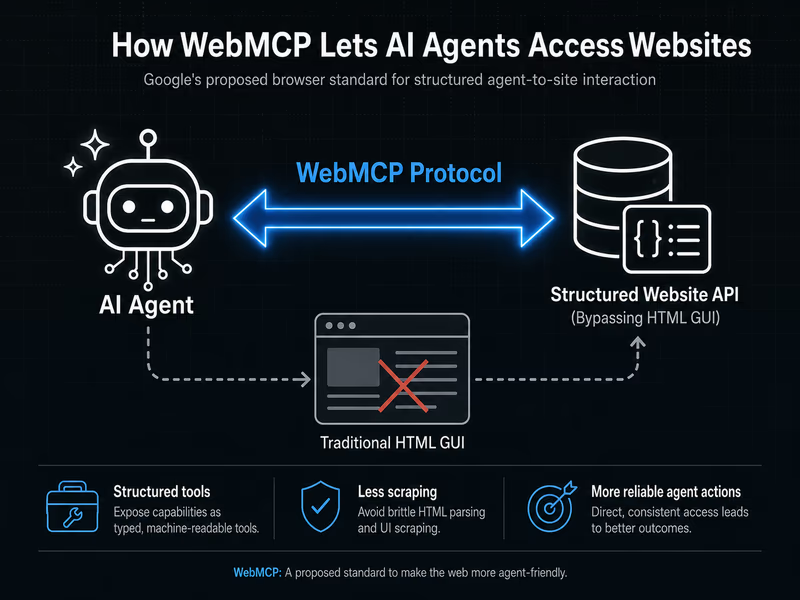
* The Transition from SEO to WebMCP: Traditional search engine optimization is losing its efficacy. Businesses must prepare for Google's proposed open standard, WebMCP (Web Model Context Protocol), which allows AI agents to interact directly with structured website tools and APIs rather than human-readable HTML.
* The Rise of Premium Paywalls: As free search traffic dries up, high-quality publishers will increasingly retreat behind hard paywalls. This will bifurcate the web into premium, subscription-only safe havens and a free, low-quality internet saturated with programmatic AI junk.
* Ecosystem-First Development: Businesses must design checkout and interaction models that can be easily parsed and executed inside an Google-controlled frame. If your product cannot be purchased via a voice command to a Siri-Gemini agent, it may cease to exist in the consumer consciousness.
The Point of No Return
Sundar Pichai is correct in asserting that "we're entering a new phase of the AI platform shift." However, this shift is not a simple, clean upgrade. It is a controlled demolition of the open web's economic foundations.
By forcing Gemini agents and generative UI onto billions of screens, Google is safeguarding its search monopoly against native AI rivals like OpenAI and Perplexity. But in doing so, it risks starving the very creators who made Google's search index valuable in the first place. If Google cannot scale its conversational advertising formats before publishers run out of capital, its state-of-the-art AI agents will find themselves presiding over a highly optimized, beautifully synthesized, but entirely empty digital wasteland.