
Google-Pentagon AI Deal Fuels $17B Defense Push, Draws Congress Scrutiny
Google partners with the Pentagon for classified AI work, reversing its 2018 stance and sparking internal protests over military weaponization.
Google and the Pentagon have reportedly signed a classified agreement allowing the Department of Defense (DoD) to deploy Google’s advanced AI models for national security purposes. This deal, centered on the Gemini AI model, grants the Pentagon the right to use Google's technology for "any lawful government purpose," marking a complete pivot from the search giant's historical reluctance to engage in military contracts. This development coincides with a massive $17 billion surge in U.S. defense spending, a figure anchored by the projected costs of the first Trump-era battleship and a broader push to modernize the American warfighting force.

A Reversal of AI Principles
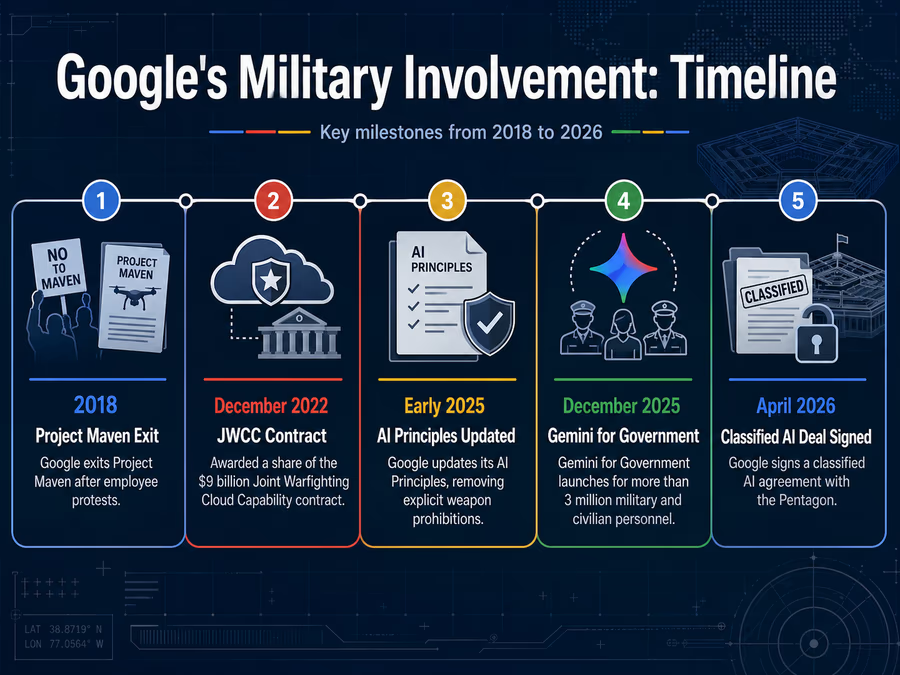
The agreement marks a definitive end to the era of caution that followed Google's 2018 withdrawal from Project Maven. At that time, massive employee protests forced the company to abandon a $9 million contract for analyzing drone footage. In the aftermath, Google established a set of AI principles that explicitly pledged to avoid developing technology for weapons or surveillance. However, in early 2025, Google updated these principles, removing the specific language that prohibited such developments. This internal policy shift paved the way for the current classified agreement, effectively removing the guardrails that once separated Google’s commercial innovation from military application.
A Google spokesperson stated that the company remains committed to the position that AI should not be used for domestic mass surveillance or autonomous weapons without appropriate human oversight. The spokesperson characterized providing API access to commercial models under standard practices as a "responsible approach" to supporting national security. However, the contract specifically notes that Google does not have the right to control or veto lawful government operational decisions once the technology is in the Pentagon's hands.
Gemini at the Frontline
Google’s integration into the defense infrastructure has been building for years. After winning a share of the $9 billion Joint Warfighting Cloud Capability (JWCC) contract in late 2022, the company’s involvement accelerated. In December 2025, the Pentagon selected "Gemini for Government," granting three million military and civilian personnel access to the AI. By March 2026, Google was already deploying Gemini AI agents across unclassified Pentagon networks.
This latest classified deal places Google alongside other major industry players like OpenAI and xAI, all of whom are now providing models for the DoD's most sensitive work. The Pentagon’s "Artificial Intelligence Strategy for the Department of War," released on January 9, 2026, mandates an "AI-first" warfighting force. The goal is to leverage commercial innovation at "wartime speed," bypassing traditional bureaucratic hurdles to achieve military dominance.
Internal Dissent and Ethical Alarms
The move has reignited fierce internal opposition. Over 600 Google employees, including senior leadership, signed an open letter to CEO Sundar Pichai urging him to reject involvement in classified military projects. "As people working on AI, we know that these systems can centralise power and that they do make mistakes," the letter reads. "We feel that our proximity to this technology creates a responsibility to highlight and prevent its most unethical and dangerous uses."
For many inside the company, the lack of transparency is the primary concern. "Currently, the only way to guarantee that Google does not become associated with such harms is to reject any classified workloads," the employee letter states. Andreas Kirsch, a Research Scientist at Google DeepMind, expressed his disapproval more bluntly, stating he was "speechless" at the deal, calling the use of Gemini for classified tasks "shameful."

Geopolitical Stakes and Supply Chain Risks
The push for unrestricted AI access has already created friction within the industry. According to unverified reports, the Pentagon’s insistence on "any lawful purpose" clauses led to a major dispute with Anthropic. These reports suggest that Anthropic’s resistance to these terms resulted in the company being designated a "supply chain risk" by the government. This indicates a tightening grip by the DoD on AI vendors, as the U.S. attempts to outpace the China’s People's Liberation Army (PLA), which is reportedly accelerating its own AI-driven modernization.
While Google’s deal aims to add roughly $6 billion in contract value to the company’s bottom line by 2027, the long-term impact on its workforce remains uncertain. The lack of a unified Congressional framework for military AI means that these individual agency-level deals are currently the only governance structure in place. This leaves the ethical responsibility largely in the hands of the Pentagon, with fewer established guardrails to prevent the transition of Gemini from a productivity tool into a component of lethal autonomous systems.
Looking Ahead
As Google further embeds itself into the military-industrial complex, the distinction between a Silicon Valley tech firm and a defense contractor continues to blur. The deployment of Gemini agents across military networks is likely just the beginning. With Congress still stalled on comprehensive AI regulation, the precedent set by this deal may dictate the ethical boundaries of the global AI arms race for decades to come. The industry will be watching closely to see if Google's talent pool—the very people who built Gemini—will remain at a company that has now fully embraced its role in the future of warfare.