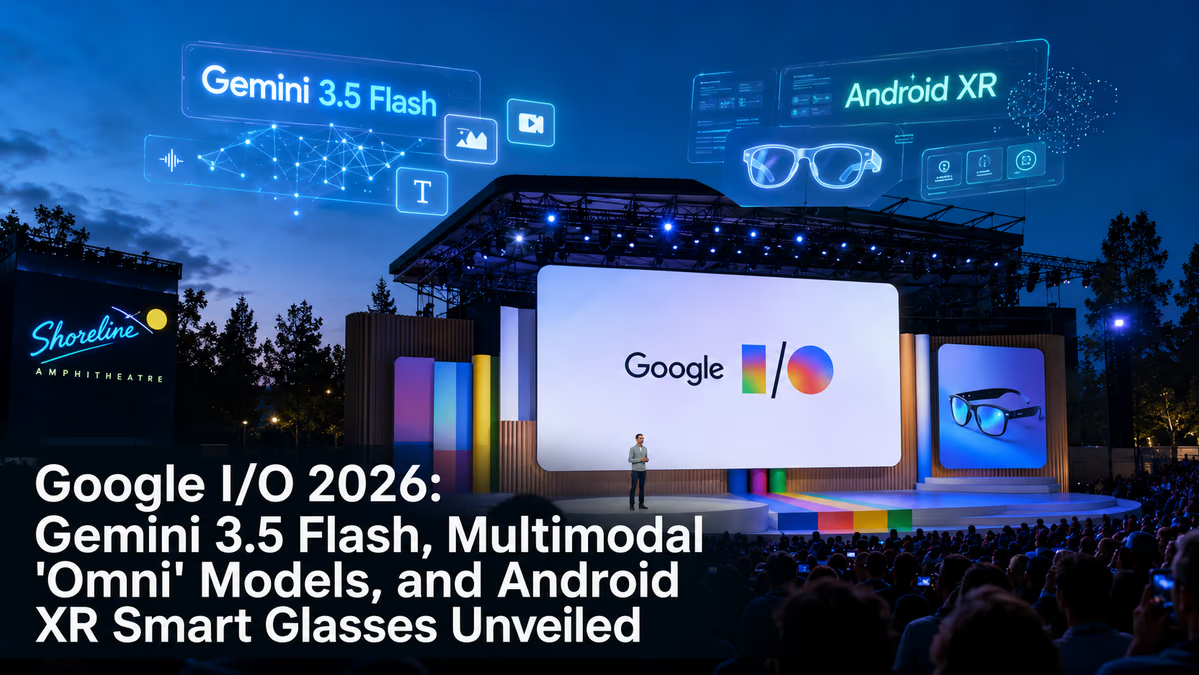
Google I/O 2026: Gemini 3.5 Flash, Multimodal 'Omni' Models, and Android XR Smart Glasses Unveiled
Google I/O 2026 highlights the shift to agentic AI with Gemini 3.5 Flash, Gemini Omni, and Samsung-partnered Android XR smart glasses.
Google opened its annual I/O 2026 developer conference at the Shoreline Amphitheatre on May 19, presenting a major structural shift toward fully autonomous AI agents, next-generation multimodal models, and wearable consumer hardware. This year's event officially marked the beginning of the "agentic Gemini era," highlighting Google's transition from passive AI assistants to proactive systems capable of independent planning, reasoning, and real-world execution.
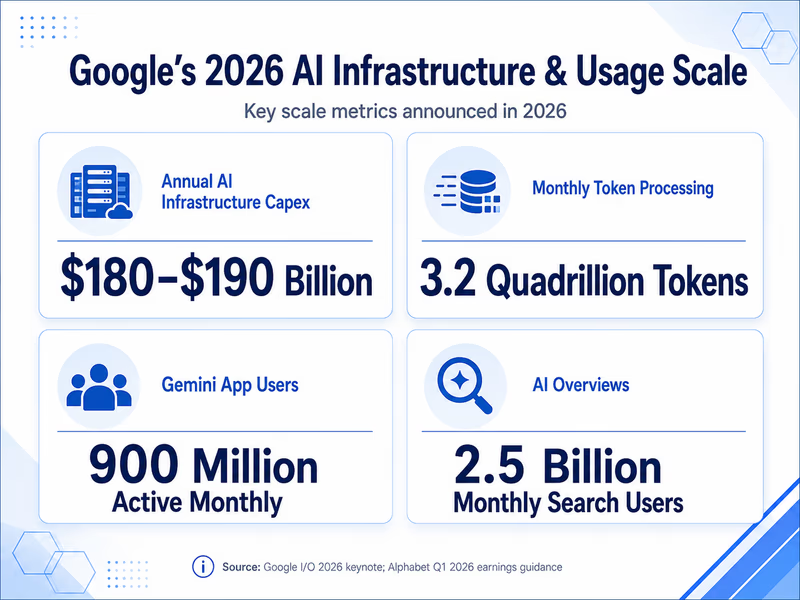
A decade after pivoting the company to be AI-first, Google is backing this technological transition with unprecedented infrastructure investments. Sundar Pichai, CEO of Google and Alphabet, emphasized the long-term vision during his keynote: "Ten years since we pivoted the company to be AI-first, we still see AI as the most profound way to advance our mission and improve people's lives at scale." He noted that the industry is "entering a new phase of the AI platform shift," driven by exponential increases in adoption. Monthly token processing across Google products has surged sevenfold to over 3.2 quadrillion tokens, while the Gemini app has surpassed 900 million monthly active users, and AI Overviews in Search now reach over 2.5 billion monthly users.
Gemini 3.5 Flash and the Agentic Benchmark Leap
Leading the software announcements was the immediate general availability of Gemini 3.5 Flash, launched on May 19 as the first model in the Gemini 3.5 series. Engineered for speed and efficiency, the new model is up to four times faster in output tokens per second than comparable frontier models. It is positioned to accelerate developer innovation in building agent-first applications, offering substantial cost savings for enterprises.
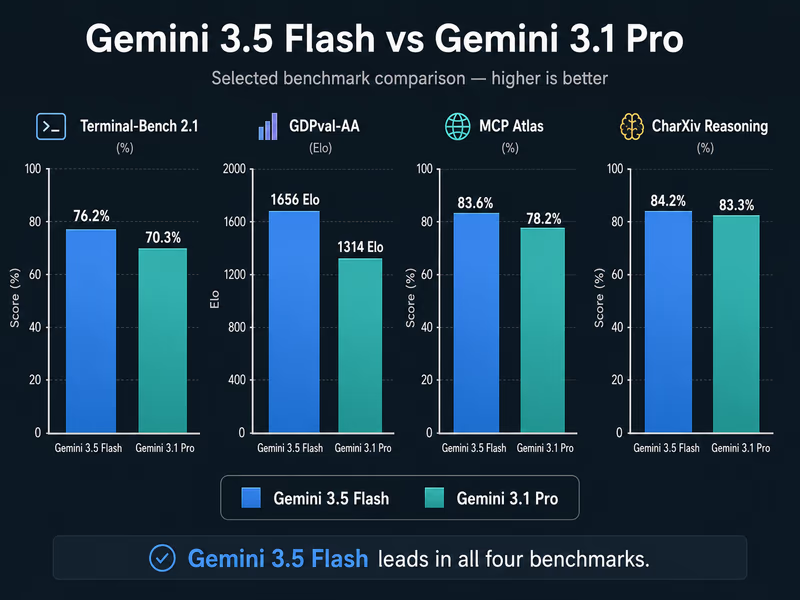
Crucially, Gemini 3.5 Flash outperforms the older Gemini 3.1 Pro across a majority of key benchmarks, demonstrating exceptional utility in coding and agentic execution. The model achieved 76.2% on Terminal-Bench 2.1, 1656 Elo on GDPval-AA, 83.6% on MCP Atlas, and 84.2% on CharXiv.
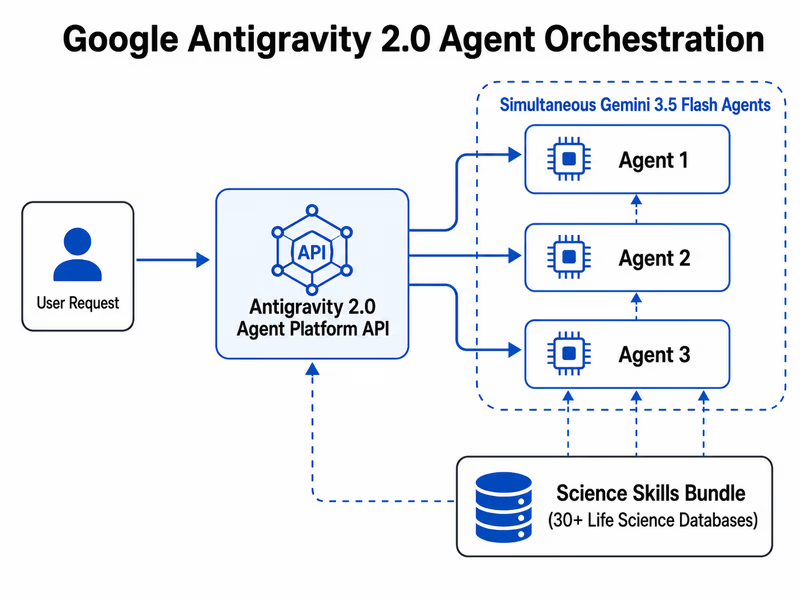
Koray Kavukcuoglu, CTO of Google DeepMind and Chief AI Architect at Google, explained the architectural advantages: "[Gemini] 3.5 Flash is especially good when deploying multiple agents simultaneously and completing long-running tasks with massive improvements in coding and tool use." To support developers building these multi-agent ecosystems, Google also upgraded its agent-first development platform, Antigravity, to version 2.0. Looking ahead, the higher-tier Gemini 3.5 Pro model is anticipated to release in June 2026.
Gemini Omni and Spark: Creating New Realities
Google also showcased Gemini Omni, a highly anticipated multimodal "world model" capable of seamlessly generating any output modality from any input, starting initially with advanced video capabilities. "Omni is where Gemini's ability to reason meets the ability to create," stated Kavukcuoglu.
The first model in this family, Gemini Omni Flash, began rolling out in the weeks following the conference to developers and enterprise customers via the Gemini API and Agent Platform API, with integrations expanding into the consumer-facing Gemini app, Google Flow, and YouTube Shorts. Commenting on the expansive potential of these world-modeling capabilities, Demis Hassabis, CEO of Google DeepMind, remarked, "Anything becomes a canvas for creating entirely new realities."
For enterprise users, Google introduced Gemini Spark, a new 24/7 cloud-based personal AI agent. Operating within Gemini Enterprise and Workspace, Spark is designed to autonomously execute complex workflows and tasks on behalf of users. The tool is scheduled to roll out to Google AI Ultra subscribers, with plans to operate directly within Chrome and power Information Agents in Search later in the summer of 2026.
Additionally, Google demonstrated its commitment to specialized academic research by introducing the Science Skills bundle for Gemini for Science. The package integrates over 30 major life science databases and tools, making it immediately available on GitHub and for Google Antigravity users to accelerate biological and clinical research.
Entering Wearable Hardware: Android XR Glasses
In a direct challenge to competitors like Meta, Google partnered with Samsung to unveil a new line of Android XR-powered AI smart glasses. The initial models, scheduled to launch in Fall 2026, will debut as "audio glasses."
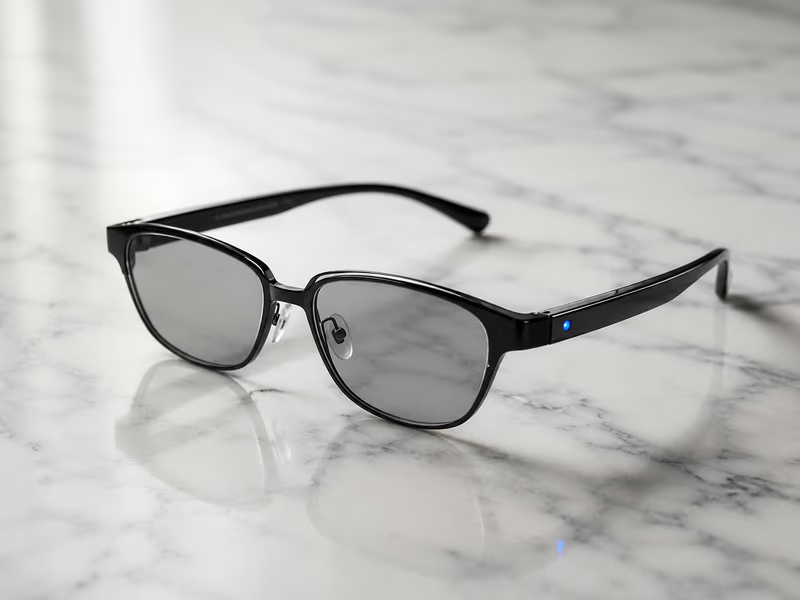
While Samsung oversees the hardware engineering, Google has partnered with prominent eyewear brands Warby Parker and Gentle Monster to design fashionable, lightweight frames. Functioning as a phone companion, the glasses are compatible with both Android and iOS devices. They rely primarily on voice control via Gemini AI to assist users with real-time navigation, translations, summarized notifications, and hands-free photo capture and editing.
Jay Kim, Executive Vice President and Head of Customer Experience at Samsung, highlighted the strategic importance of the collaboration: "This intelligent eyewear marks an important step in Samsung's vision for AI." While the initial audio-only collections arrive in Fall 2026, more advanced display-integrated Android XR glasses are expected to follow in 2027.
Infrastructure Backing the Agentic Era
To support the massive compute requirements of these real-time agentic models and wearable devices, Google announced its eighth-generation Tensor Processing Units, the TPU 8t and TPU 8i, tailored for AI training and inference. Supporting this scale, Google confirmed that its capital expenditure is expected to reach approximately $180-$190 billion this year, cementing its position as a primary builder of global AI infrastructure.