Google Embraces Open Source with Gemma 4: Multi-Token Prediction Delivers 3x Speed Boost
Google's Gemma 4 shifts to a permissive Apache 2.0 license and introduces Multi-Token Prediction drafters for a 3x inference speedup.
A New Chapter for Open-Source AI
Google DeepMind has fundamentally altered its position in the open-source ecosystem with the release of Gemma 4, a new family of models that moves beyond the restrictive 'open-weight' labels of its predecessors. Released on April 2, 2026, the Gemma 4 family is licensed under the commercially permissive Apache 2.0 framework, granting developers the freedom to modify, redistribute, and commercially exploit the models without the constraints seen in earlier iterations.
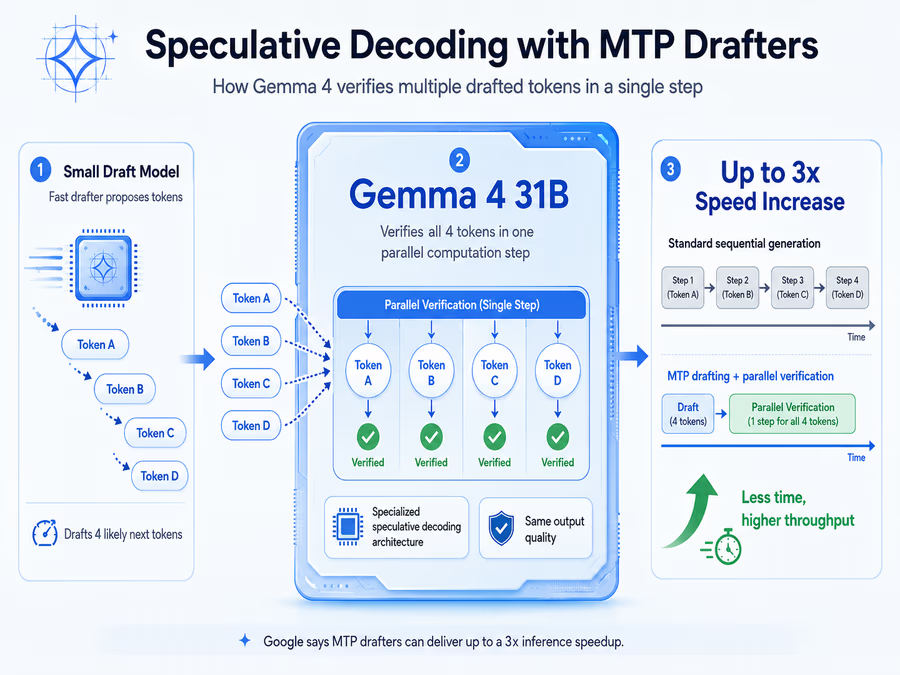
The release is not merely a licensing shift but a significant technical leap. On May 5, 2026, Google introduced Multi-Token Prediction (MTP) drafters for the family, a specialized speculative decoding architecture that enables up to a 3x speedup in inference performance. This enhancement allows for faster token generation without compromising the model's reasoning logic or output quality, addressing one of the most persistent bottlenecks in large language model (LLM) deployment.
Multimodal Capabilities and Model Architecture
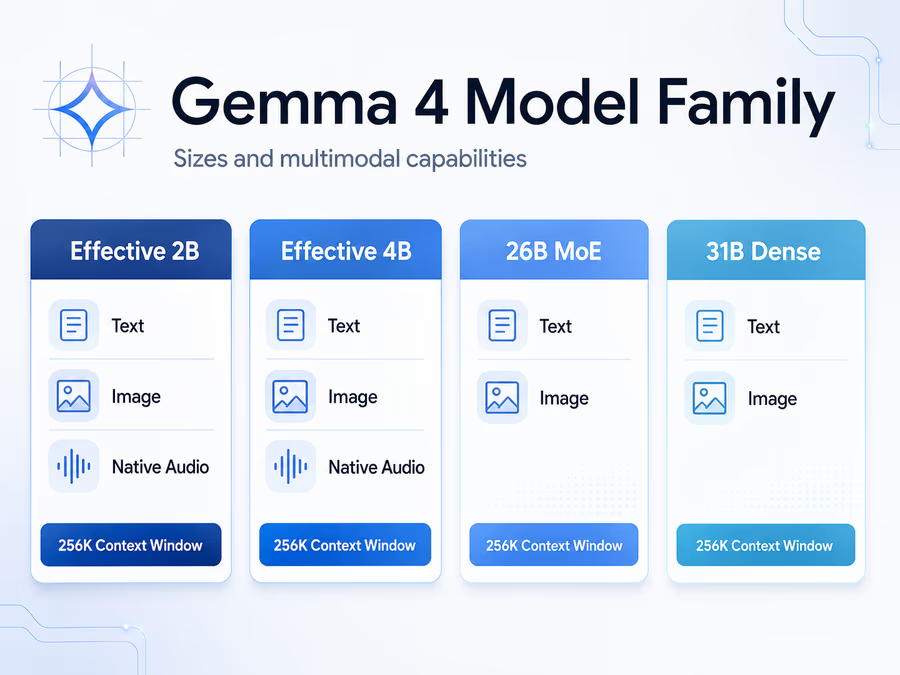
The Gemma 4 family is structured to meet diverse computational needs, offering four distinct sizes: Effective 2B (E2B), Effective 4B (E4B), a 26B Mixture of Experts (MoE), and a 31B Dense model. Breaking the mold of previous lightweight models, the entire family is multimodal, supporting text and image inputs. The smaller E2B and E4B variants go a step further, featuring native audio input capabilities designed for highly responsive voice interfaces.
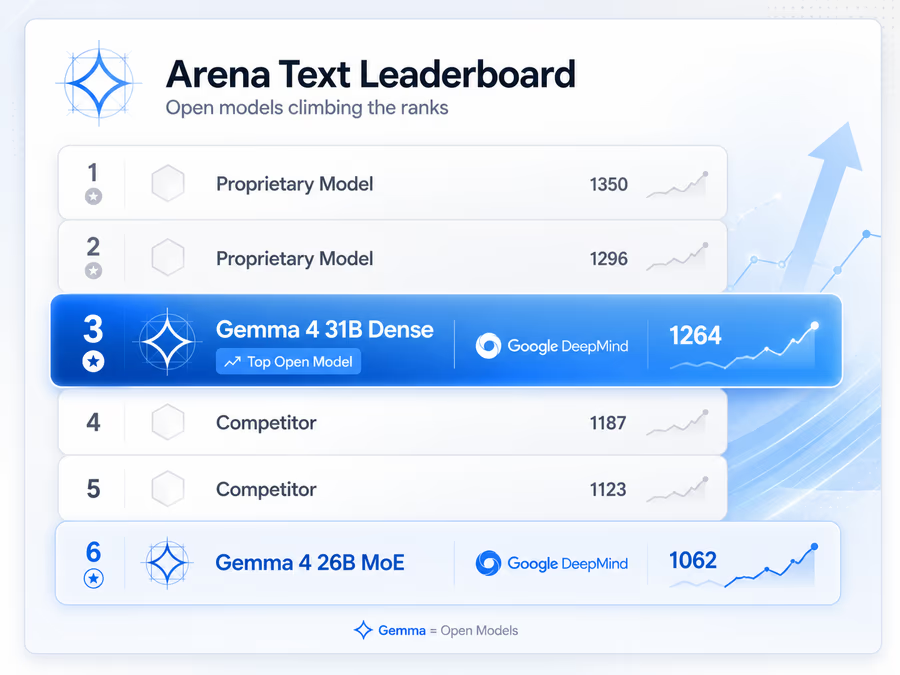
Performance benchmarks suggest that Google’s open-source offerings are now competing directly with top-tier proprietary models. The 31B Dense variant currently holds the third position on the Arena text leaderboard, while the 26B MoE variant has secured the sixth spot. All models in the family benefit from a significantly expanded context window of up to 256K tokens, allowing for the processing of extensive documents and complex agentic workflows.
According to the Google Blog on April 2, 2026: "Today, we are introducing Gemma 4 — our most intelligent open models to date. Purpose-built for advanced reasoning and agentic workflows, Gemma 4 delivers an unprecedented level of intelligence-per-parameter."
Breaking the Inference Bottleneck
The introduction of MTP drafters addresses the memory-bandwidth limitations that typically slow down LLM inference. In standard models, the processor spends a disproportionate amount of time moving parameters to generate a single token. Speculative decoding mitigates this by pairing the primary Gemma 4 model with a smaller, faster 'draft model.' This secondary model predicts multiple future tokens simultaneously, which the larger model then verifies in parallel.
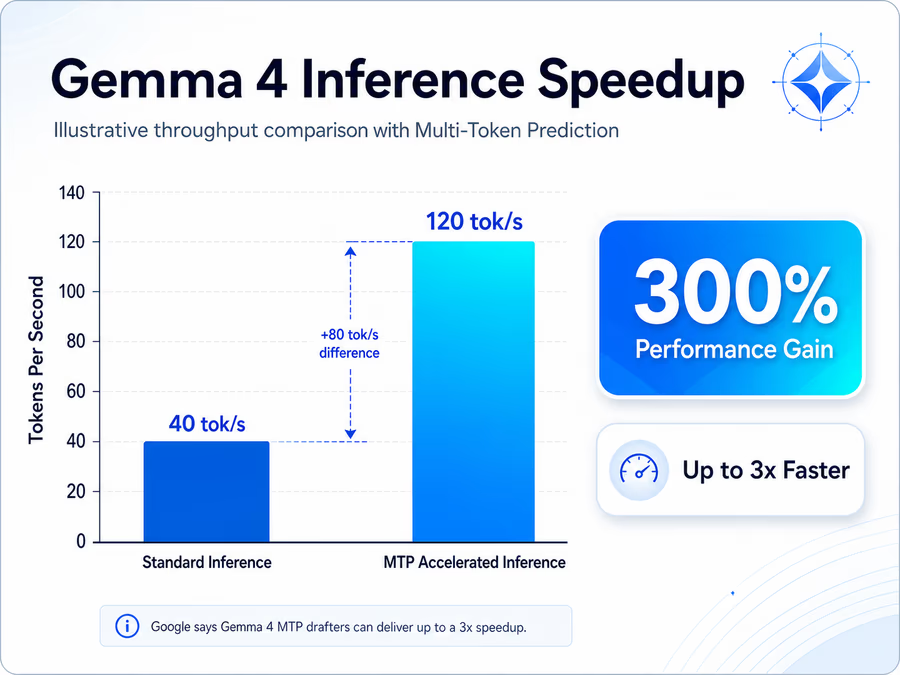
"By using a specialized speculative decoding architecture, these drafters deliver up to a 3x speedup without any degradation in output quality or reasoning logic," Google stated during the May 5 announcement. This efficiency allows developers to achieve frontier-level AI performance on reduced hardware, making local development of offline coding assistants and autonomous agents more viable on consumer-grade GPUs.
The Strategic Pivot Toward Digital Sovereignty
This shift toward the Apache 2.0 license is viewed by industry analysts as a strategic move to foster a developer ecosystem reminiscent of Android and Chrome. While previous Gemma versions allowed access to weights, they were subject to usage terms that some developers found restrictive. The new licensing model focuses on "complete developer flexibility and digital sovereignty," according to Google, granting users full control over their data and infrastructure.
This move may have been in the works for years. According to unconfirmed reports and a rumored internal memo from May 2023, some within Google argued for a more aggressive open-source strategy to counter the rapid advancement of community-driven models. By embracing a truly open approach now, Google is positioning Gemma 4 as a foundation for a new generation of transparent, locally-controlled AI applications.
Future Implications and Competitive Landscape
The arrival of Gemma 4 intensifies the competition in the open-weights arena, where Meta’s Llama series, Mistral, and Alibaba’s Qwen have previously held significant mindshare. The combination of high-speed inference, multimodality, and permissive licensing makes Gemma 4 a formidable candidate for edge computing and mobile integration.
Looking ahead, the optimization of E2B and E4B models for IoT and mobile devices will likely lead to more sophisticated on-device AI that preserves battery life while delivering near-instantaneous responses. As Google continues to integrate these models into its broader ecosystem—including optimizations for NVIDIA GPUs via TensorRT-LLM—the barrier to entry for building high-performance, private AI applications continues to fall. The focus now shifts to the developer community to see how this newfound 'intelligence-per-parameter' will be utilized in real-world agentic workflows.