Google’s Unannounced Gemini 3.2 Flash Surfaces in Stealth Testing on Arena
Google's unannounced Gemini 3.2 Flash model has appeared in stealth testing on LM Arena, demonstrating significant gains in 3D coding and SVG generation.
Google appears to be preparing a refined iteration of its efficient Gemini model series, as users on the Eleuther AI Arena—commonly known as LM Arena—have spotted a "Gemini 3.2 Flash" version undergoing blind testing. This unannounced model represents a swift follow-up to the Gemini 3 series, which only recently became the standard for Google’s high-speed AI workflows. The appearance of the 3.2 variant underscores a persistent strategy at Google DeepMind to iterate rapidly in a hyper-competitive market where deployment speed and inference efficiency are as critical as raw reasoning power.
LM Arena, a public platform for evaluating large language models (LLMs) through pairwise blind comparisons, has become the industry's go-to for gathering human preference data. By allowing users to vote on responses without knowing which model generated them, Google can refine its weights and architectures against real-world prompts before a general release. According to early data from Arena leaderboard submissions and API logs, model strings identifying Gemini 3.2 began appearing as early as March 2026, suggesting a significant lead time for internal and stealth testing.
Performance Gains in Graphics and Code
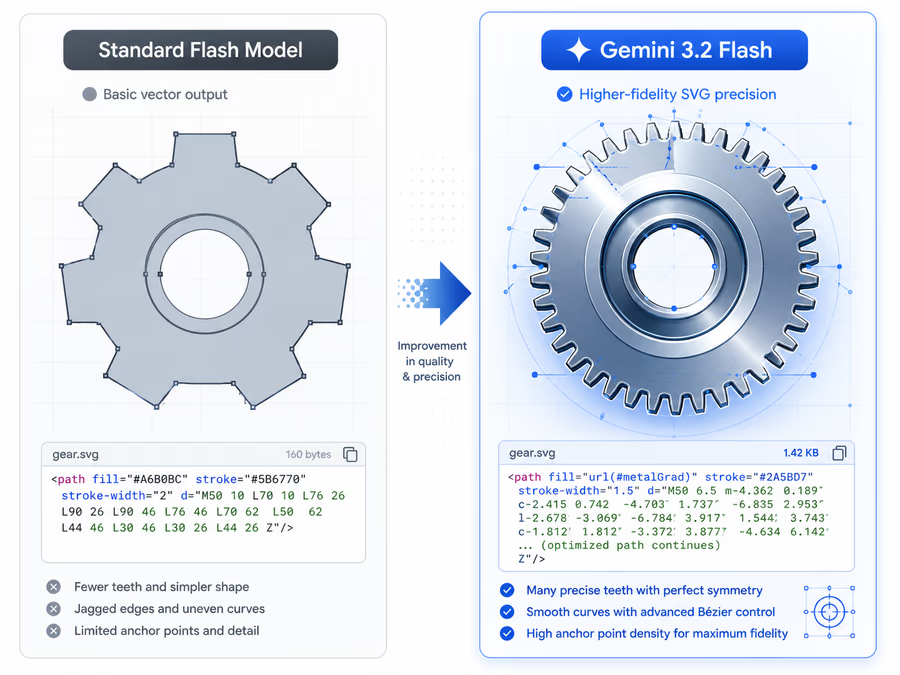
Initial reports from users interacting with the stealth model suggest that Gemini 3.2 Flash is more than a simple speed update. While the Flash series is traditionally prioritized for its low latency and affordability, this new iteration is reportedly outperforming the current Gemini 3 Flash in specific, high-complexity tasks. Notably, the 3.2 version shows enhanced accuracy in SVG generation and greater detail in the creation of vector graphics.
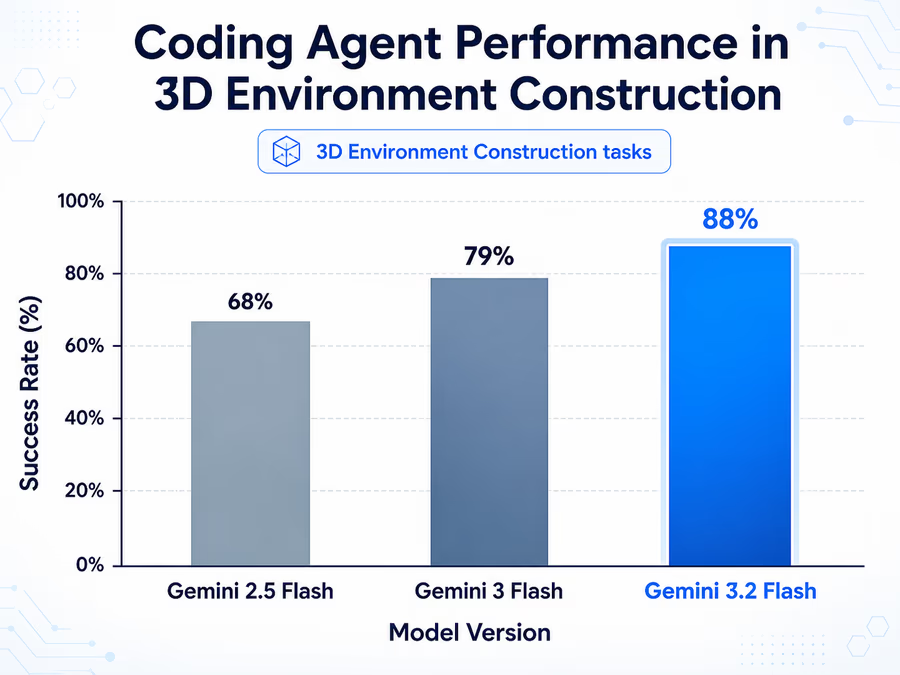
Perhaps the most significant leap cited by testers is the model's extended coding capability. Gemini 3.2 Flash has demonstrated the ability to generate entire interactive 3D environments, a task that typically requires higher-tier models. This shift suggests that Google is successfully trickling down high-level reasoning and spatial awareness into its smaller, more cost-efficient models.
A representative from Cursor, a popular AI-integrated code editor, previously noted the value of the Flash series in development workflows. "For the first time, Gemini 3 Flash combines speed and affordability with enough capability to power the core loop of a coding agent," the representative stated regarding the previous version. "We were impressed by its tool usage performance, as well as its strong design and coding skills." The leap to 3.2 appears to solidify this "agentic" capability.
The Strategic Pivot to a Portfolio Approach
Google's move to introduce Gemini 3.2 Flash so quickly follows a pattern of rapid deprecation. For instance, the company recently announced that Gemini 2 Flash and Flashlight on Vertex AI would be discontinued on June 1, 2026. This aggressive lifecycle management forces developers to remain agile, moving to newer models like 3.1 and 3.2 to maintain performance parity.
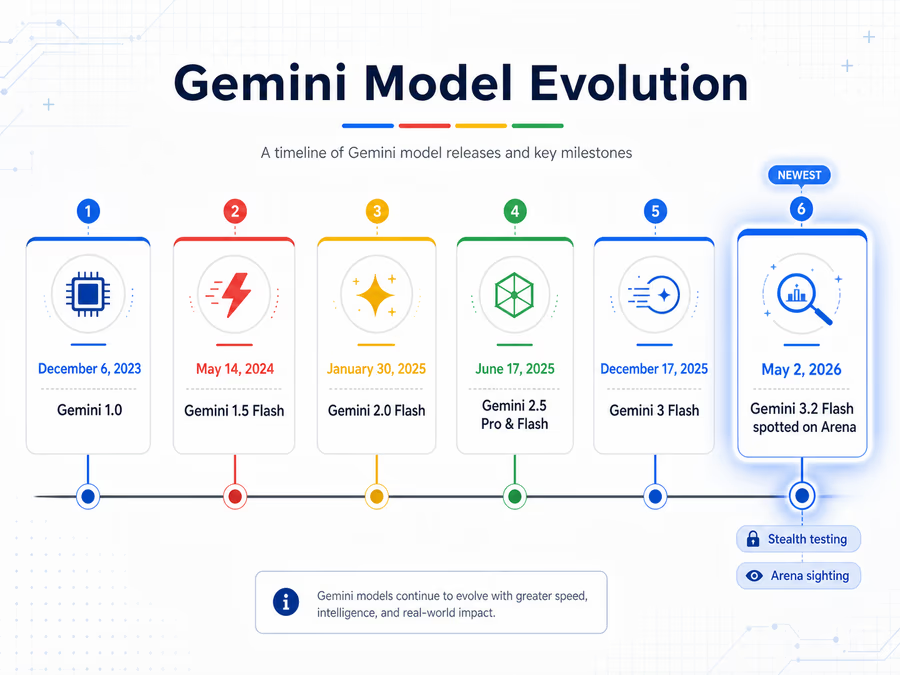
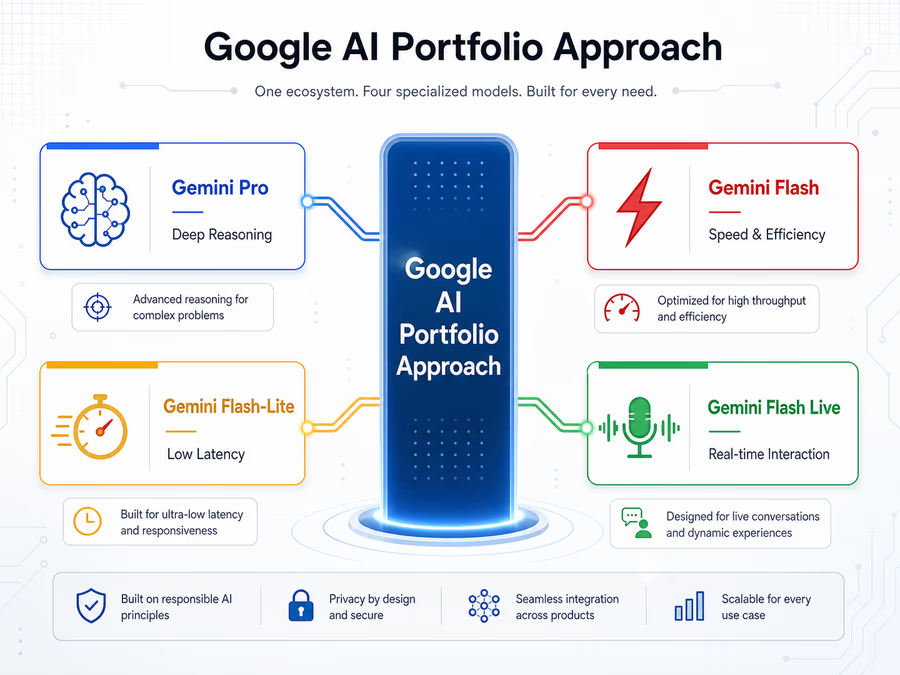
As of May 2026, the Gemini 3.2 model is reportedly becoming available across Google's tier-based plans, including Google AI Pro, Google AI Ultra, and via the Gemini API. This rollout aligns with Google’s "portfolio approach," which balances distinct models like Pro (for deep reasoning), Flash (for speed/cost), and Flash-Lite (for lightweight tasks). Gemini 3.2 Flash is characterized as a minor yet vital update within the Gemini 3 family, focusing on inference stability and accuracy with long contexts—an essential feature for enterprise users handling massive datasets.
Why Stealth Testing Matters
Google's use of LM Arena for stealth testing is a practice shared by its primary competitors. Similar behavior was observed during the testing phases of OpenAI's GPT-5 (codenamed "summit") and Google’s own "Nano Banana" (Gemini 2.5 Flash Image). While Arena’s methodology has faced some criticism regarding potential vote manipulation and user subjectivity, it remains a vital signal for how a model will perform in the hands of the general public without the filter of corporate marketing.
Industry partners have already begun integrating these faster models into their core architectures. A Workday representative recently commented that the Gemini Flash series "gives us a powerful new frontier model to fuel Workday's AI-first strategy." Similarly, Salesforce’s Agentforce has integrated these models to deploy intelligent agents faster than previous cycles allowed.
Looking Ahead: Google I/O and Beyond
With Gemini 3.2 Flash now emerging from the shadows, the industry's eyes turn toward Google I/O 2026, scheduled for May 19-20. Speculation is mounting that Google may use the event to announce Gemini 4.0 or perhaps a version 3.8, alongside further updates to its multimedia suite, including Veo for video and Lyria for music.
The emergence of Gemini 3.2 suggests that the cycle of AI development is moving away from massive annual releases toward a continuous stream of incremental but impactful updates. For developers and enterprises, the focus is shifting toward "agentic AI"—systems that don't just answer questions but perform autonomous tasks with minimal oversight. As Gemini 3.2 Flash lowers the cost and latency of these complex workflows, the barrier to deploying sophisticated AI agents continues to fall across the global economy.