Google Backs Anthropic’s $35 Billion Data Center Expansion Ahead of Planned IPO
Anthropic secures a Google-backed $35 billion financing package to lease and operate U.S. data centers ahead of its planned IPO.
Anthropic is transitioning its operational strategy to directly lease and operate its own data centers in the United States, securing a massive $35 billion financing package backed by Google to fuel the expansion. This strategic shift represents a major step toward owning its compute infrastructure, driven by surging demand for its Claude family of AI models and preparations for a potential public market debut.
The $35 billion financing package is structured as a private credit deal, supported by a lease-payment guarantee from Google and credit enhancement from Broadcom. Under this arrangement, Google will backstop lease payments for five data centers tied to Anthropic, providing the critical financial security needed to unlock the massive capital. Additionally, Google will supply its custom Tensor Processing Units (TPUs) to power these facilities, deepening the integration between the two tech giants.
A Massive Infrastructure Footprint
To support its growing workload, Anthropic has signed more than a dozen preliminary agreements for data centers with a combined capacity exceeding 1 gigawatt (GW). This expansion is built on several high-profile partnerships. On November 12, 2025, Anthropic entered into a $50 billion data center partnership with Fluidstack for facilities in Texas and New York, which are expected to come online throughout 2026. Furthermore, on April 10, 2026, the company signed a multi-year contract with specialized cloud provider CoreWeave for data center space featuring Nvidia chip architectures.
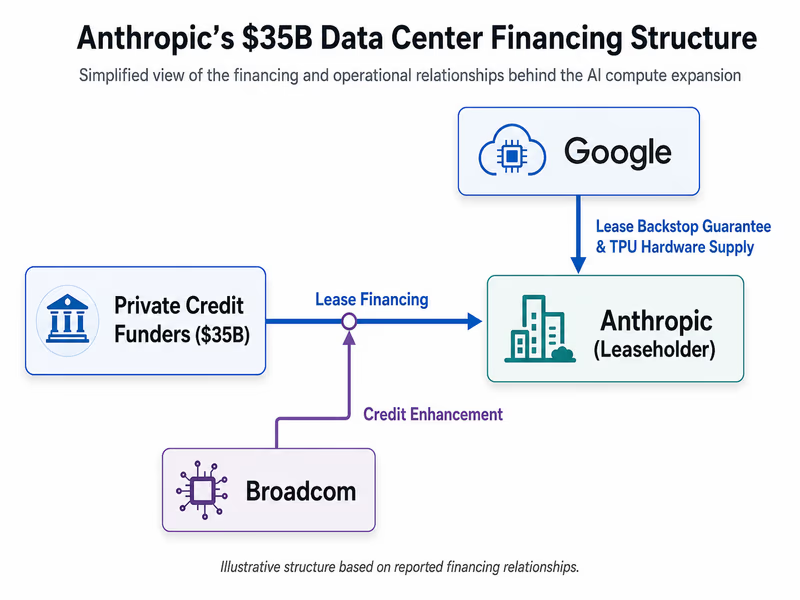
This multi-faceted hardware strategy allows Anthropic to mitigate supply chain risks. By utilizing Google’s TPUs, Amazon’s Trainium processors, and Nvidia GPUs, the company maintains operational flexibility across its training and inference pipelines.
Krishna Rao, CFO of Anthropic, highlighted the importance of this capital push: "This funding will help us serve the historic demand we are experiencing, stay at the research frontier, and bring Claude to more of the places where work happens."
Skyrocketing Valuation and IPO Plans
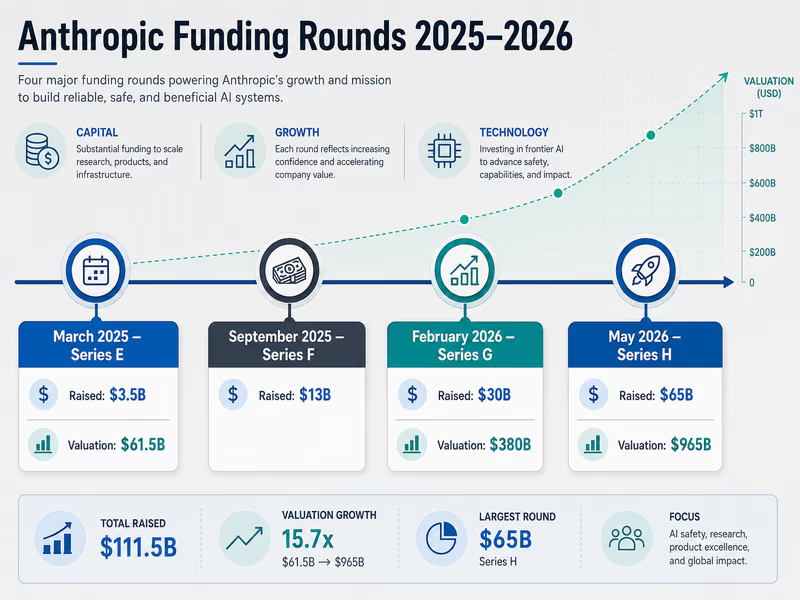
The scale of the infrastructure expansion matches Anthropic’s explosive financial trajectory. In May 2026, the company completed a Series H funding round, raising $65 billion and achieving a post-money valuation of $965 billion. This valuation places Anthropic at the very top of the generative AI market. Just weeks later, in early June 2026, the company confidentially filed paperwork for a U.S. Initial Public Offering (IPO).
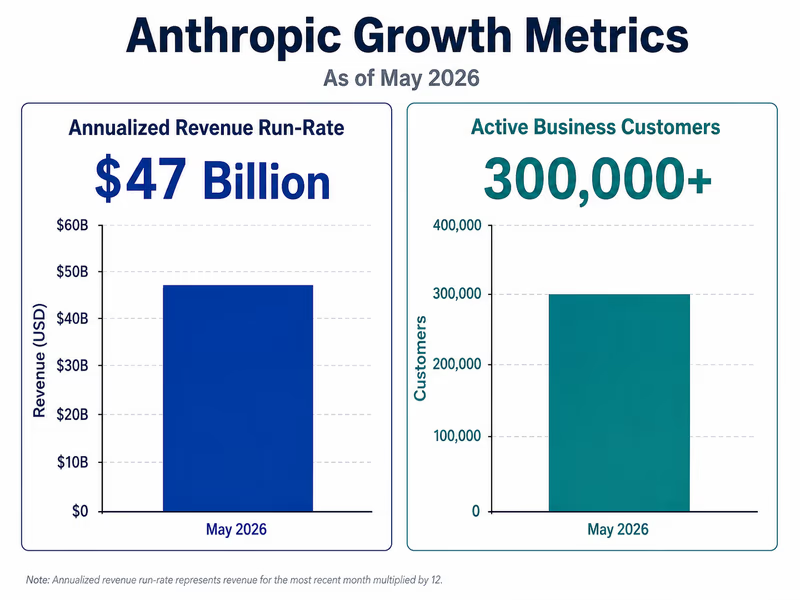
Driving this investor enthusiasm is a highly lucrative enterprise business. By May 2026, Anthropic’s annualized revenue run-rate reached $47 billion, supported by a customer base of over 300,000 business clients. This growth coincides with the launch of Claude Fable 5, alongside reports of plateaus in consumer web traffic for some of its primary competitors.
Brad Gerstner, Founder and CEO of Altimeter Capital, observed this market shift, noting that "Claude's latest advancements have driven large-scale adoption among the world's most demanding organizations. This momentum positions Anthropic to lead the next phase of AI innovation and capture the enormous opportunity ahead."
Google’s Deepening Role and Regulatory Shadows
Google's relationship with Anthropic has evolved from a traditional venture investment into a structurally integrated partnership. Google began investing in Anthropic in October 2023 with a $500 million injection, committing an additional $1.5 billion over time. This was followed by a $1 billion investment in March 2025 and a massive $10 billion commitment around April 2026.
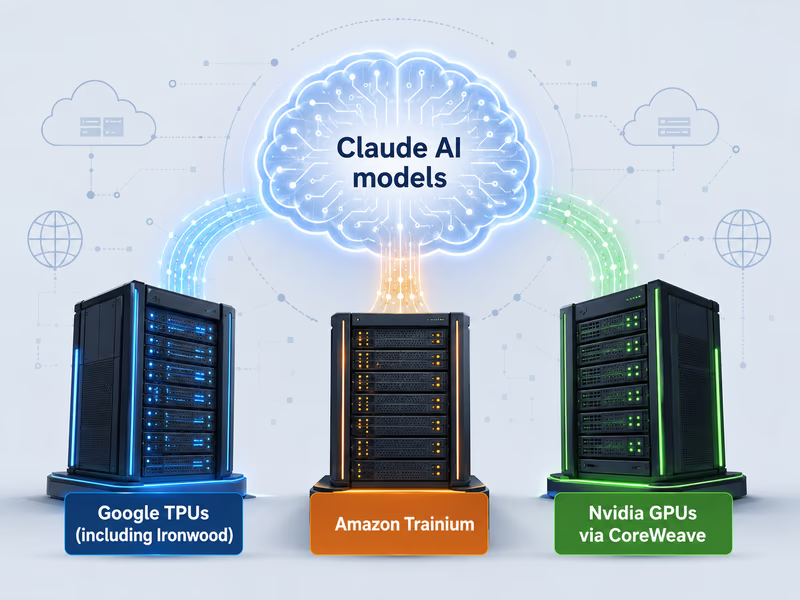
By guaranteeing Anthropic’s lease payments and supplying hardware, Google has established a vertically integrated model for AI financing. This dynamic benefits Anthropic by securing premier real estate and hardware, while providing Google with a reliable high-volume buyer for its silicon.
Thomas Kurian, CEO of Google Cloud, emphasized this collaborative success: "Anthropic's choice to significantly expand its usage of TPUs reflects the strong price-performance and efficiency its teams have seen with TPUs for several years. We are continuing to innovate and drive further efficiencies and increased capacity of our TPUs, building on our already mature AI accelerator portfolio, including our seventh generation TPU, Ironwood."
Unverified reports suggest that Alphabet had initially planned to invest up to $40 billion directly in Anthropic. However, neither Google nor Anthropic has commented on the specific financial mechanics of the current lease commitments. This caution may stem from regulatory scrutiny; in 2024, the U.S. Federal Trade Commission (FTC) launched investigations into the tight-knit relationships between major tech conglomerates and independent AI startups.
Forward-Looking Implications
The sheer scale of Anthropic's 1-gigawatt build-out highlights the intense "compute arms race" dominating the technology sector. Securing high-performance infrastructure has become the primary battleground for AI leadership. For context, OpenAI is reportedly pursuing its own 10-gigawatt data center campus to keep pace.
However, this unprecedented expansion brings severe challenges for global energy grids. Operating gigawatt-scale data centers requires immense power generation, raising urgent concerns about the capacity of existing utility systems. To accommodate this next wave of AI growth, energy providers and policymakers will face immense pressure to accelerate grid upgrades and reform permitting regulations. How fast these energy hurdles can be resolved will likely dictate the speed of AI progress over the rest of the decade.