
GitHub Copilot's Shift to Token Billing Sparks Backlash Over Skyrocketing Developer Costs
GitHub Copilot's transition to a token-based AI Credit billing model has triggered backlash as power users face skyrocketing monthly costs.
GitHub Copilot officially transitioned to a usage-based billing model on June 1, 2026, replacing its legacy "premium request units" (PRUs) with a new system of "GitHub AI Credits." The structural overhaul has immediately triggered widespread frustration among power users, with some developers reporting projected monthly bill increases of up to 60 times their previous rates under the new metered system.
The Mechanics of the Metered System
Under the newly activated pricing architecture, billing is directly tied to token consumption, which tracks input, output, and cached context. One GitHub AI Credit is mathematically pegged to $0.01 USD.
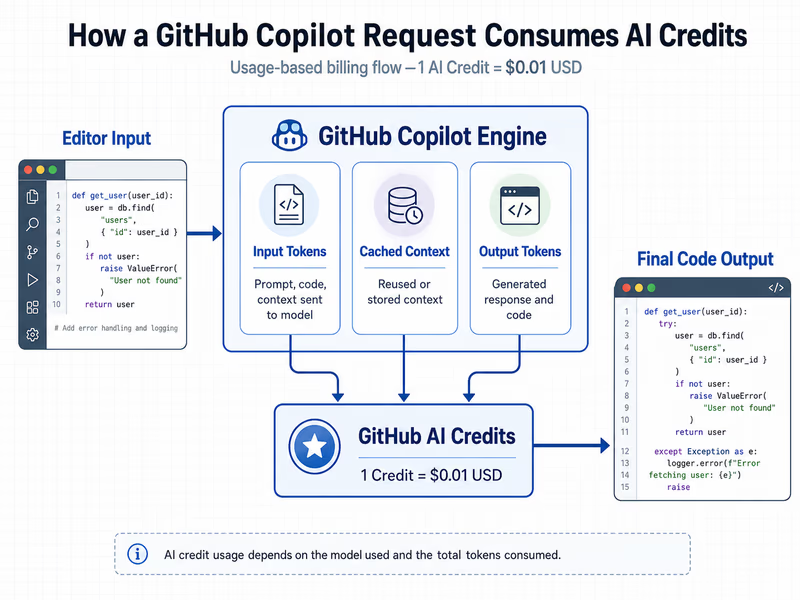
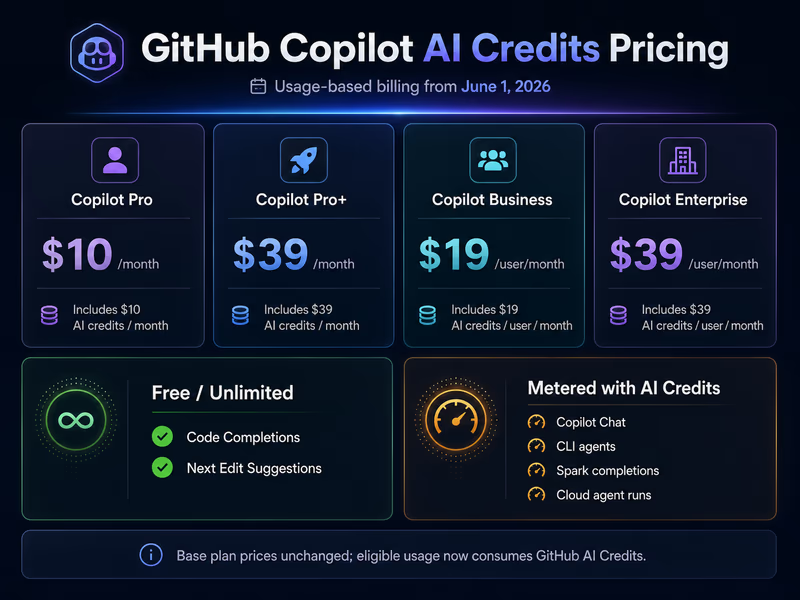
While standard inline code completions and Next Edit Suggestions remain unlimited and free of charge, a wide suite of advanced features now actively drains a user's monthly credit allotment. These metered features include Copilot Chat, CLI agents, cloud agent runs, Spark completions, and integrations with third-party coding agents.
The base subscription pricing for popular tiers remains numerically unchanged on paper: Copilot Pro is still $10 per month, Pro+ is $39 per month, and Copilot Business and Enterprise stand at $19 and $39 per user per month, respectively. However, these monthly flat fees no longer represent an unlimited spending limit. Instead, they have been converted into a fixed monthly allowance of AI Credits.
Developers React to 'Sticker Shock'
The financial consequences of this change became clear almost immediately after the June 1 rollout. Some power users who heavily rely on multi-step agentic workflows reported massive shifts in their projected costs.
"My projected bill next month: $847. For the EXACT same usage pattern," shared one Copilot Pro+ subscriber on Reddit. "That's not a price increase — that's a 22x markup."
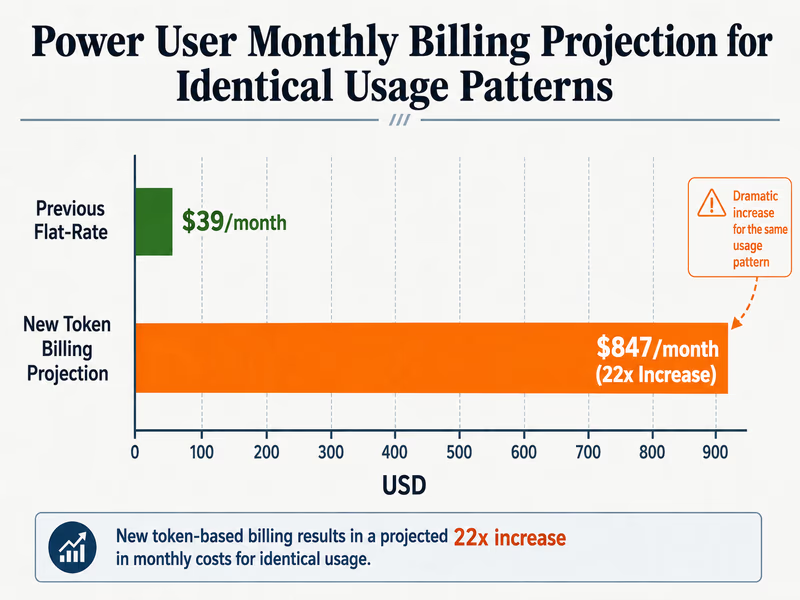
Another developer writing on the GitHub user forum echoed this sentiment, describing the transition as "a staggering shift from a 'predictable subscription' to a 'stressful meter-based' service that hinders my productivity rather than helping it."
The frustration is compounded by the unpredictable nature of AI agent interactions. Because Copilot frequently sends extensive code context to underlying models to ensure accuracy, users are being charged for large volumes of background data over which they have little direct control.
One Reddit user lamented a frustrating experience where Copilot provided poor suggestions that required manual correction, only to find the session had consumed 1,180 credits. "It gave some pretty mediocre suggestions. Didn't really solve the problem – I still had to do most of the work myself. Then I checked the actual usage page, 1,180 credits used. That's 16% of my monthly Pro+ allowance. Gone. For basically nothing," the user posted. Additionally, unverified reports and community sentiment suggest that GitHub's per-token pricing for some models may be significantly higher than if developers were to access the underlying models directly through standard provider APIs.

Aligning Pricing to Rising Compute Demands
GitHub leadership has defended the restructuring as a necessary evolution to accommodate the massive compute demands of modern generative AI. Chief Product Officer Mario Rodriguez explained that the previous flat-rate subscription was no longer viable given the trajectory of developer workflows.
"GitHub Copilot simply is not the same product it was a year ago—it now powers far more complex, agentic workflows that consume far more compute," Rodriguez stated. He added that the billing changes are designed "to deliver a more sustainable and reliable product experience by aligning pricing to actual usage and costs."
According to Rodriguez, the previous system created an imbalance where "today, a quick chat question and a multi-hour autonomous coding session can cost the user the same amount," a dynamic that became financially unsustainable as multi-hour agent operations grew in popularity.
Mitigating the Blow for Enterprises
To help organizations ease into the new cost structure, GitHub has introduced pooling features and promotional buffers. Businesses and Enterprise customers can pool their AI Credits across their entire organization, allowing the unused credits of less active developers to offset the heavy consumption of power users.
Furthermore, GitHub is offering temporary promotional credits through August 2026, which injects an additional $30 per user for Business plans and $70 per user for Enterprise plans. Annual subscription holders are also temporarily shielded, continuing on their existing premium request-based billing until their current terms expire, though their PRU model multipliers were updated on June 1st to reflect the new cost realities.
To prevent immediate billing surprises, GitHub launched a preview bill experience in early May 2026, giving administrators a window to monitor and adjust team usage before the system went live.
A Broader Shift in the AI Market
The changes at GitHub are not occurring in isolation. They point to a broader, structural realignment across the entire artificial intelligence industry as companies grapple with the massive capital expenditures required to run advanced inference models.
Arun Chandrasekaran, an analyst at Gartner, noted that Copilot's pricing pivot "may be an early example" of what the market should expect moving forward. He predicted that we will see more companies move toward token or consumption-based pricing, especially as advanced reasoning models and agentic workflows drive significantly higher compute consumption at the inference.
This trend is already visible among competitors. Anthropic transitioned its Claude Enterprise subscribers to a token-based billing system in April 2026. In response to Copilot's pricing spike, some developers are already evaluating alternative coding assistants like Cursor or opting to build custom setups using direct API access to OpenAI or Anthropic models to maintain tighter, more predictable budget controls.