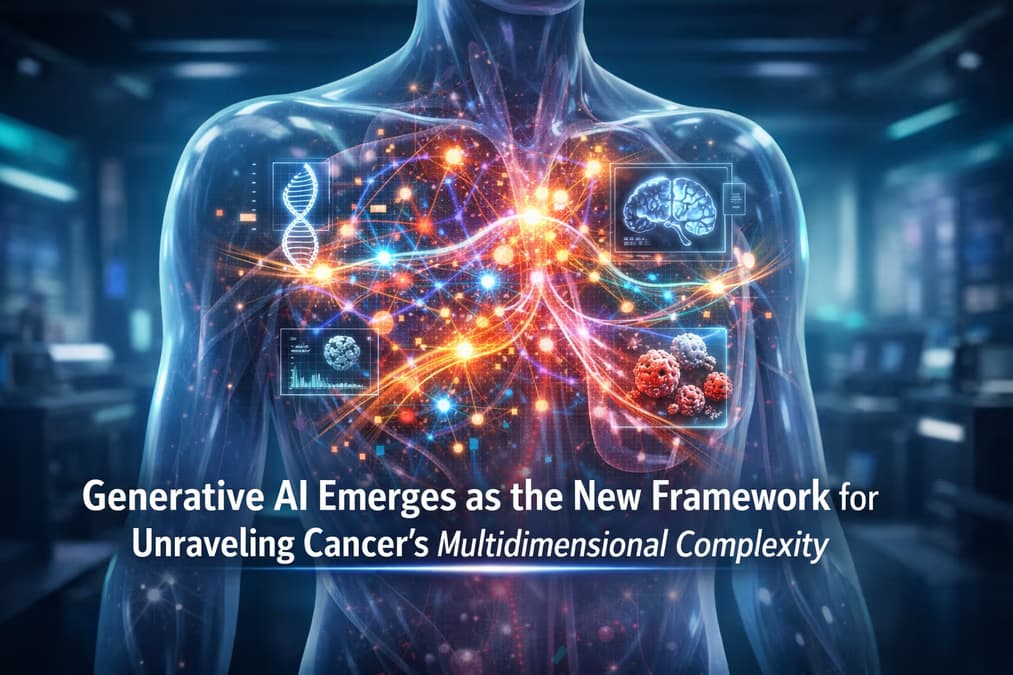
Generative AI Emerges as the New Framework for Unraveling Cancer’s Multidimensional Complexity
Researchers in the journal Cell argue that generative AI models provide a new constructionist framework to master cancer's complex biological patterns.
A Shift in the Oncological Paradigm
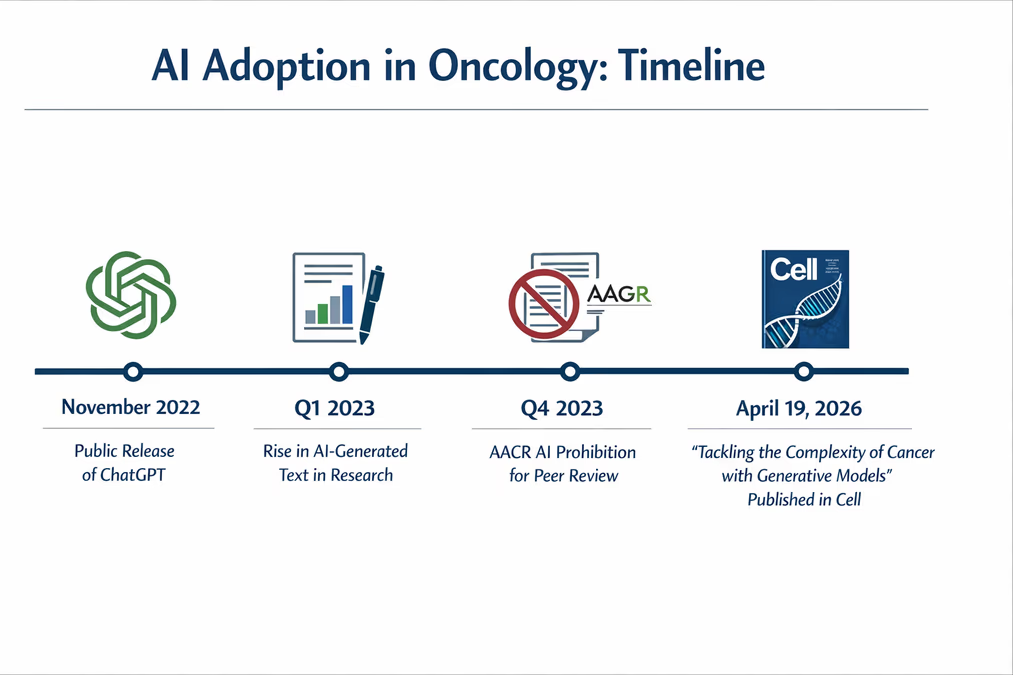
Scientists are pivoting from a reductionist view of oncology toward a "constructionist" approach powered by generative artificial intelligence, according to a landmark study published in the journal Cell on April 19, 2026. The article, authored by Conard AM, Hughes M, Hall J, and colleagues, argues that generative models are now essential for synthesizing the vast, multi-layered data required to understand the intricate nature of cancer.
For decades, the field has relied on frameworks like the "Hallmarks of Cancer" to systemize understanding. While revolutionary, this reductionist method often struggles to capture the full, multiscale complexity of the disease. Generative AI is emerging as a complementary tool that learns complex dynamics directly from diverse data sources, prioritizing the accurate representation of biological complexity over simplified classification. This allows researchers to integrate unstructured input and perform in-context learning to recognize patterns that were previously incomprehensible.
Multimodal Fusion and Synthetic Data
One of the most significant advantages of generative AI in oncology is its ability to fuse multimodal data. By combining genomic information, clinical records, and even social determinants of health, these algorithms can identify subtle patterns to predict patient outcomes and personalize treatment plans.
In the realm of oncological imaging, generative AI is currently revolutionizing how clinicians detect and diagnose tumors. Beyond mere classification, these models generate synthetic medical images to improve image quality and predict tumor progression. This capability addresses a long-standing challenge in the field: data scarcity. By creating high-fidelity synthetic images of rare cancer types or early-stage tumors, generative AI expands the datasets available to train diagnostic algorithms, making them more robust and accurate for all patients.
Addressing Clinician Burnout and Administrative Friction
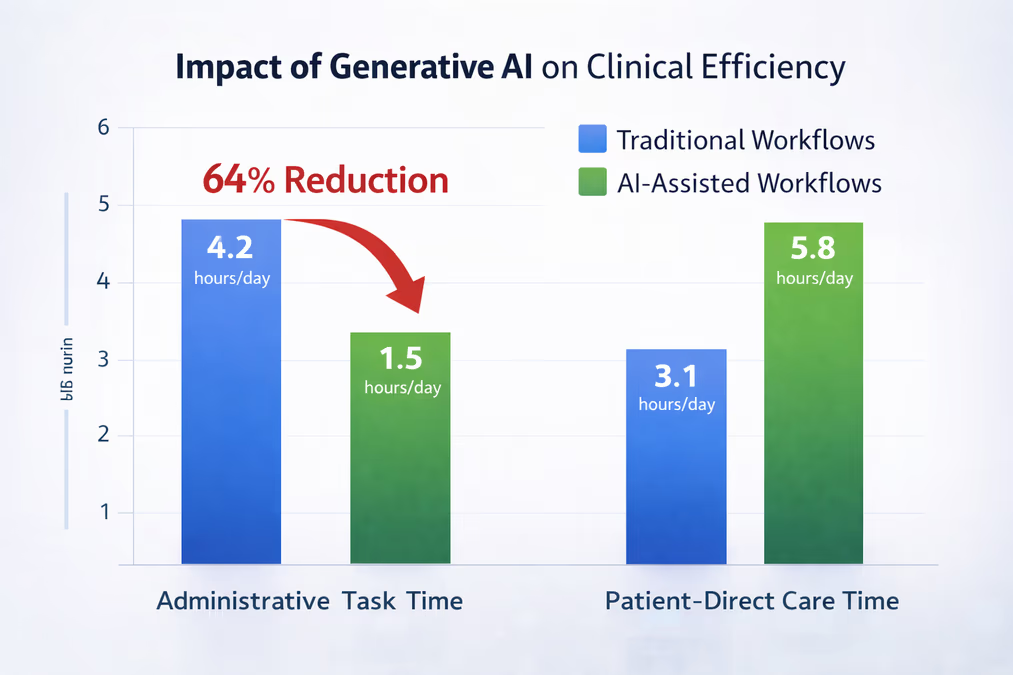
Beyond pure research, generative AI is making immediate inroads into the clinical environment. Large Language Models (LLMs) are being deployed to summarize medical visits, generate complex clinical reports, and answer pressing questions from oncology teams. The objective is to automate time-consuming administrative tasks, thereby allowing medical professionals to dedicate more of their bandwidth to direct patient care.
Matthew Matasar, MD, Chief of the Division of Blood Disorders at Rutgers Cancer Institute, suggests that we are at an inflection point with the arrival of AI as a tool in advancing oncology work. He noted that specialized LLMs and AI-enabled clinical charting capabilities have led to a tremendous acceleration of early adoption over the last year, yet we have only scratched the surface.
However, the integration of these tools must be handled with caution. Danielle S. Bitterman, MD, a radiation oncologist at Brigham and Women's Hospital, stated that while language models and generative AI have immense potential to reduce clinician burnout, they must be implemented in a way that optimizes value alongside patient safety. Arturo Loaiza-Bonilla, MD, added that agentic AI is not meant to replace doctors but rather to remove the friction points that occur during routine clinical practice.
Ethical Innovation and the Path Forward
As the use of AI grows, so does the need for oversight. The use of AI-generated text in cancer research manuscripts and reviewer comments saw a dramatic spike in the first quarter of 2023, shortly after the release of ChatGPT. This surge led journals like those of the American Association for Cancer Research to implement strict policies regarding generative AI in peer review.
Researchers Yashbir Singh, Quincy A. Hathaway, and Bradley J. Erickson from the Mayo Clinic emphasize that as the industry navigates this frontier, it must remain committed to ethical innovation, ensuring the patient remains at the center of all efforts. This includes addressing critical factors such as patient privacy, algorithmic bias, and ensuring equitable access to these advanced tools across different socioeconomic groups.
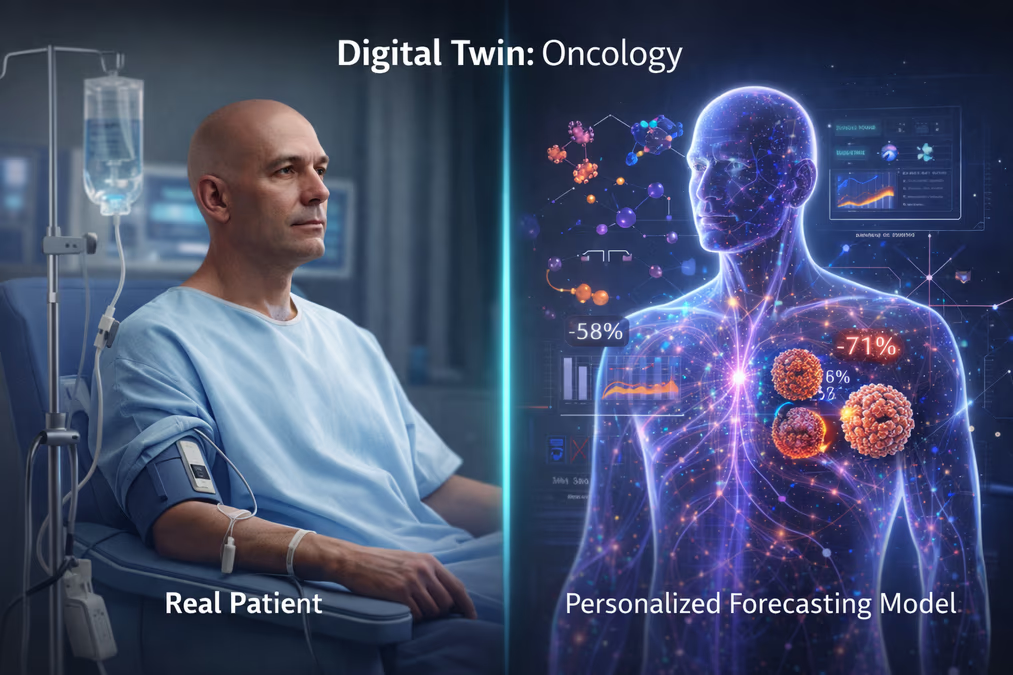
Looking ahead, the development of "digital twins"—virtual patient models that simulate individual treatment responses—represents the next frontier of personalized forecasting. For the AI industry, this signals a massive market for foundation models, such as Google's Med-Gemini, tailored to complex biological data. For patients, it promises a future of smarter diagnoses, earlier detection, and therapies specifically tuned to the unique molecular signatures of their cancer.