Flash Forward: Why Google's Cheaper, Faster Gemini 3.5 Flash Could Redefine the Agentic AI Race
Google's Gemini 3.5 Flash prioritizes speed and cost-efficiency, fundamentally altering the economics and deployability of enterprise agentic AI.
By mid-May of any fiscal year, the typical enterprise Chief Information Officer is usually staring at a terrifying spreadsheet: an annual AI token budget already entirely depleted. Building proof-of-concept models is cheap, but scaling those concepts into production-grade, long-horizon agents that execute thousands of autonomous loops is financially ruinous under the pricing structures of legacy frontier models.
With the release of Gemini 3.5 Flash, Google is signaling a tactical pivot in the generative AI war. The era of the hyper-bloated, slow, and expensive "expert" model is yielding to a more practical paradigm: high-throughput, aggressively priced, "Flash-first" architectures designed specifically for the rigorous demands of agentic workflows.
The Brutal Economics of the Agentic Era
To understand why Gemini 3.5 Flash is a critical release, one must first look at the unit economics of autonomous AI. True agents do not simply generate a single email; they analyze code repositories, monitor live feeds, consult internal databases, and recursively debug their own output. This loop-driven behavior means a single user task can easily consume millions of tokens of context and output.
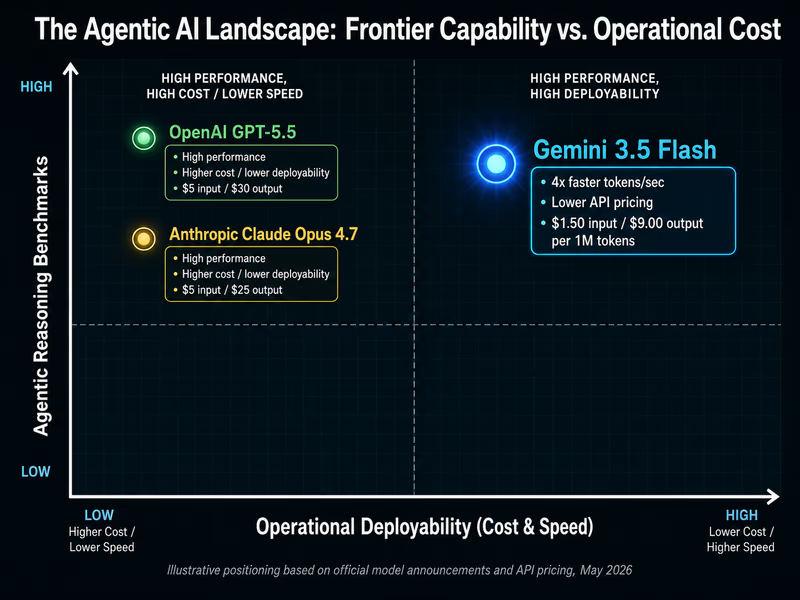
Under competitor pricing models—such as OpenAI's GPT-5.5 or Anthropic's Claude Opus 4.7—running these loops at scale is commercially unviable. As Google and Alphabet CEO Sundar Pichai noted during the launch, "You've heard the anecdotes from other CIOs that companies are already blowing their annual token budgets and it's only May. If companies used a mix of Flash and other models they could save a lot of money."
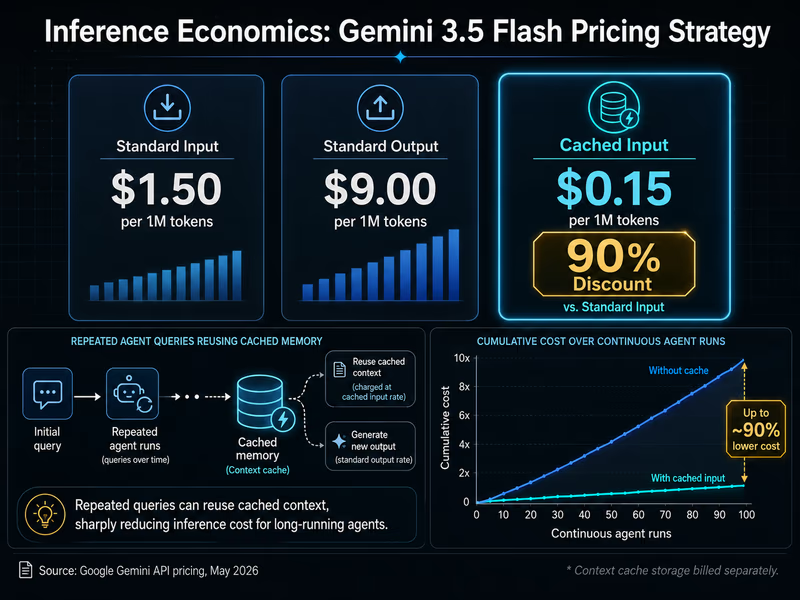
Google has priced Gemini 3.5 Flash at $1.50 per million input tokens and $9.00 per million output tokens. Crucially, however, the model introduces a massive 90% discount for cached input tokens, pricing them at a mere $0.15 per million. This pricing is a direct attack on the memory bottleneck of agentic systems. Because an agent must maintain state and history across long-horizon tasks, keeping a 1-million-token context window active has historically been cost-prohibitive. By slashing the cost of cached inputs to pennies, Google has made sustained, multi-turn agentic memory economically feasible for the first time.
Speed is a Functional Capability, Not a Luxury
In human-to-AI chat interfaces, output latency is a matter of user experience. In multi-agent systems, latency is a structural bottleneck. When dozens of micro-agents are communicating, negotiating, and validating each other's work in parallel, a slow model causes the entire software pipeline to grind to a halt.
Gemini 3.5 Flash delivers an output token-per-second (TPS) rate that Google reports is four times faster than comparable frontier models. This speed is not just about responsiveness; it is a fundamental enabler of complex agentic architecture.
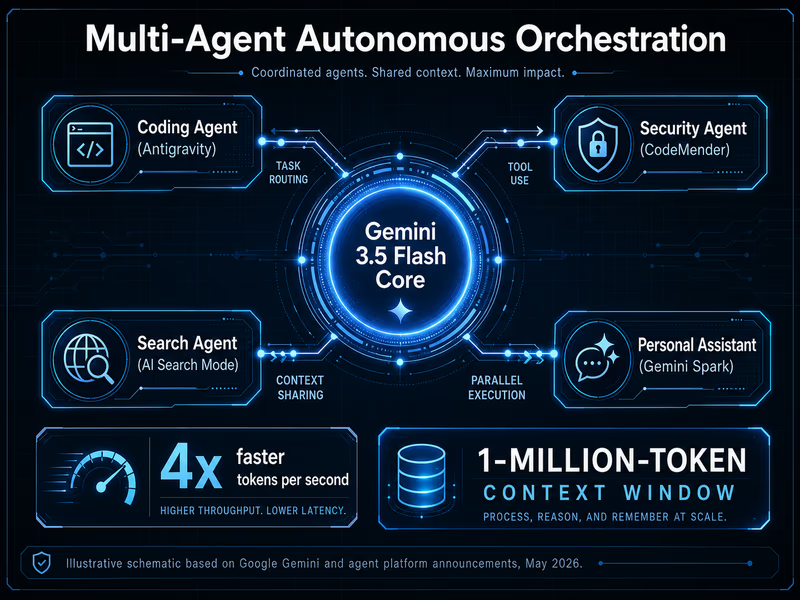
"[Gemini] 3.5 Flash is especially good when deploying multiple agents simultaneously and completing long-running tasks with massive improvements in coding and tool use," says Koray Kavukcuoglu, CTO of Google DeepMind and Chief AI Architect at Google. "It can independently execute complex coding pipelines or manage iterative research projects entirely by itself. We have even managed to successfully test it by having our agents build a working operating system entirely from scratch."
This speed-to-intelligence ratio alters how developers design workflows. Instead of relying on a single, massive model to slowly digest a problem, developers can deploy dozens of Gemini 3.5 Flash agents simultaneously, working in parallel to solve discrete aspects of a problem in a fraction of the time and cost.
The Benchmark Shift: Flash Outruns Pro
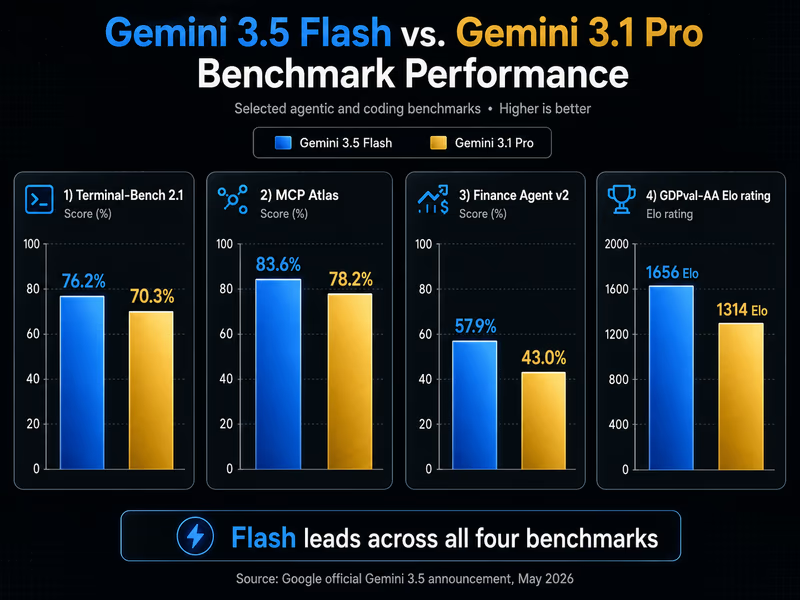
Historically, "Flash" or "Lite" models were heavily compromised versions of their "Pro" siblings—useful for basic classification, but inadequate for complex reasoning. Gemini 3.5 Flash shatters this tier system by outperforming its predecessor, Gemini 3.1 Pro, on core benchmarks that measure agentic capability:
* Terminal-Bench 2.1: Gemini 3.5 Flash scores 76.2% compared to Gemini 3.1 Pro’s 70.3%, showing superior facility with command-line environments.
* MCP Atlas: Scoring 83.6% against 78.2% for 3.1 Pro, demonstrating more robust model-context protocol handling.
* Finance Agent v2: Achieving 57.9% compared to 3.1 Pro’s 43.0%, representing a massive leap in multi-step financial reasoning.
* GDPval-AA: Securing an Elo rating of 1656 compared to 1314 for 3.1 Pro.
These numbers indicate that Google’s architectural focus has pivoted toward operational performance. As Nick Patience, VP and practice lead of AI platforms at The Futurum Group, explains: "With Gemini 3.5 Flash, Google is trying to signal that the frontier model race is increasingly about operational deployability, not just benchmark performance... That is a direct response to the inference economics pressure OpenAI and Anthropic are also navigating."
Overcoming the Execution Gap
Google's move is also a self-aware correction of its past missteps. Sundar Pichai candidly acknowledged that Google has historically been "a bit behind" the frontier on agentic coding, tool use, instruction following, and long-horizon tasks, attributing this gap to a lack of developer-facing surface area for coding products.
To bridge this chasm, Google is deeply embedding Gemini 3.5 Flash across its consumer and developer ecosystems. It is now the default engine powering the Gemini app and the new AI Mode in Google Search globally. It is also the brain behind Google’s revamped Antigravity development platform, its new CodeMender security agent, and the Gemini Spark personal assistant roll-out.
While competitors like xAI with Grok Build and Anthropic with their Claude updates focus on developer tooling, Google is leveraging its massive search infrastructure. Liz Reid, Google Search Chief, noted that the company has "combined the best of the search engine with the best of AI to build a true AI search experience that brings together advanced Gemini models, agent capabilities, and the full breadth of the world's information."
The Strategic Verdict
The launch of Gemini 3.5 Flash represents a tactical shift in the LLM wars. By refusing to participate solely in a race of raw model size, Google has chosen to dominate the battlefield of efficiency, cost, and developer utility.
For enterprise decision-makers, the lesson is clear: the future of AI integration does not lie in waiting for a trillion-parameter oracle to solve every problem. Instead, the future belongs to highly optimized, blisteringly fast, and economically sustainable models like Gemini 3.5 Flash that can run autonomously in the background without bankrupting the organization. Google has laid down the gauntlet; now, the rest of the industry must figure out how to match their math.