FBI Reports AI-Driven Cybercrime Surge as Annual Losses Top $20 Billion
The FBI's 2025 IC3 report reveals AI-related fraud exceeded $893 million, as total cybercrime losses hit a record $20.8 billion.
The Federal Bureau of Investigation has officially categorized "AI-related" incidents as a formal crime descriptor for the first time, revealing that artificial intelligence fueled nearly $900 million in reported fraud losses during 2025. The 2025 Internet Crime Report (IC3 Annual Report), released in April 2026, details a landscape where synthetic media and voice cloning are no longer emerging threats but established tools in the cybercriminal toolkit.
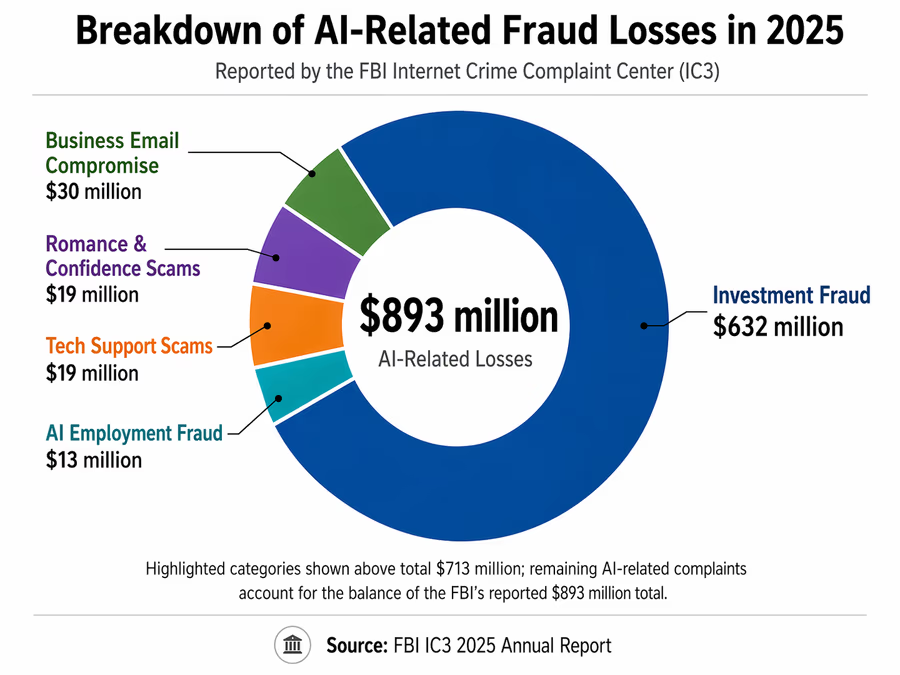
According to the report, the FBI received over 22,000 complaints specifically referencing the use of AI in 2025. Adjusted losses tied to these complaints exceeded $893 million, a figure the bureau describes as likely conservative. Because many victims are unable to recognize the presence of AI—particularly in sophisticated phishing or voice-based scams—the actual financial impact is suspected to be significantly higher.
The Rising Cost of Synthetic Deception
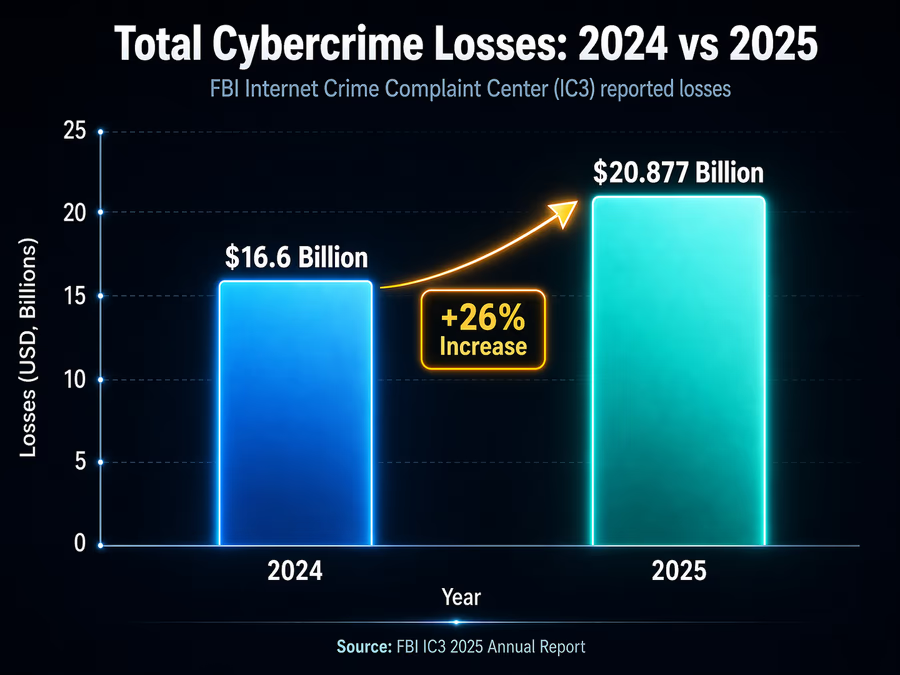
Overall cybercrime losses in 2025 surpassed $20 billion for the first time, reaching a staggering $20.877 billion across more than 1 million complaints. This represents a 26% increase from the $16.6 billion reported in 2024. While the total number of phishing complaints saw a slight dip, the financial damage associated with them tripled, suggesting that criminals are using AI to trade volume for high-precision, high-value targeting.
Investment fraud remains the primary driver of AI-enabled financial loss, accounting for approximately $632 million. Criminals are increasingly using deepfake video content and AI-generated scripts to build trust with victims in elaborate "pig butchering" schemes. Beyond investments, Business Email Compromise (BEC) with an AI nexus resulted in $30 million in losses, while romance and tech support scams each accounted for roughly $19 million.
Patricia Titus, Field CISO at Abnormal AI, emphasized the gravity of these findings. "$893 million in AI-enabled fraud. $3 billion from Business Email Compromise alone. $20.87 billion in total cybercrime losses in 2025. One million complaints filed," Titus noted. "And here's the part that should keep every security leader up at night: the FBI openly admits the AI-related number is almost certainly higher than reported, because most victims don't even realize AI was involved in the attack against them."
The Explosion of Voice Cloning and Employment Fraud
One of the most alarming trends identified in the report is the 400% jump in the use of voice cloning for fraud. This technology allows attackers to impersonate loved ones, executives, or government officials with terrifying accuracy. In one high-profile case from June 2025, a New York man was sentenced for his role in a grandparent scam that used AI to mimic a family member's voice to solicit emergency funds.
AI is also being leveraged to infiltrate corporate networks through employment fraud. The FBI recorded $13 million in losses from scams involving voice spoofing and deepfakes during online job interviews. In these scenarios, attackers use synthetic personas to secure remote positions, with the ultimate goal of gaining unauthorized access to internal systems and sensitive data.

Legislative and Proactive Responses
The FBI report notes that AI-enabled synthetic content is becoming increasingly difficult to detect and easier to create, which allows criminal actors to conduct successful fraud schemes against individuals and financial institutions alike. In response, the bureau has urged the public to “Take a Beat” to identify potential red flags, advising individuals to resist the manufactured urgency often present in digital scams.
On the legislative front, the rise of these technologies has prompted action in Washington. A bipartisan Senate bill, the AI Fraud Accountability Act, has been introduced to criminalize digital impersonation for fraudulent purposes, carrying a proposed sentence of up to three years. Additionally, Senator Maggie Hassan has recently reached out to major AI voice-cloning providers, including Meta, Microsoft, and Google, urging them to implement more rigorous safeguards.
Proactive operations have shown some success in mitigating these losses. Operation Level Up in 2024 reportedly saved victims over $500 million by identifying cryptocurrency fraud before transfers were finalized. In early 2026, the FBI launched Operation Winter SHIELD to provide organizations with updated frameworks for defending against AI-enhanced social engineering.
Future Implications
As we move deeper into 2026, the distinction between human and synthetic interaction will continue to blur. The 2025 IC3 data suggests that the inherent difficulty in detecting AI-generated content is the greatest challenge facing both law enforcement and the public. For organizations, the shift necessitates a move away from traditional security awareness toward a model that assumes any digital communication could be synthetically altered.
Unverified reports from within the law enforcement community suggest that internal FBI analysis believes the AI-related loss figure could be three to four times higher than the $893 million reported, as forensic tools struggle to keep pace with the mass production of phishing content via Phishing-as-a-Service (PhaaS) platforms. As AI tools become more accessible, the barrier to entry for launching sophisticated global fraud campaigns continues to fall, making public awareness and legislative accountability the primary lines of defense.