Open-Source Ascendant? DeepSeek V4's Code Prowess Challenges Proprietary AI Dominance
DeepSeek V4 Pro shatters the proprietary AI moat, matching Claude and GPT-5.5 at a fraction of the cost using open-weight architecture.
The economics of frontier artificial intelligence just collapsed, and the shockwaves are radiating directly out of Hangzhou. When DeepSeek dropped its V4 preview on April 24, 2026, it did not merely iterate on the open-weight paradigm; it fundamentally rewrote the rules of enterprise AI deployment. For years, the reigning narrative among Silicon Valley's elite was that building state-of-the-art models required a closed-loop monopoly: proprietary datasets, proprietary training pipelines, and, crucially, an endless firehose of capital poured into NVIDIA's proprietary hardware. DeepSeek V4 has exposed that narrative as a self-serving myth.
Funded by the quantitative hedge fund High-Flyer and guided by founder Liang Wenfeng, DeepSeek has established a reputation for achieving astronomical efficiency. The release of their R1 model in early 2025 triggered what venture capitalist Marc Andreessen aptly termed 'AI's Sputnik Moment.' That release, which proved a highly competitive model could be trained for a fraction of the traditional cost, sparked a global stock market correction that temporarily wiped out hundreds of billions of dollars in hardware valuation. If R1 was the warning shot, DeepSeek V4 is the direct hit. Released under the permissive MIT License, the V4 series offers open-weight, commercially viable models that go toe-to-toe with the most expensive closed-source APIs on Earth, while running on hardware that bypasses Western export restrictions entirely.
The Brutal Math of Algorithmic Parity
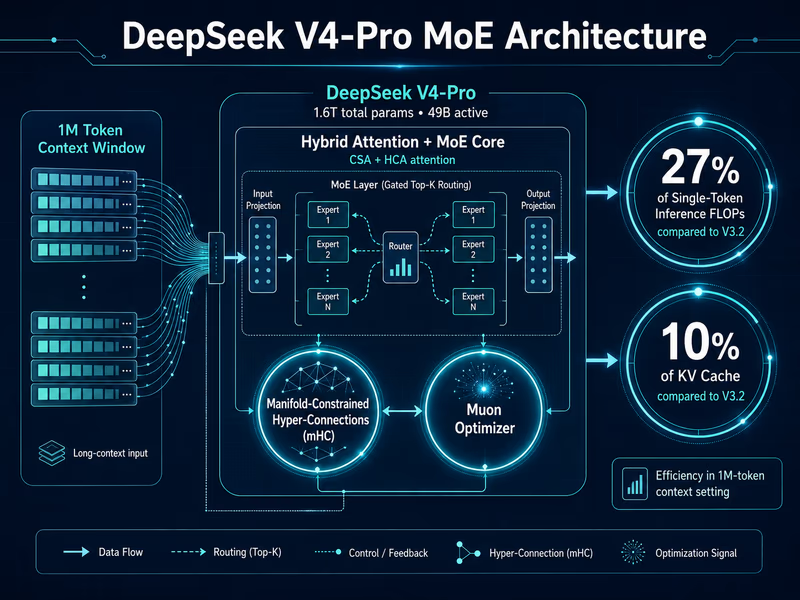
To understand the magnitude of this disruption, one must look past the marketing fluff and focus on the benchmarks. Coding has long been the ultimate litmus test for reasoning models—it requires logical consistency, long-range planning, and absolute precision. Historically, closed models like Anthropic's Claude and OpenAI's GPT series held an unchallenged monopoly here. DeepSeek V4 Pro, a Mixture-of-Experts (MoE) powerhouse boasting 1.6 trillion total parameters (with 49 billion active parameters per forward pass), has demolished that hierarchy.
On the grueling SWE-bench Verified benchmark, which measures an AI's ability to resolve real-world software issues in complex codebases, DeepSeek V4 Pro scored an astonishing 80.6%. This leaves it virtually indistinguishable from Anthropic's flagship Claude Opus 4.6, which squeaked ahead at 80.8%. More impressively, on LiveCodeBench—a dynamic test that prevents training set leakage by using fresh competitive programming problems—DeepSeek V4 Pro achieved 93.5%, leaving Claude Opus 4.6 in the dust at 88.8%. In the competitive coding arena of Codeforces, the V4-Pro-Max variant secured a 3206 Rating, eclipsing Gemini-3.1-Pro High and cementing its status in the Grandmaster tier.
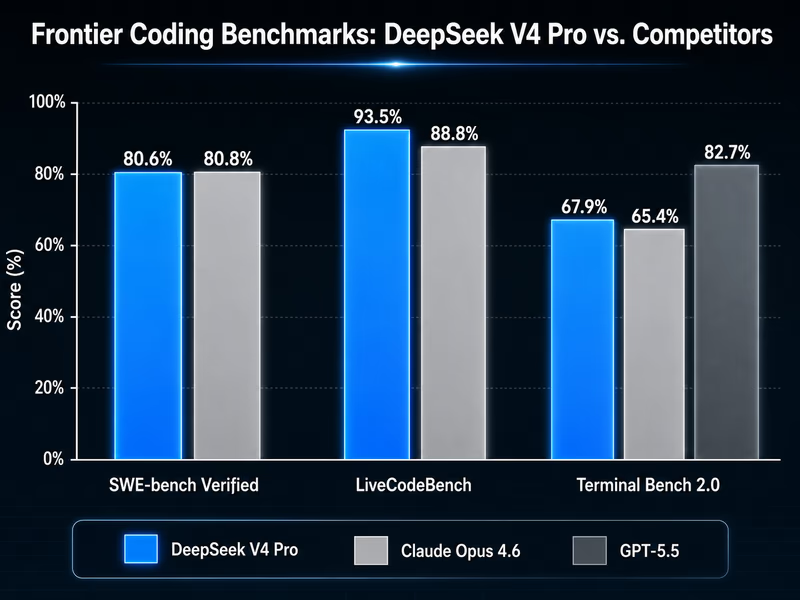
While OpenAI's GPT-5.5 still maintains an edge in system-level execution—scoring 82.7% on Terminal Bench 2.0 compared to DeepSeek's 67.9%—the gap is closing with terrifying speed. DeepSeek still easily outpaced Claude Opus 4.6 (65.4%) on that same terminal test. What we are witnessing is not a budget alternative; it is elite-tier performance delivered without the gatekeeping of a proprietary API.
Overcoming the Silicon Monopolies
Perhaps the most geopolitically significant aspect of DeepSeek V4's development is its training pedigree. Amidst intense trade tensions and strict export controls designed to starve Chinese firms of high-end Western silicon, DeepSeek trained V4 extensively on Huawei Ascend 950PR chips.
This is a massive blow to the assumption that frontier AI is a game that can only be played on NVIDIA's high-end Blackwell or H100 architectures. While unverified rumors circulated that smuggled Western silicon might have played a minor role—claims that NVIDIA itself dismissed as 'far-fetched'—the official, documented partnership with Huawei proves that algorithmic efficiency can successfully bypass hardware bottlenecks.
By leveraging architectural innovations like Manifold-Constrained Hyper-Connections (mHC) and the proprietary Muon Optimizer, DeepSeek's engineers stabilized their training runs and extracted maximum utility from domestic hardware. This focus on efficiency carries over directly to inference: for a massive 1-million (1M) token context window, DeepSeek-V4-Pro requires a mere 27% of the single-token inference FLOPs and only 10% of the KV cache compared to its predecessor, V3.2. It turns out that when you cannot simply throw infinite GPUs at a problem, you are forced to build smarter architecture.
The Paradigm Shift in Enterprise Economics
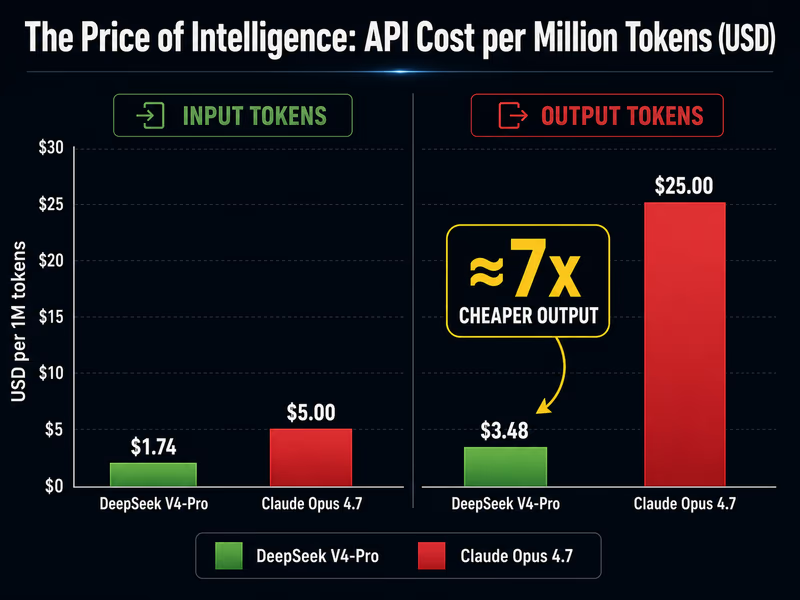
For developers and enterprise decision-makers, the technical achievements of DeepSeek V4 are impressive, but the financial implications are revolutionary. The cost of running high-context, proprietary models has been a massive barrier to widespread AI integration. Anthropic's Claude Opus 4.7 charges roughly $5.00 per million input tokens and a staggering $25.00 per million output tokens.
Now, look at the economics of DeepSeek V4-Pro. Its API pricing sits at approximately $1.74 per million input tokens (on a cache miss) and $3.48 per million output tokens. This represents a 7-fold reduction in output token costs compared to its Western rival. When scaled across millions of daily operations, a 700% cost reduction changes projects from financially unviable to highly profitable overnight.
Because DeepSeek V4 is released under the MIT License, enterprises do not even have to rely on DeepSeek's APIs. They can download the weights, host the model on their own infrastructure, and fine-tune it on proprietary data without risking intellectual property leakage. This completely mitigates the threat of vendor lock-in, data privacy violations, and sudden API price hikes that have plagued early adopters of closed-source AI.
A Hybrid Future Dominated by the Open-Weight Alliance
We are entering an era of deep pragmatism in artificial intelligence. The romantic notion of a single, omniscient, closed-source superintelligence hosted in a centralized cloud is giving way to a highly distributed, hybrid ecosystem. In this new world, highly specialized, open-weight models like the DeepSeek V4 series, Meta's Llama, and Mistral will handle the heavy lifting of enterprise automation, coding, and private data processing.
DeepSeek’s trajectory—from its founding in July 2023 to a projected $10 billion valuation in 2026—proves that the center of gravity in AI development has shifted. By democratizing elite-level coding capabilities and proving that frontier performance can be achieved on non-Western hardware at a fraction of the historical cost, DeepSeek has not just challenged proprietary AI dominance. It has rendered the concept of a proprietary moat obsolete.