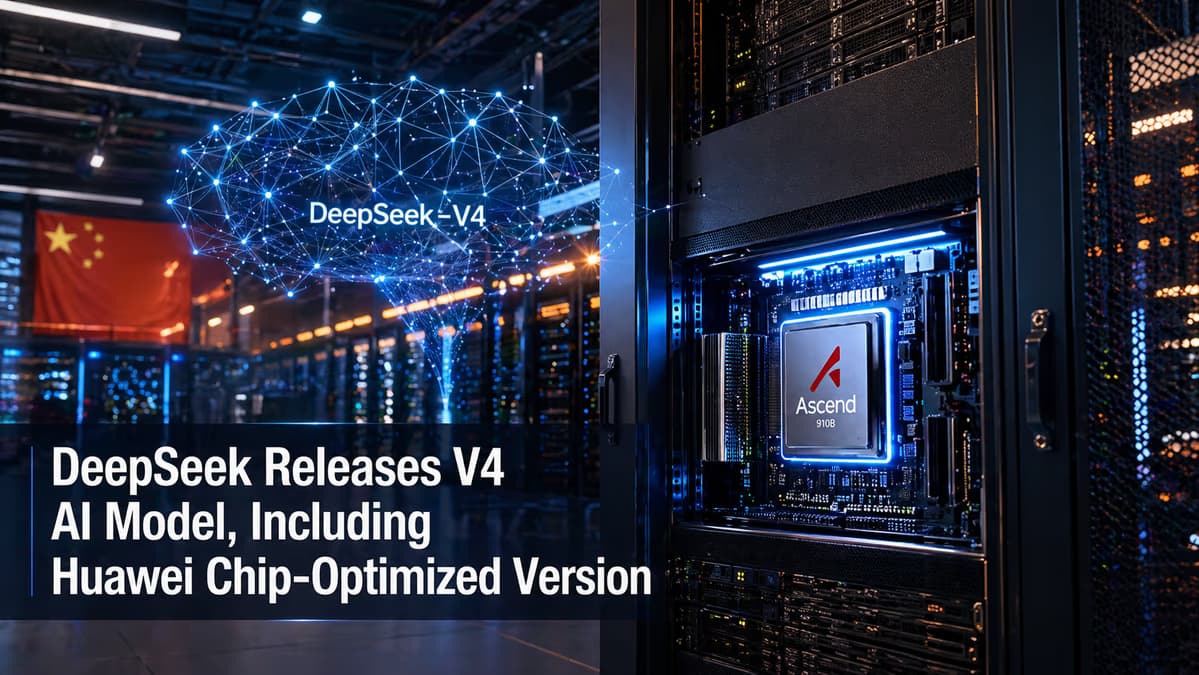
DeepSeek Releases V4 AI Model with Specialized Optimization for Huawei Hardware
DeepSeek launches V4 AI models featuring specialized Huawei chip optimization, signaling a major step in China’s quest for AI self-sufficiency.
DeepSeek Unveils V4 and V4-Flash Models
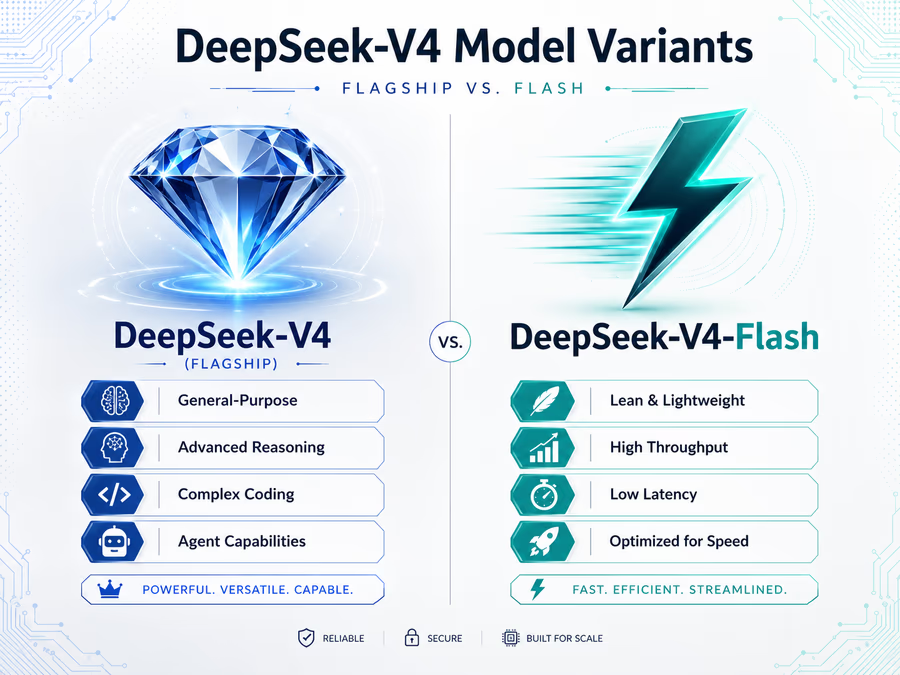
Chinese research institute DeepSeek has launched preview versions of its latest artificial intelligence model, DeepSeek-V4, featuring a specialized variant designed to run optimally on Huawei’s Ascend chip architecture. Released in April 2024, the rollout includes two distinct versions: a flagship "pro" model known as DeepSeek-V4 and a lightweight, high-speed variant dubbed DeepSeek-V4-Flash. This release marks a significant milestone for the firm, which was founded by the quantitative trading organization DeepQuant, as it seeks to bridge the gap between Chinese domestic AI capabilities and leading Western models.
The flagship DeepSeek-V4 is designed as a general-purpose powerhouse with specific advancements in complex reasoning, coding, and autonomous agent capabilities. Meanwhile, the V4-Flash model targets applications requiring high throughput and low latency, offering a lean alternative for developers prioritizing speed and efficiency. Both models are being positioned as open-source contributions to the global AI community, a move intended to foster a robust developer ecosystem within and beyond China.
Challenging the Global Hierarchy
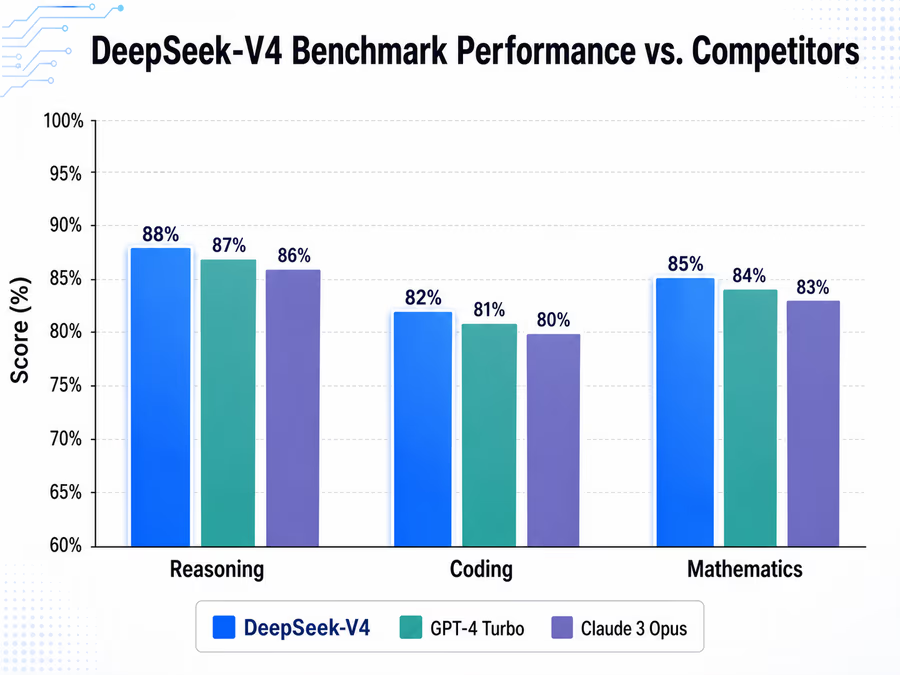
DeepSeek has made bold claims regarding the performance of its latest iteration. According to official announcements from the firm, DeepSeek-V4 significantly improves reasoning, knowledge, coding, mathematics, and agent capabilities, and achieves strong competitiveness against leading US models like GPT-4 Turbo and Claude 3 Opus on various benchmarks. While these claims remain subject to independent verification by the broader research community, they signal an aggressive push by Chinese firms to compete at the highest levels of large language model (LLM) development.
The ability to rival GPT-4 Turbo is particularly noteworthy, as it suggests that the gap in model architecture and training efficiency between Silicon Valley and Chinese research labs may be narrowing. DeepSeek’s focus on autonomous task execution—or "agent" capabilities—reflects a broader industry trend toward AI systems that do not just generate text but can actively solve multi-step problems and interact with software environments.
A Strategic Move Toward Hardware Independence
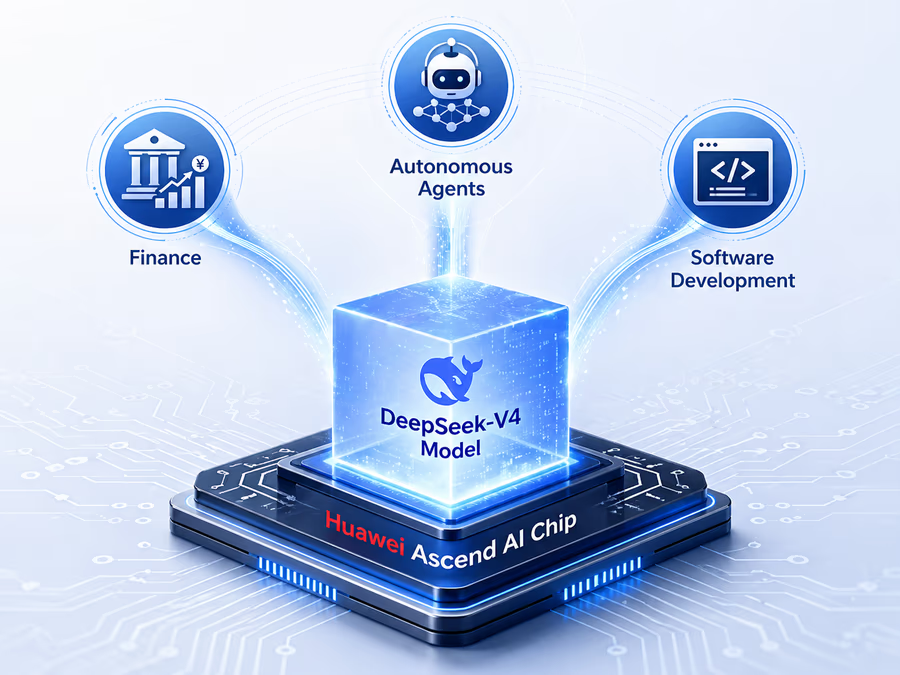
Perhaps the most impactful aspect of the release is the version of DeepSeek-V4 specifically optimized for Huawei’s Ascend AI technology. This development is a direct response to the tightening of global semiconductor export controls, which have limited the availability of high-end hardware from manufacturers like Nvidia. By tailoring its software to domestic hardware, DeepSeek is helping to build a self-contained AI ecosystem that is less vulnerable to international supply chain disruptions.
Industry analysts suggest that the release of the Huawei Ascend-optimized version is a significant step towards China's AI self-sufficiency. This sentiment is echoed by the broader strategic landscape in China, where tech giants like Baidu, Alibaba, and Tencent are also pouring resources into domestic infrastructure. Huawei has been particularly active in this space, positioning its Ascend 910B chip as a viable alternative to Western GPUs for training and deploying sophisticated LLMs.
Implications for the AI Ecosystem
The dual-pronged approach of releasing an open-source model alongside hardware-specific optimizations could have lasting effects on how AI is developed in the region. For Chinese developers, the availability of a model that is "pre-tuned" for domestic silicon reduces the technical debt and performance overhead usually associated with running state-of-the-art AI on non-standard hardware. This could accelerate the deployment of AI in sectors ranging from finance—DeepSeek’s parent company’s specialty—to manufacturing and autonomous systems.
Furthermore, the open-source nature of the V4 family serves as a strategic counter-maneuver to the proprietary models of OpenAI and Anthropic. By allowing others to build upon their work, DeepSeek increases its influence and ensures its architecture becomes a standard in the emerging Chinese AI landscape. This transparency also invites global collaboration, potentially leading to faster innovation in model optimization and lean training techniques.
The Path Ahead
As DeepSeek moves beyond the preview phase of V4, the focus will likely shift to real-world deployment and the validation of its benchmark claims. If the Huawei-optimized version delivers on its performance promises, it could serve as a blueprint for other Chinese AI labs looking to decouple from Western hardware. The competition is not just about who has the smartest model, but who can run that model most efficiently on the hardware they have access to.
The global AI race is increasingly becoming a battle of integration. While US firms currently lead in raw model performance and access to cutting-edge chips, the DeepSeek V4 release demonstrates that Chinese firms are becoming adept at vertical integration—tightly coupling their algorithms with domestic hardware to maximize every cycle of compute power. This evolution suggests a future where the AI landscape is split into distinct technological stacks, each with its own hardware foundations and software standards.