DeepSeek Permanently Slashes V4 Pro Pricing by 75%, Escalating AI Price War
DeepSeek permanently slashes its flagship V4 Pro API pricing by 75%, intensifying the global AI price war and altering enterprise unit economics.
Hangzhou-based AI startup DeepSeek has permanently reduced the pricing of its flagship V4 Pro model by 75 percent. The pricing adjustment officially took effect on May 31, 2026, at 15:59 UTC, turning what was originally introduced as a temporary promotional discount into a permanent pricing structure. The strategic price cut heavily undercuts Western frontier AI models and signals a major escalation in the global industry price war.
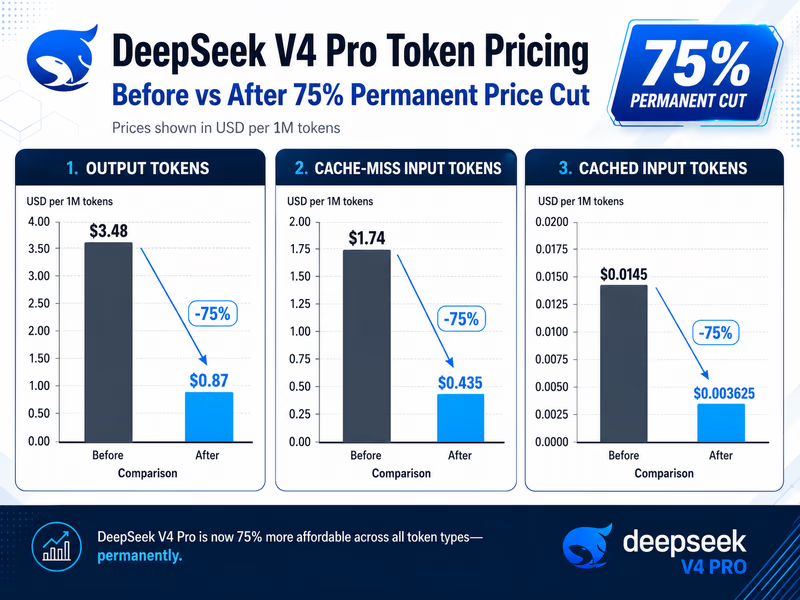
Under the newly finalized pricing model, DeepSeek V4 Pro output tokens are priced at $0.87 per million, down from the original price of $3.48. Cache-miss input tokens have fallen to $0.435 per million, compared to the original launch price of $1.74, while cached input tokens are now priced at an ultra-low rate of $0.003625 per million, down from $0.0145. These price reductions apply directly to the V4 Pro model, which boasts a massive 1-million-token context window and a maximum output capacity of 384,000 tokens.
Driving Down the Cost of High-Context Compute
According to industry experts, DeepSeek’s ability to maintain these aggressive price cuts stems from fundamental improvements in model architecture rather than short-term market discounting.
"V4-Pro was engineered to cut the cost of long-context inference, reportedly running at roughly a quarter of the single-token compute and a tenth of the memory footprint of its predecessor at very long context," said Sanchit Vir Gogia, Chief Analyst and CEO at Greyhound Research. "This is why the price cut is permanent rather than promotional. It is not a discount. It is an efficiency gain being passed through."
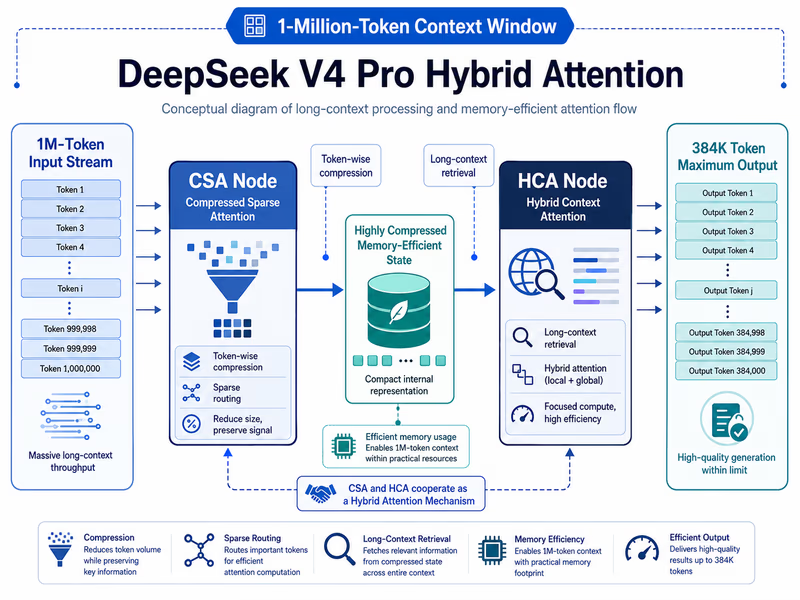
In company statements, DeepSeek described its V4 generation as welcoming the era of cost-effective 1-million context length. This efficiency is largely attributed to the introduction of a novel Hybrid Attention mechanism, which combines Compressed Sparse Attention (CSA) and Hybrid Context Attention (HCA). This architecture is specifically designed for ultra-high context efficiency, drastically reducing the physical computational overhead required to process massive documents, codebases, or complex multi-turn conversations.
Disrupting the Western AI Monopolies
DeepSeek’s pricing strategy places substantial pressure on prominent Western AI providers, including OpenAI, Anthropic, and Google. By offering a frontier-adjacent model at a fraction of the cost, DeepSeek presents a highly attractive alternative to OpenAI’s GPT-5, Anthropic’s Claude Opus 4.7, and Google’s Gemini 3.5 Flash.
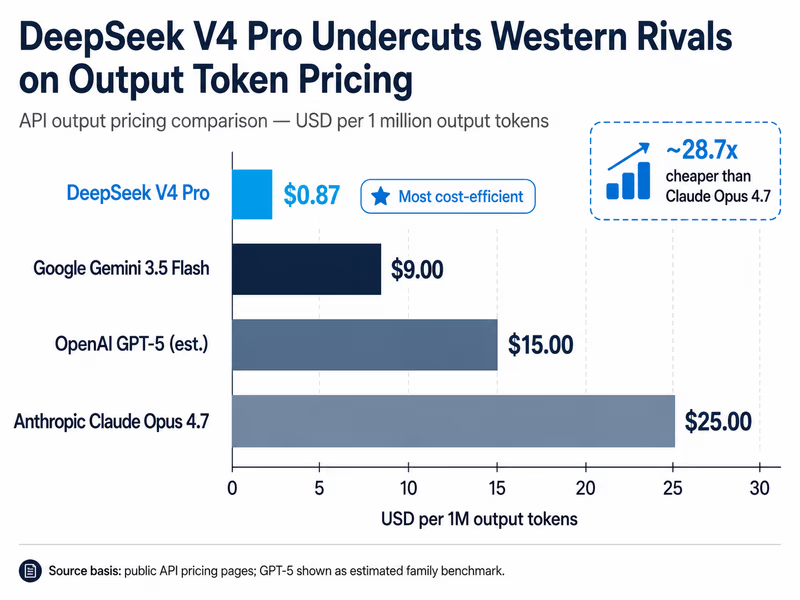
This pricing pressure is already driving strategic shifts among competitors. Google has consistently lowered the prices of its Gemini models to remain competitive, while OpenAI has begun focusing more heavily on consumer platform features and advertising, indicating an industry-wide recognition that raw API token revenue may not sustain previous valuations. Meanwhile, geopolitical and technical considerations remain a focal point; Anthropic has previously accused DeepSeek of utilizing "distillation attacks" to train its models on Claude’s outputs, highlighting the friction between the competing developers.
Additionally, there are unverified reports in the industry suggesting that DeepSeek has optimized its underlying infrastructure to run on Huawei's Ascend 950 supernodes. If true, this optimization allows the Hangzhou startup to bypass the expensive "Nvidia tax" imposed by US export controls on high-end hardware, giving DeepSeek a unique structural cost advantage in training and running its cluster.
The Dilemma for Enterprise Buyers
For enterprise buyers, Chief Technology Officers, and developers, the permanent 75 percent price cut fundamentally changes the unit economics of AI-driven application development. High-volume and agentic workloads, which were previously cost-prohibitive due to compounding token fees, are now financially viable. DeepSeek also maintains full API compatibility with both OpenAI ChatCompletions and Anthropic API formats, allowing developers to switch models with minimal engineering friction. Because the V4 models are open-source and released under the permissive MIT License, companies also have the option of local deployment.
However, enterprise adoption is not without hurdles. Decision-makers must weigh the extreme cost savings against the potential geopolitical and technical risks associated with routing sensitive proprietary data through a Chinese AI provider. For highly regulated industries such as finance, healthcare, and defense, these security concerns may outweigh the economic benefits.
Looking Ahead
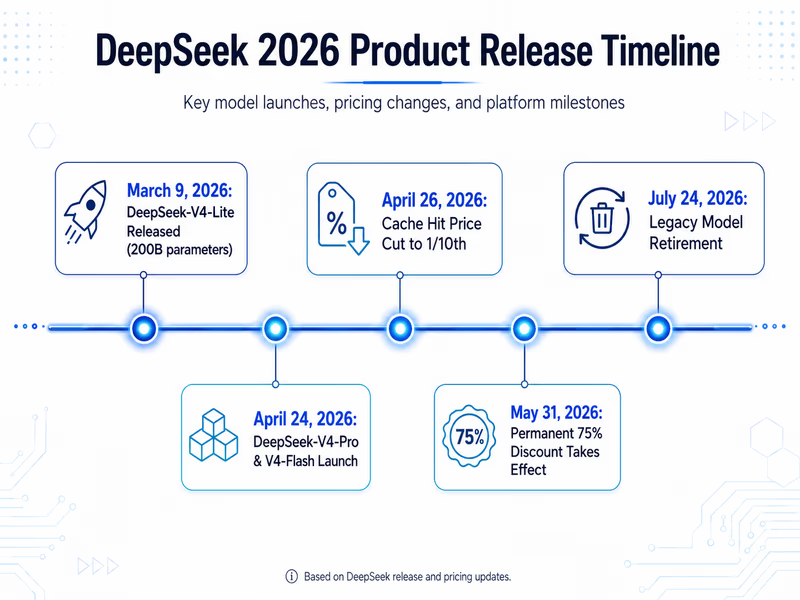
DeepSeek’s aggressive road map continues to push the rest of the industry forward. The V4 generation originally previewed on April 24, 2026, alongside DeepSeek-V4-Flash. Just two days later, on April 26, the company reduced its input cache hit prices to a tenth of their initial launch rates.
As the company cleans up its portfolio, legacy models deepseek-chat and deepseek-reasoner are scheduled for full retirement on July 24, 2026, at 15:59 UTC, at which point they will become completely inaccessible. The transition marks a complete pivot to the highly optimized V4 architecture, solidifying a new baseline for what developers can expect to pay for high-performance, long-context LLMs.