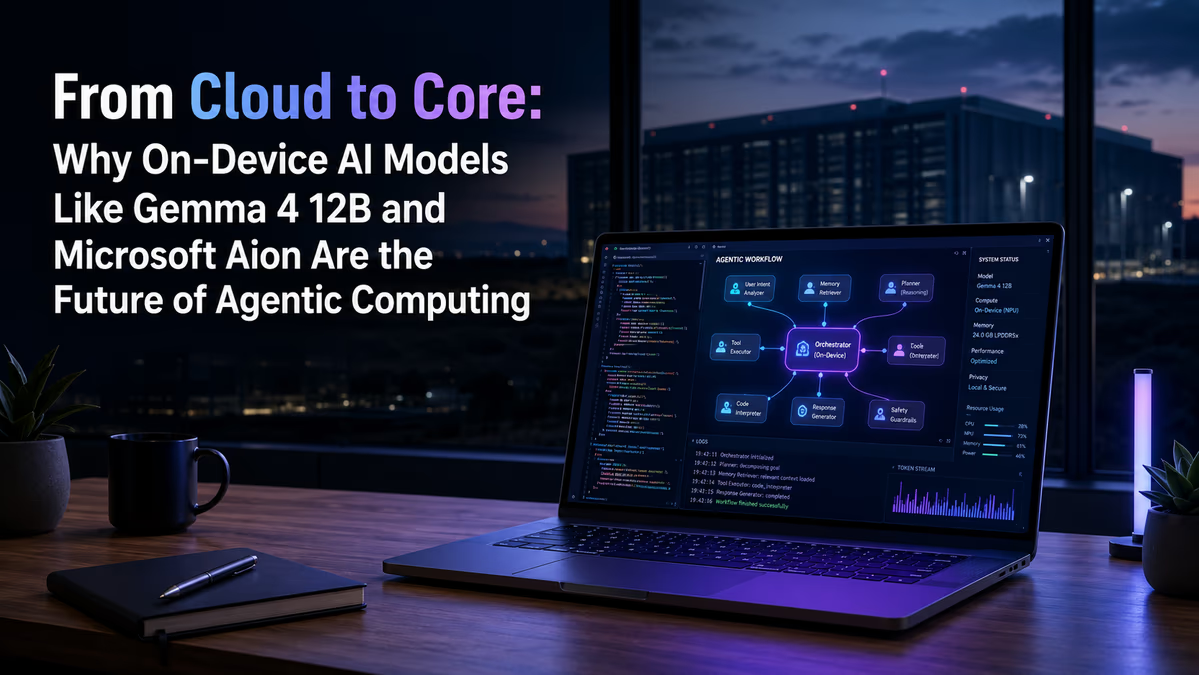
The Death of the Cloud API: Why Gemma 4 and Microsoft Aion Represent the True Beginning of the Agentic Era
How Google's Gemma 4 12B and Microsoft's Aion models are shifting AI from expensive cloud servers to local, private agentic loops on our laptops.
The economic fantasy of the cloud-first AI bubble is officially cracking. For the past three years, the industry has operated under a collective delusion: that every micro-interaction, every automated email draft, and every multi-step digital workflow must be routed through a multi-billion-dollar data center in Virginia or Iowa. This architecture is not only unsustainable; it is an active bottleneck for the next major phase of artificial intelligence: agentic computing.
An AI agent is not a chatbot. It does not sit patiently waiting for a single prompt, offer a single response, and go to sleep. Agents plan, loop, reason, call external APIs, self-correct, and execute complex workflows over minutes or hours. If an agent has to make fifty sequential cloud calls to accomplish a single task, the latency becomes intolerable, the data privacy risks multiply exponentially, and the API bill will quickly bankrupt the enterprise deploying it.
This is why the events of early June 2026 represent a massive paradigm shift. With the simultaneous arrivals of Google DeepMind’s Gemma 4 12B and Microsoft’s Aion line of on-device models, the gravity of AI development is rapidly shifting from the cloud to the core. We are entering the era of zero-marginal-cost intelligence, executed entirely on the silicon sitting right under our fingertips.
The Architectural Pivot: Google's Gemma 4 12B
Google DeepMind’s official release of Gemma 4 12B on June 3, 2026, is a masterclass in local optimization. Historically, running a multimodal model—one capable of understanding text, images, and audio—on a standard consumer laptop was a pipe dream. You either had to run multiple specialized models in parallel, eating up precious VRAM, or compromise on quality.
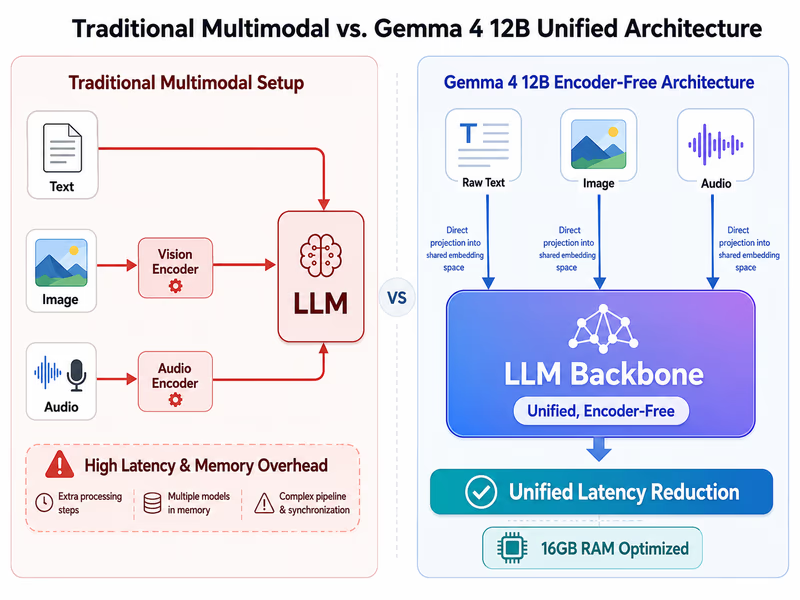
Gemma 4 12B solves this through a brilliant unified, encoder-free architecture. By natively processing text, images, and audio directly into its primary large language model (LLM) backbone, it bypasses the need for separate heavy encoders. The practical result? Drastically reduced latency, a significantly lighter memory footprint, and the ability to run smoothly on standard laptops equipped with at least 16GB of RAM or VRAM.
As Lian Jye Su, an analyst at Omdia, noted, this unique architecture "helps with the model running very efficiently on limited resources." It means a developer on a standard consumer laptop can build and experiment with local, multimodal agents without paying a single cent to a cloud provider. Better yet, because Google released Gemma 4 12B under the permissive Apache 2.0 license, enterprises have complete commercial freedom to modify, package, and deploy these local agents at scale.
This isn't an academic exercise. Google is shipping these models with actual runtime tools like the Google AI Edge stack, including macOS applications like Google AI Edge Gallery and the voice dictation tool Eloquent. This isn't a future promise—it is highly functional, local, multimodal AI running today.
Microsoft’s Windows Play: The Local Agentic Loop
Not to be outdone on its own home turf, Microsoft used its Build 2026 conference to position Windows 11 as the definitive operating system for AI agents. Rather than funneling developers back into Azure, Microsoft took a surprisingly pragmatist path, introducing its new Aion line of on-device models optimized to run locally across CPUs, discrete GPUs, and Neural Processing Units (NPUs).
Microsoft’s strategy relies on a two-pronged approach. First is Aion 1.0 Instruct, a highly optimized small language model (SLM) tailored for rapid-fire chat, text generation, and local summarization (set for an open-source release on Hugging Face in July 2026). The second, and far more intriguing development, is Aion 1.0 Plan.
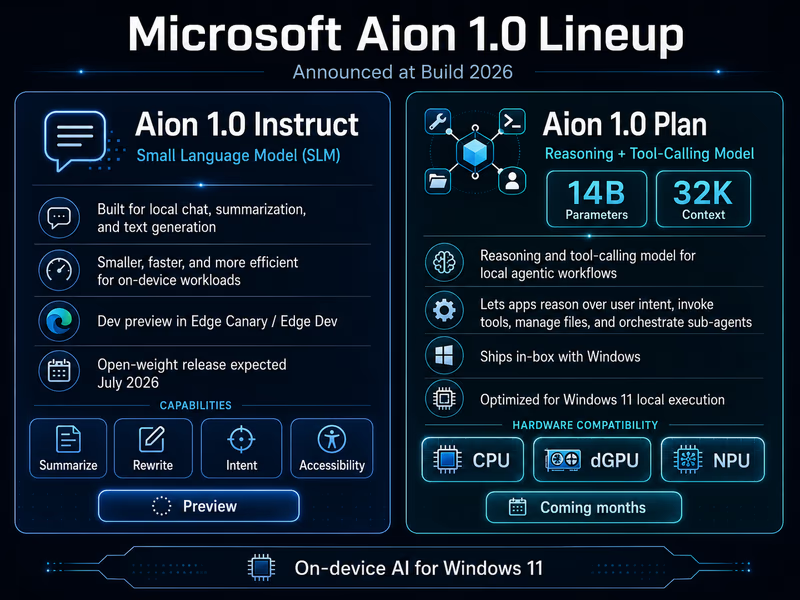
Aion 1.0 Plan is a 14-billion-parameter reasoning and tool-calling powerhouse boasting a 32K context length. It is designed to act as the cognitive engine for local agentic workflows. By running directly on Windows 11 hardware, Aion 1.0 Plan allows developers to build systems that can execute multi-step tasks, interact with desktop apps, and manage background workflows without ever pinging an external server.
Microsoft CEO Satya Nadella summarized this shift perfectly, stating that Aion 1.0 Instruct and Aion 1.0 Plan work in tandem to form a "full local agentic loop without having to round trip to the cloud."
By building this infrastructure directly into Windows, Microsoft is sending a clear message to the software ecosystem. In the words of Gartner analyst Ed Andersen, "Microsoft is trying to communicate to the developer audience in particular that it is the best place for them to come and build their AI agents."
The Unforgiving Economics of Agentic Computing
To understand why this shift is inevitable, one only has to look at the balance sheets of modern AI startups. The prevailing SaaS model of paying per token to a centralized API provider like OpenAI or Anthropic works fine for simple, search-like queries. But when an autonomous agent is tasked with "researching competitors, compiling a report, and updating the CRM," it may run hundreds of thousands of tokens through a model just to produce a single output.
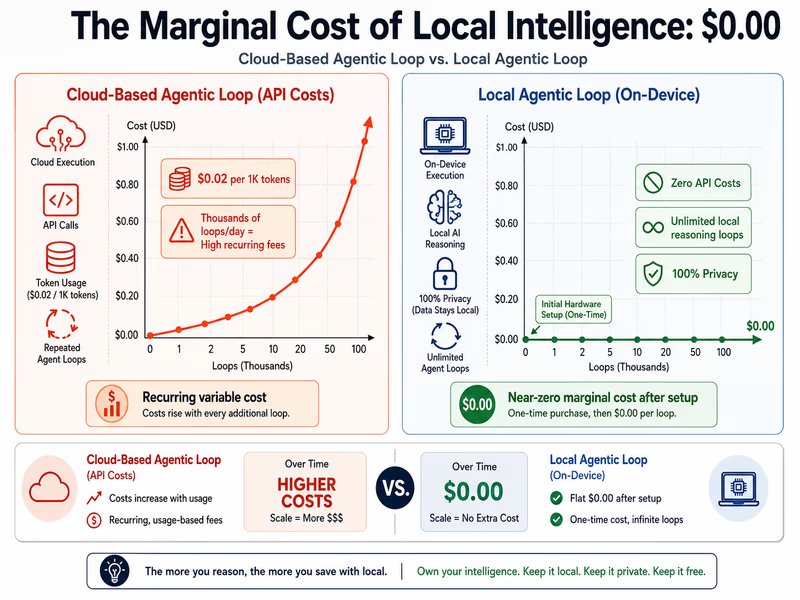
If that processing happens in the cloud, the unit economics of the product collapse. If that processing happens on the user’s local GPU or NPU, the marginal cost of that agent’s reasoning steps drops to exactly zero.
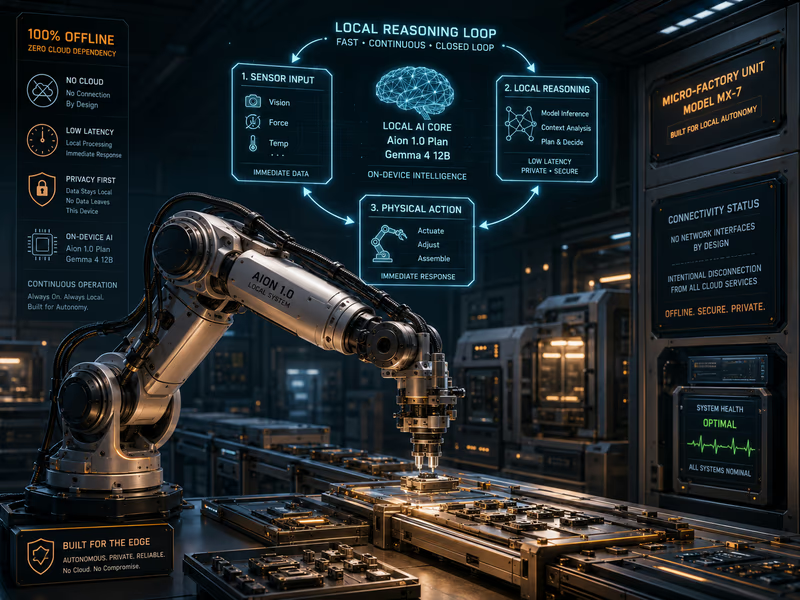
Furthermore, agentic computing in fields like robotics and Internet of Things (IoT) demands offline reliability. If an industrial robot arm relying on adaptive intelligence loses its Wi-Fi connection for even a fraction of a second, the entire assembly line halts. By running models like Aion 1.0 Plan or Gemma 4 12B locally, physical systems gain continuous operation, bulletproof security, and sub-millisecond feedback loops. This is precisely why we are seeing Microsoft partner with robotics firms like Richtech Robotics to embed this adaptive local intelligence directly into physical hardware.
The New Battleground: Local Runtimes
The broader Gemma 4 family—ranging from lightweight 2B models to beefier 31B variants—has already reportedly surpassed 150 million downloads since its initial family introduction in April 2026. This is a staggering indicator of where developer sentiment actually lies. Developers do not want to be locked into proprietary cloud APIs that can change, get more expensive, or suffer from downtime. They want digital sovereignty.
We are witnessing the democratization of high-tier intelligence. The next generation of breakthrough software won't be built by companies with the largest cloud budgets, but by developers who can wring the absolute most performance out of local silicon. Google and Microsoft have fired the opening salvos in this local AI war. As NPUs become standard in consumer hardware, the cloud will increasingly be relegated to what it was always meant to be: a backup and storage solution, not the brain.