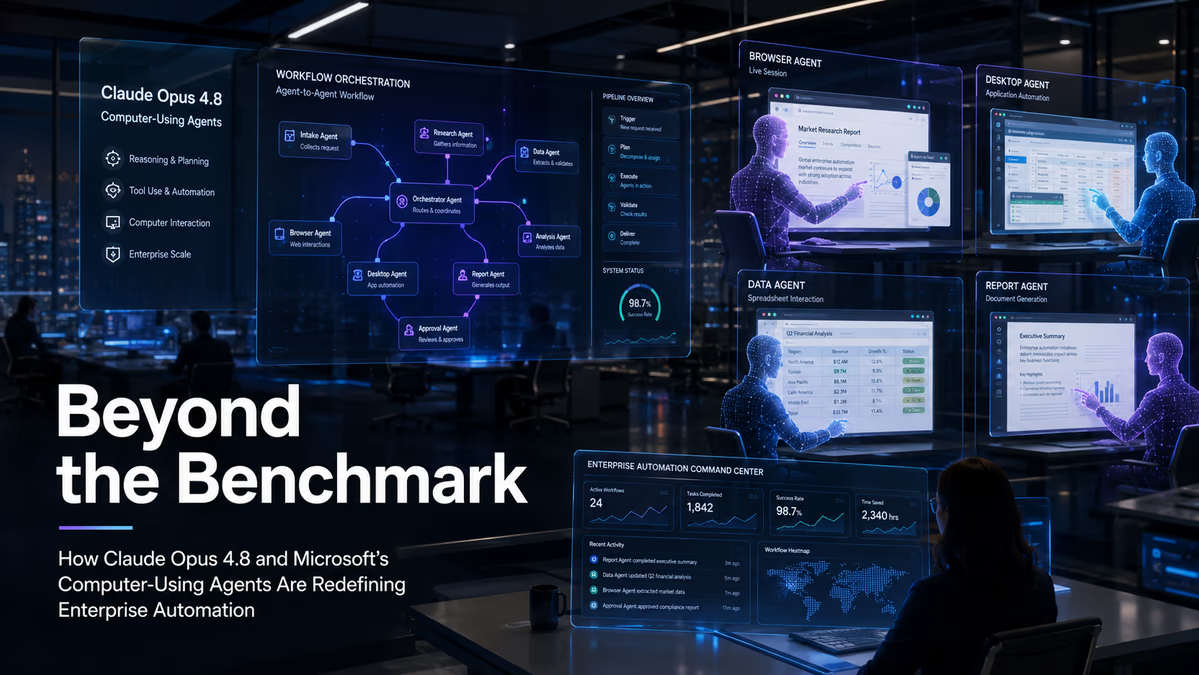
Beyond the Benchmark: How Claude Opus 4.8 and Microsoft's Computer-Using Agents Are Redefining Enterprise Automation
Discover how Claude Opus 4.8 and Microsoft Copilot Studio are shifting enterprise automation from brittle APIs to autonomous digital coworkers.
The multi-million dollar enterprise software integration backlog is about to evaporate, and not because of some breakthrough in API engineering. Instead, we are entering an era where software interfaces are navigated not by humans, but by autonomous digital employees. For decades, Chief Information Officers have poured fortunes into Robotic Process Automation (RPA) and custom middleware, trying to force disparate systems to talk to one another. It was a brittle, expensive approach to automation that shattered the moment a vendor updated a user interface or changed a database schema.
That era is officially over. The simultaneous maturation of Anthropic’s Claude Opus 4.8 and Microsoft Copilot Studio’s computer-using agents has quietly rewritten the rules of corporate productivity. We are no longer talking about passive chatbots that summarize documents; we are witnessing the birth of the active "digital coworker" capable of operating complex desktop environments just like a human worker.
Claude Opus 4.8: The Engine of Agentic Reason
On May 28, 2026, Anthropic launched Claude Opus 4.8, a model specifically optimized for agentic operations, multidisciplinary reasoning, and financial analysis. While the AI community routinely obsessively tracks benchmark updates, the real story lies in how Claude Opus 4.8 translates raw intelligence into production-grade execution.
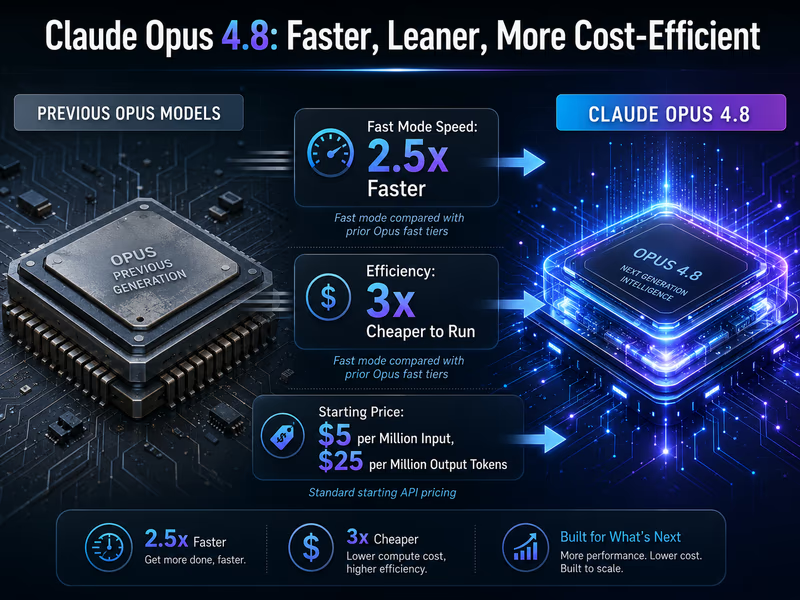
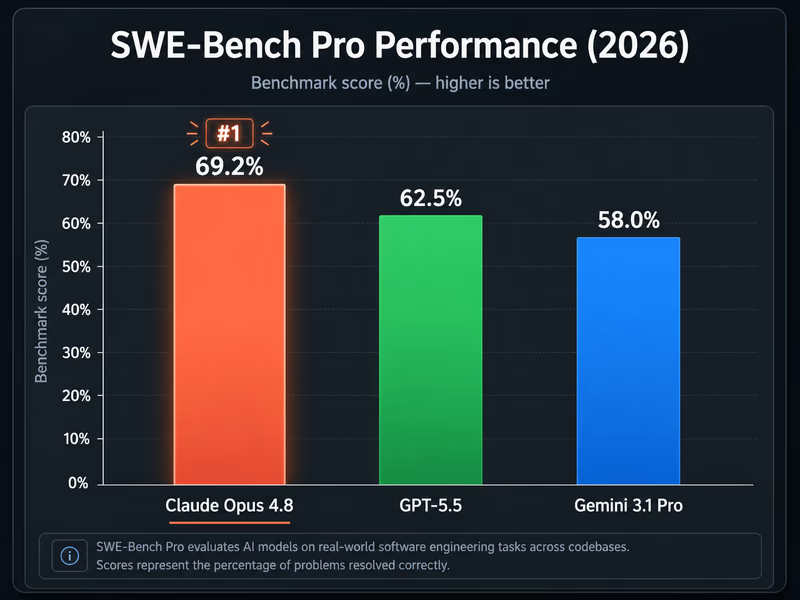
Opus 4.8 scored a stellar 69.2% on the SWE-Bench Pro benchmark, comfortably outpacing OpenAI’s GPT-5.5 and Google’s Gemini 3.1 Pro. But benchmarks only tell part of the story. The true leap is economic and behavioral. Anthropic has optimized this model's fast mode to run at 2.5 times the speed of its predecessor while slashing the cost of running it threefold. With pricing starting at $5 per million input tokens and $25 per million output tokens, the unit economics of deploying agentic reasoning at scale have finally crossed the threshold of mainstream corporate viability.
This is not just faster, cheaper math; it is a fundamental shift in reliability. Kay Zhu, Co-Founder and CTO of an agentic tooling startup, noted the paradigm shift on their proprietary test suite: “On our Super-Agent benchmark, Claude Opus 4.8 is the only model to complete every case end-to-end, beating prior Opus models and GPT-5.5 at parity on cost. For agent products in translation, deep research, slide-building, and analysis, it delivers powerful reliability.”
Crucially, this reliability stems from self-correction. “Claude Opus 4.8 has noticeably better judgment,” explains Tom Pritchard, a Staff Engineer working closely with Claude Code. “In Claude Code, it asks the right questions, catches its own mistakes, pushes back when a plan isn't sound, and builds up confidence around complex, multi-service explorations before making big changes.”
Microsoft's Moat: Distribution and Action Governance
If Anthropic has built the intellectual engine, Microsoft has built the steering wheel and chassis. On May 13, 2026, Microsoft Copilot Studio achieved general availability (GA) for its computer-using agents across all commercial Power Platform geographies.
By allowing AI agents to interact directly with websites and legacy desktop applications through the user interface, Microsoft is routing around the API bottleneck entirely. As Charles Lamanna, President of Business Applications and Agents at Microsoft, bluntly summarized: “If a person can use the app, the agent can too.”
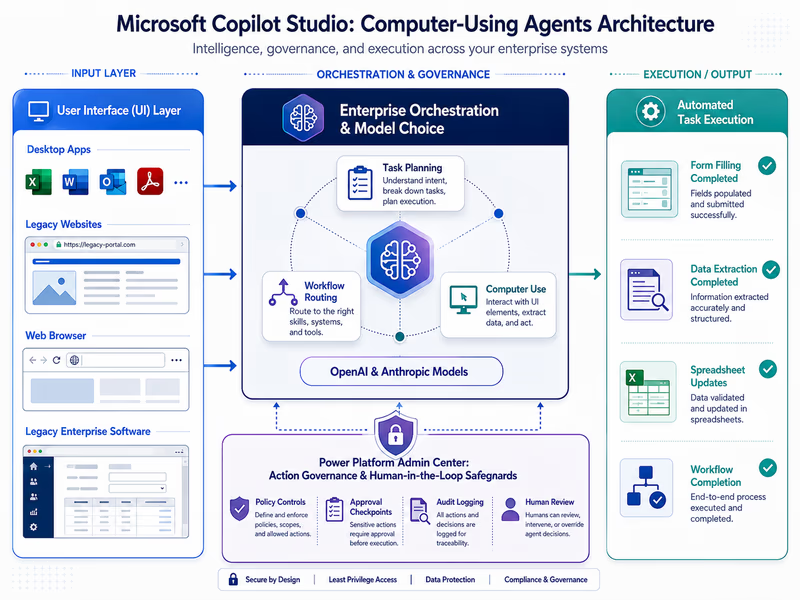
This capability democratizes enterprise automation. Processes that previously lacked APIs—such as entering data into twenty-year-old green-screen mainframes or navigating fragmented local government websites—can now be automated by drawing on the same UI elements humans use. Crucially, Microsoft has wrapped this capability in the enterprise-grade governance of the Power Platform, incorporating secure authentication, strict model selection boundaries, and human-in-the-loop check-points for critical, irreversible decisions.
Furthermore, Microsoft has added agent-to-agent (A2A) communication and real-time voice integration via Dynamics 365 Contact Center. An organization is no longer deploying isolated, single-task scripts. Instead, they are building a collaborative ecosystem where a voice-based agent can gather customer details, hand the task over to a research agent powered by Claude Opus 4.8, and dispatch a third transaction-focused agent to update the company’s legacy CRM.
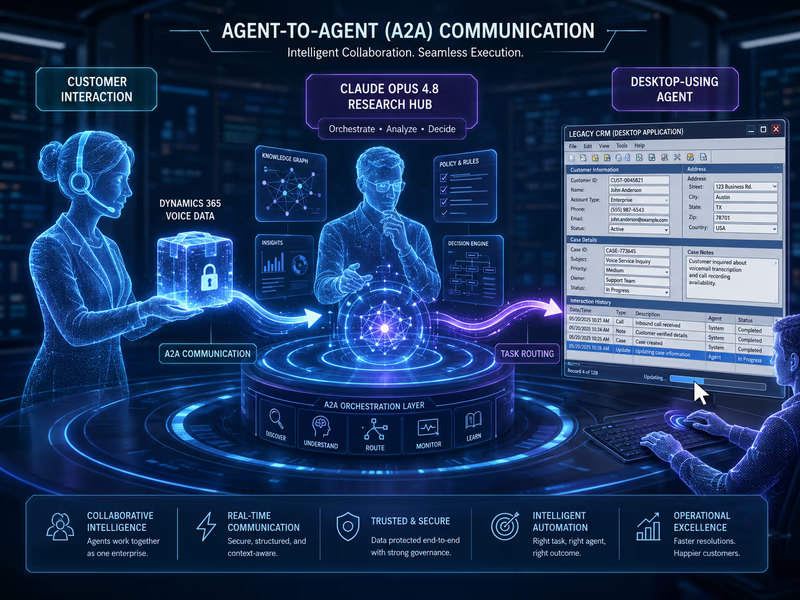
As Mitch Ashley, VP and Practice Lead of Software Lifecycle Engineering at The Futurum Group, points out: “General availability in Copilot Studio repositions the conversation from integration backlog to action governance, and model choice across OpenAI and Anthropic confirms that competitive value sits at the operating layer.”
The Rise of the "Hire, Don't Buy" Philosophy
This shift is fundamentally reshaping how enterprises look at procurement. For the last twenty years, the standard playbook was to buy SaaS applications and spend twice as much integrating them. Under the emerging "Hire, Don't Buy" philosophy, companies are looking to add digital team members rather than acquiring more software.
Traditional RPA was brittle because it was blind; it followed coordinates on a screen. Modern computer-using agents, however, possess semantic understanding. They understand that a "Submit" button is still a "Submit" button, even if it is blue instead of green, or if it has moved to the left side of the page. This eliminates the maintenance overhead that doomed early automation initiatives.
“Recent enhancements focus on making it easier to move from building an agent to running one confidently across complex, dynamic environments, with consistent quality and the ability to evolve as business needs change,” says Nitasha Chopra, VP & COO of Microsoft Copilot Studio.
The Road Ahead: Mythos-Class and the Operating Layer
While Microsoft holds a clear production lead with its GA deployment, the broader battle has only begun. Anthropic's Claude Computer Use remains in a paid beta, and Google's Gemini Computer Use is locked in a public preview. However, rumors of Anthropic’s next move are already circulating: unverified reports suggest they are actively working to transition their highly anticipated, frontier Mythos-class models (currently in limited preview under Project Glasswing) to general availability in the coming weeks.
For enterprise technology leaders, waiting to see how these platform wars shake out is a losing strategy. The value in AI has officially migrated from the model layer to the orchestration and operating layers. Businesses must stop asking "Which LLM is best?" and start asking "How do we manage, govern, and audit a workforce of digital coworkers?"
Those who build the infrastructure to govern these autonomous workflows today will spend the next decade scaling their operations at near-zero marginal cost. Those who don't will remain stuck in the integration backlog forever.