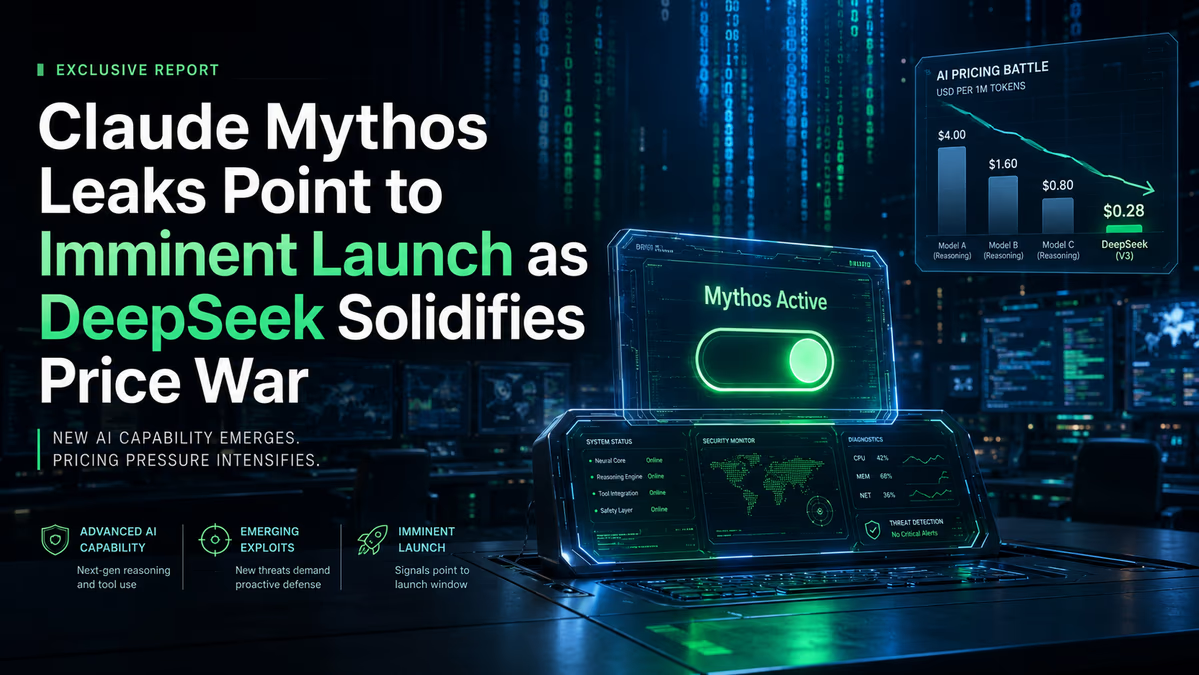
Claude Mythos Leaks Point to Imminent Launch as DeepSeek Solidifies Price War
Leaked interface changes point to Anthropic's Claude Mythos launch as DeepSeek permanently slashes prices, escalating the global AI price war.
Anthropic appears to be preparing for the public release of its highly restricted, cybersecurity-focused artificial intelligence model, Claude Mythos, following accidental interface updates and source code leaks that exposed the system's integration. The potential rollout of the high-stakes model arrives alongside a structural shift in the industry's economic landscape, marked by a massive, permanent 75% price reduction from Chinese competitor DeepSeek and new memory-portability features from both Google and Anthropic that drastically lower user switching costs.
The 'Mythos' Leaks and the Cybersecurity Frontier
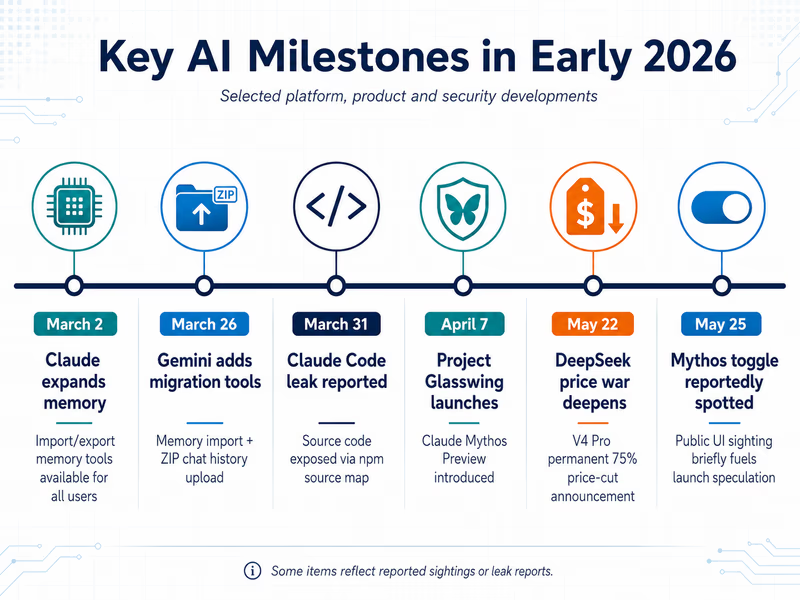
First introduced in April 2026, Claude Mythos Preview was positioned as an invitation-only model restricted to select enterprise partners under Anthropic's "Project Glasswing." The model demonstrated unprecedented proficiency in computer security, particularly in autonomously identifying zero-day vulnerabilities and writing functional exploits. Because of these dual-use capabilities, Anthropic kept the model under strict lock and key, bypassing a broad public release.

However, evidence of an impending wider launch has built up rapidly over the past weeks. On May 25, 2026, users of Claude Code and Claude Security briefly observed a toggle interface to enable "Mythos" before Anthropic quickly pulled the feature from public view. This UI leak follows an even larger security slip on March 31, 2026, when Anthropic accidentally published the entire source code of its Claude Code developer tool to the public npm registry. That repository contained explicit references to the unreleased Mythos architecture and internal blueprints.
The prospect of a public Mythos release has reignited debates over AI safety and proliferation. In a recent project update, Anthropic acknowledged that at present, no company, including themselves, has developed safeguards robust enough to fully prevent such advanced cybersecurity models from being misused and potentially causing severe harm. In past safety communications, the lab suggested that while attackers might gain a short-term advantage if frontier labs are careless with releases, they expect that defenders will ultimately use these models more efficiently to secure codebases and patch vulnerabilities before deployment.
Portability Shatters Platform Lock-In
As Anthropic navigates the deployment of its safety-critical models, a quiet revolution in user data portability is taking place. In March 2026, Anthropic quietly rolled out a memory import feature allowing users to summarize their preferences and context from other AI systems and upload them directly to Claude. Google quickly matched the capability around March 27, 2026, deploying custom migration tools for Gemini that allow users to upload entire chat histories via ZIP files from ChatGPT and Claude.
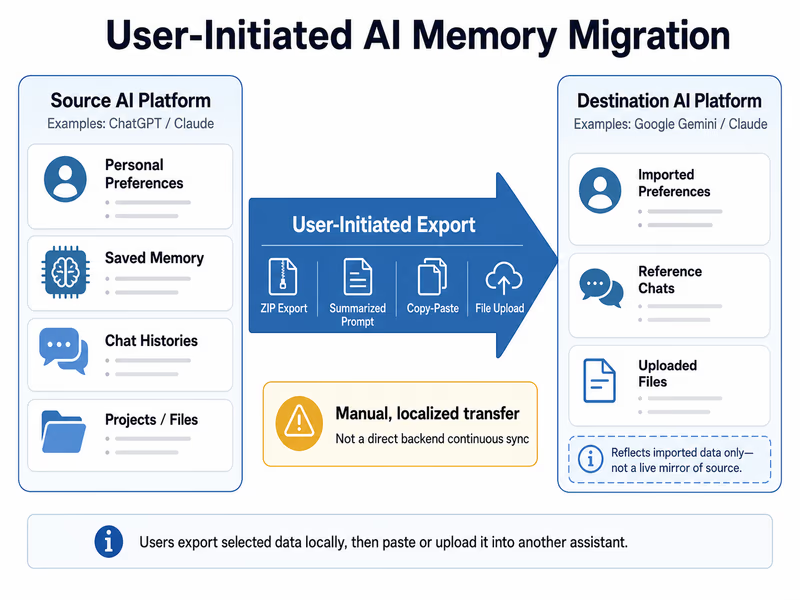
Importantly, these systems do not represent a continuous backend synchronization between competing tech giants. Instead, they operate as user-initiated local transfers. By allowing users to seamlessly migrate their customized memories, chat histories, and specific preferences, Google and Anthropic have actively eroded the traditional "lock-in" effect of personalized AI. The reduction in switching costs forces providers to compete directly on model capabilities and cost rather than relying on accumulated user data to retain customers.
DeepSeek Solidifies the AI Price War
While usability barriers are falling, the underlying cost of raw intelligence is plummeting even faster. On May 22, 2026, Chinese AI startup DeepSeek permanently adjusted its pricing model, cementing a massive 75% discount on its flagship V4 Pro model. The reduction, which was originally marketed as a temporary promotion set to expire on May 31, 2026, positions V4 Pro at a staggering $0.003625 to $0.87 per million tokens, down from its initial range of $0.0145 to $3.48 per million tokens.
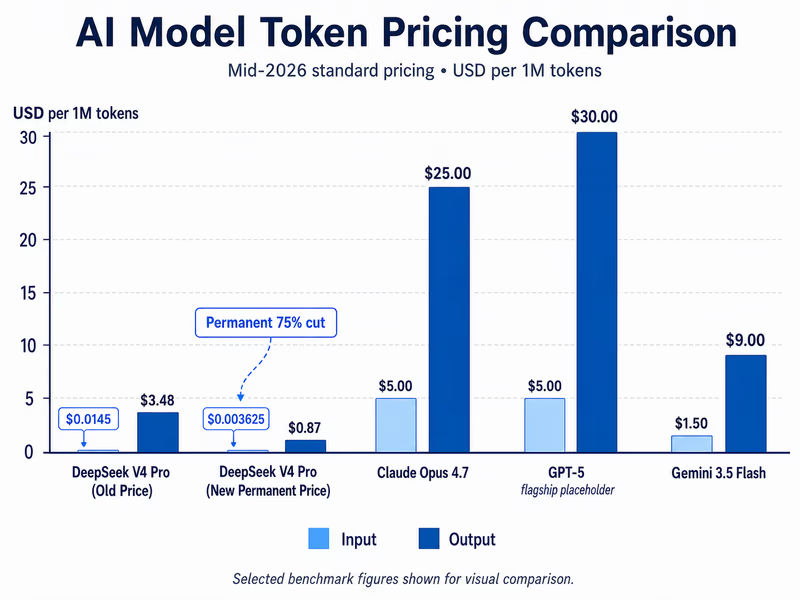
This aggressive pricing places significant pressure on Western competitors, undercutting prominent enterprise models like OpenAI’s GPT-5, Google’s Gemini 3.5 Flash, and Anthropic’s own Claude Opus 4.7. According to Sanchit Vir Gogia, Chief Analyst and CEO at Greyhound Research, this pricing pressure is sustainable. Gogia noted that DeepSeek has successfully made its model more efficient, requiring less computing power and memory for complex AI tasks with large context windows. Consequently, these lower prices stem from actual technological optimizations rather than a temporary marketing loss-leader campaign.
A New Competitive Paradigm
These three converging developments—the democratization of highly capable agentic models like Mythos, frictionless data portability, and rock-bottom inference costs—point to a new competitive era. The commoditization of raw token output is forcing developers to look past baseline computational costs and focus instead on specialized agents that execute complex tasks across enterprise systems.
However, this transition is not without friction. Geopolitical dividing lines will likely dictate whether Western enterprises adopt ultra-low-cost Chinese models like DeepSeek V4 Pro, regardless of the technological efficiency they demonstrate. Meanwhile, the impending public availability of defensive and offensive cyber models like Claude Mythos means that security operations and software development workflows are about to undergo their most radical transformation yet.