The Silent Revolution: How Apple's Gemini Deal Reshapes the Consumer AI Landscape
Apple's partnership with Google Gemini signals a pragmatic strategy shift, trading complete vertical control for rapid AI deployment.
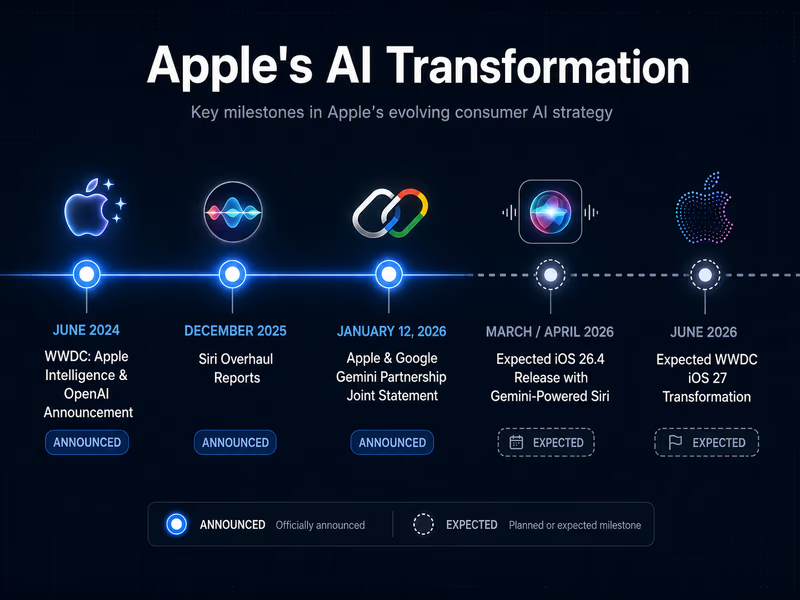
For decades, Apple’s grand strategic doctrine has been simple: if a technology is core to the user experience, you must own the entire stack. From building its own world-class silicon to designing custom operating systems, Cupertino’s insistence on vertical integration has been its greatest competitive moat. But on January 12, 2026, that dogma met a quiet, pragmatic end.
By officially confirming a multi-year partnership to integrate Google's Gemini models into Apple Intelligence, Apple did not just upgrade its software; it signaled a fundamental shift in how the consumer AI wars will be fought. This is not a standard corporate licensing agreement. It is an acknowledgment that in the era of generative AI, the sheer velocity and astronomical capital expenditure required to train competitive frontier models make absolute vertical integration a liability, even for the world's most valuable company.
The Capitulation of Cupertino
For the past few years, the tech industry has asked a persistent, uncomfortable question: Why does Siri still feel dumb? While OpenAI, Anthropic, and Google were busy demonstrating agentic workflows and multi-step reasoning, Apple's virtual assistant remained largely frozen in time—a glorified voice trigger for basic timers and web searches.
Apple's internal attempts to build its own large language model, codenamed "Ajax," reportedly lagged behind the rapid advancements of its competitors. By the time Apple announced Apple Intelligence in June 2024, it was clear that Cupertino was playing catch-up. The lackluster integration of AI features in the iPhone 17 launch, which barely mentioned Apple Intelligence, only underscored the depth of the capability gap.
As Francisco Jeronimo, an analyst at IDC, observed: "By outsourcing the foundational layer of its AI to Google, Apple is effectively admitting that its internal efforts couldn't compete with Google's Gemini in terms of capability and scale in the short term." He characterized the shift as a pragmatic strategy but noted it marked "a departure from Apple's historic approach to development."
Rather than stubborn persistence, Apple chose pragmatism. By integrating Google's Gemini to serve as the foundation for the next generation of Apple Foundation Models, Apple is prioritizing time-to-market over ideological purity.
The Pragmatic Hedge: Speed Over Pride
To understand why this is a brilliant business move, one must look at the economics of generative AI. Building and training a frontier LLM from scratch requires tens of billions of dollars in specialized compute, vast data-scraping pipelines, and years of specialized research. For Apple, attempting to construct an end-to-end proprietary model stack from a standing start carried immense execution risks.
Anisha Bhatia, Senior Technology Analyst at GlobalData, succinctly frames the upside of this alliance: "For Apple, partnering, rather than building an end-to-end AI proprietary model stack, could compress time-to-market and reduce execution risk by leveraging mature, already-deployed technology."
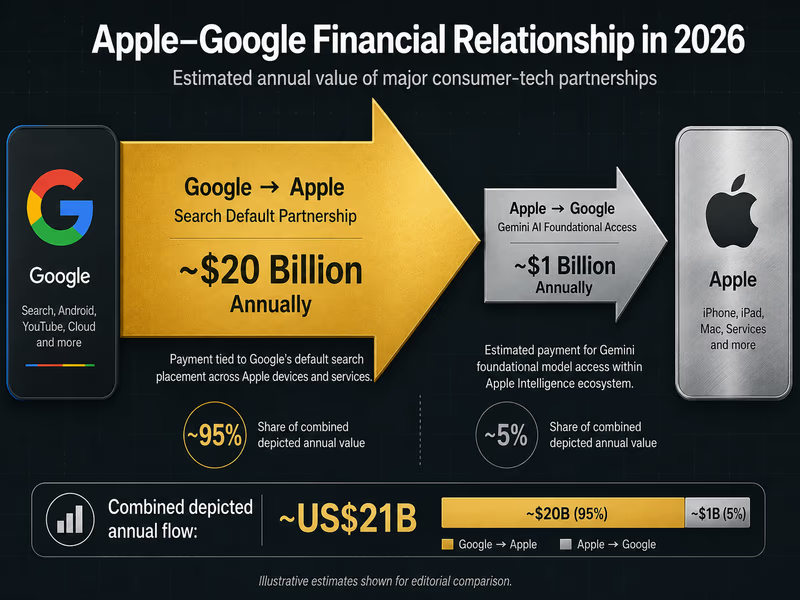
Under this deal, Apple is reportedly paying Google an estimated $1 billion annually for access to its AI technology. To put that in perspective, Google already pays Apple an estimated $20 billion annually to remain the default search engine on Safari. In essence, Apple has negotiated a highly lucrative feedback loop, using a fraction of Google’s own search distribution payments to subsidize the integration of Google’s most advanced AI models directly into iOS.
Furthermore, this arrangement preserves Apple's primary competitive differentiator: its absolute control over the user experience and customer data. During Apple's Q1 2026 earnings call, CEO Tim Cook sought to calm purists by reassuring investors that Apple will continue to run its on-device models and Private Cloud Compute system to uphold its "industry-leading privacy standards." While Google’s Gemini will provide the heavy-duty intellectual horsepower, Apple’s own orchestration layer will decide exactly what data leaves the device and how it is sanitized.
The Architecture of Sovereignty
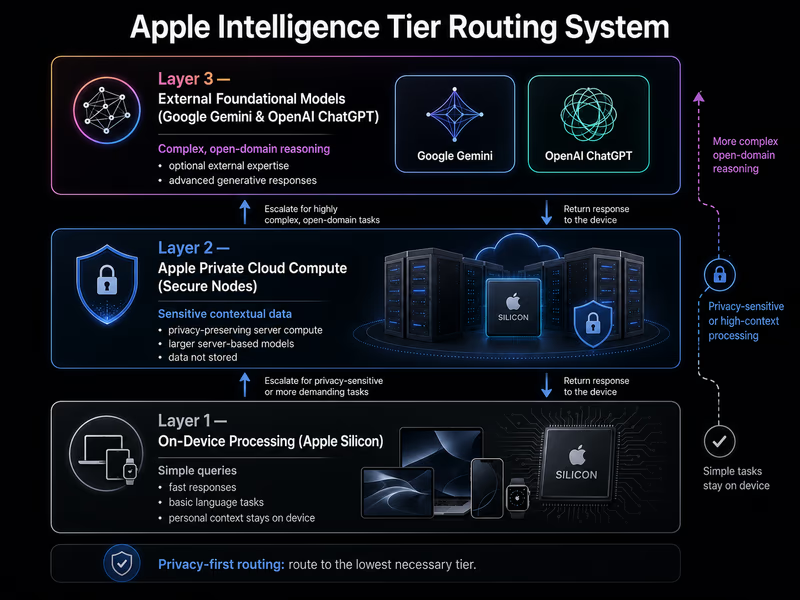
What does this partnership look like in practice? Rather than a monolithic AI takeover, Apple is building a sophisticated, tiered routing architecture:
1. On-Device Apple Intelligence: Lightweight, low-latency, proprietary Apple models handle everyday tasks—composing emails, summarizing text, and basic scheduling—locally on Apple Silicon.
2. Private Cloud Compute: For slightly more complex tasks, data is sent to Apple's highly secure, custom-silicon cloud servers, ensuring that user data is never stored or exposed.
3. Google Gemini (The Core Integration): For complex reasoning, open-domain questions, and multi-step execution, Siri will seamlessly hand off queries to Google's Gemini models.
4. OpenAI ChatGPT (The Opt-In Alternative): For users who prefer a different ecosystem, Apple maintains its existing partnership with OpenAI, offering ChatGPT as a voluntary, secondary layer.
This multi-tiered system allows Apple to keep its branding front and center. Users won't feel like they are interacting with Google; they will interact with a radically transformed Siri. According to Avi Greengart, Lead Analyst at Techsponential, this multi-year deal will "see enhanced versions of Siri... pushed as deep into Apple's ecosystem as they can go."
We are expected to see the first public fruits of this labor in March or April 2026 with the release of iOS 26.4, with rumors pointing to a developer beta demonstration as early as late February. A more comprehensive, conversational overhaul of Siri is slated for iOS 27, which will be teased at WWDC in June 2026.
A Distribution Coup for Google
While Apple gains immediate competitive parity, Google secures an unprecedented distribution channel. Gemini is already integrated into Android devices like the Samsung Galaxy S24, but embedding it deeply into the Apple ecosystem grants Google instant access to over two billion active, high-value iOS devices.
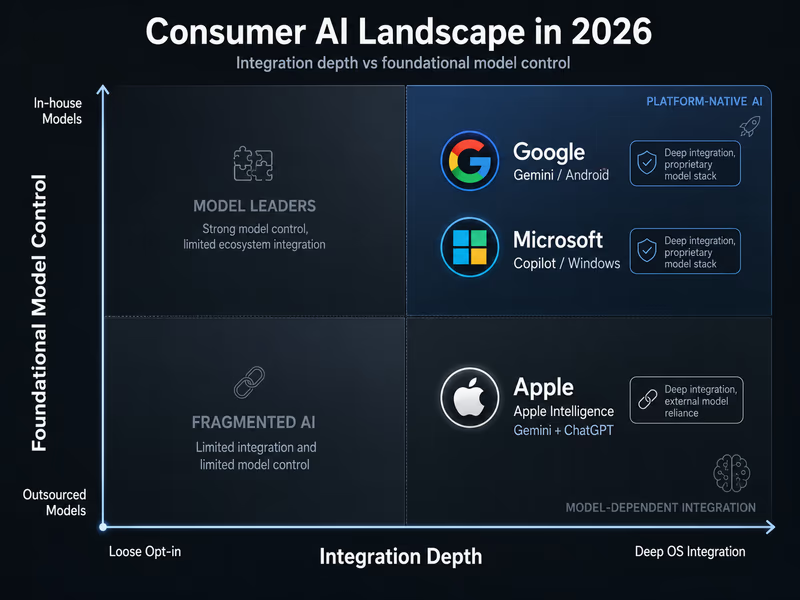
In the intense war for AI dominance between Google, Microsoft, and OpenAI, distribution is the ultimate battleground. By securing default positioning on the iPhone, Google ensures that Gemini becomes the default cognitive engine for the global professional class. This massive scale will fuel Google’s model feedback loop, refining Gemini’s capabilities far faster than its competitors can manage through standalone apps.
However, this partnership does not come without peril. The deep alliance between Cupertino and Mountain View will undoubtedly attract intense regulatory scrutiny. Google is already embroiled in a massive antitrust lawsuit concerning its $20 billion default search agreement with Apple. Adding a multi-year AI monopoly to that relationship will paint an even larger target on both companies' backs.
The Commoditization of the Foundational Layer
Apple's decision to outsource the foundational layer of its AI is a clear signal that the industry is entering a new phase. Foundational LLMs are rapidly becoming a commodity—expensive, complex infrastructure, much like the telecommunications networks or cloud data centers that power the modern web.
Apple’s true genius has never been in inventing raw infrastructure; it has been in the refinement, packaging, and commercialization of that infrastructure. By leaving the capital-intensive model-training race to Google and OpenAI, Apple can focus its immense resources on what it does best: optimizing the silicon-to-software integration, perfecting the user interface, and building a secure ecosystem that users trust.
Ultimately, this deal proves that in the AI era, owning the model is no longer the most valuable part of the value chain. Owning the user relationship is. And by transforming Siri into a highly capable, Gemini-powered agent, Apple has ensured it remains the ultimate gatekeeper of consumer attention.