Anthropic's Opus 4.8 vs. OpenAI's GPT-5.5: Who's Winning the Enterprise AI Battle?
Anthropic's Opus 4.8 and $965B valuation signal a massive shift as it overtakes OpenAI in the high-stakes enterprise AI infrastructure battle.
On May 28, 2026, the corporate AI landscape witnessed an unprecedented economic inversion. Anthropic, long cast as the cautious, safety-first research underdog, announced a jaw-dropping $65 billion Series H funding round. The deal vaulted the company’s post-money valuation to an astonishing $965 billion, comfortably leapfrogging OpenAI’s $852 billion mark set just two months prior.
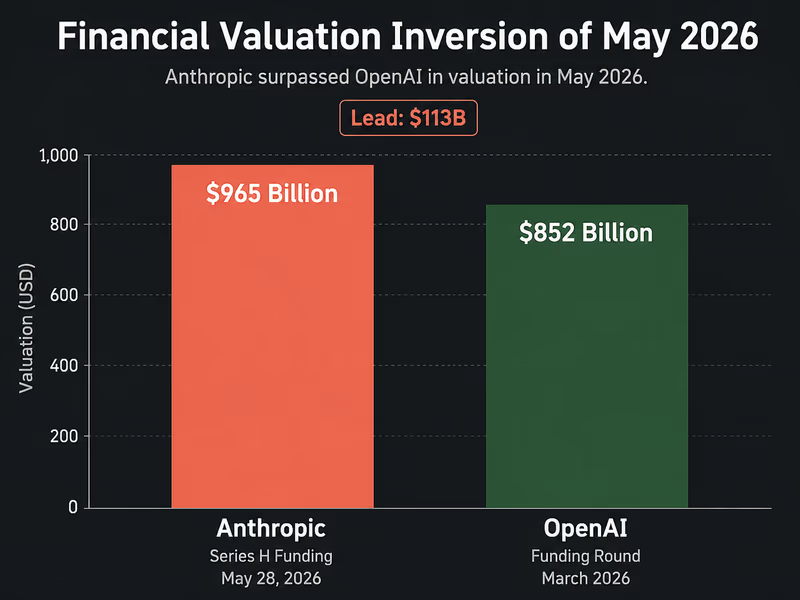
This isn't merely a paper-valuation arms race. It is the financial capitalization of a structural shift that has been quietly building all year. For the first time, the narrative of "OpenAI and everyone else" has fractured. According to transactional data from Ramp’s AI Index, Anthropic officially surpassed OpenAI in paid business adoption in April 2026.
With the concurrent releases of Anthropic’s powerhouse Claude Opus 4.8 and OpenAI’s dual-pronged strategy of GPT-5.4 Thinking and GPT-5.5 Instant, we are no longer asking who has the flashiest consumer chatbot. The real war is being fought in the boring, high-value trenches of enterprise infrastructure. And right now, Anthropic is winning the plumbing.
The Plumbing vs. The Portal
To understand why Wall Street and venture capital have suddenly valued Anthropic at nearly a trillion dollars, we have to look at the divergence in product philosophy between the two giants.
OpenAI has spent the last year building highly impressive, interactive systems designed to sit alongside humans. GPT-5.4 Thinking, launched in March 2026, is a triumph of desktop automation. With a 75.0% success rate on the OSWorld-Verified benchmark, it comfortably beats the human expert baseline of 72.4% by natively reading screenshots, writing Playwright code, and driving desktop software. It is the ultimate digital co-pilot.
Meanwhile, OpenAI’s GPT-5.5 Instant (updated on May 28) remains the default portal for millions of workers, boasting a 52.5% reduction in hallucinated claims compared to its predecessor. With over 7 million workplace seats, OpenAI’s distribution engine is formidable.
But Anthropic isn't trying to build a better desktop assistant; they are building autonomous enterprise engines. Claude Opus 4.8 represents a major evolution in agentic reliability. Rather than focusing on human-in-the-loop desktop navigation, Opus 4.8 is optimized for high-throughput, complex reasoning tasks via API. Supporting a massive 1 million token context window and an unprecedented 128,000 max output tokens, it is designed to ingest entire codebases or corporate financial histories and output fully completed work.
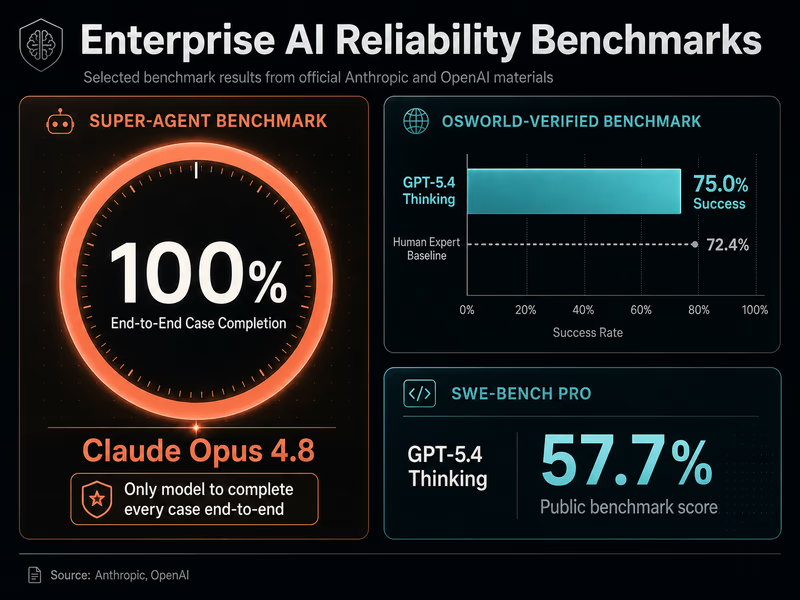
This distinction became starkly evident on the Super-Agent benchmark. While GPT-5.5 struggled with cost-effective multi-step execution, Claude Opus 4.8 completed every single test case end-to-end, outperforming its competitors at cost parity.
"On our Super-Agent benchmark, Claude Opus 4.8 is the only model to complete every case end-to-end, beating prior Opus models and GPT-5.5 at parity on cost," notes Kay Zhu, Co-Founder and CTO of an agentic workflow platform. "For agent products in translation, deep research, slide-building, and analysis, it delivers powerful reliability."
The Sovereign API Strategy
This reliability is why enterprises are quietly shifting their production workloads. Developers don't just want smart models; they want predictable, self-correcting systems.
Staff Engineer Tom Pritchard highlighted this shift in daily operations: "Claude Opus 4.8 has noticeably better judgment. In Claude Code, it asks the right questions, catches its own mistakes, pushes back when a plan isn't sound, and builds up confidence around complex, multi-service explorations before making big changes."
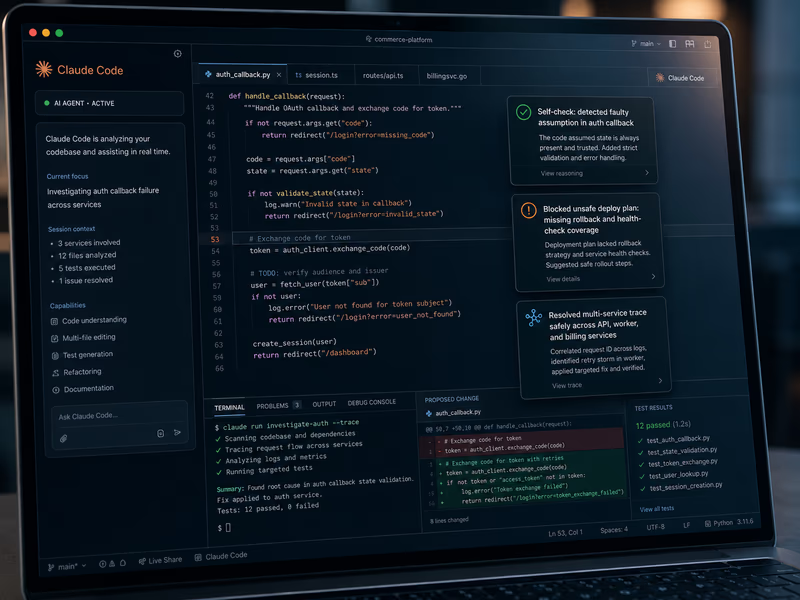
This "judgment" is precisely what makes Anthropic an enterprise darling. When building autonomous agents that handle live databases, write production-grade code (where GPT-5.4 Thinking scores a strong but still incomplete 57.7% on SWE-Bench Pro), or interact with customers, a model that "pushes back" on bad instructions is infinitely more valuable than one that blindly executes.
Furthermore, Anthropic has executed a masterclass in Switzerland-style neutrality. While OpenAI is deeply bound to Microsoft’s ecosystem—a relationship that increasingly causes friction for enterprises wary of vendor lock-in—Anthropic has distributed its risk. It is available natively via the Claude API, but also deeply integrated into Amazon Bedrock and the Claude Platform on AWS.
By partnering with hardware giants like Samsung, Micron, and SK hynix, alongside hyperscalers, Anthropic has ensured its models are embedded directly where data lives. As Philippe Laffont, Founder of Coatue, observed: “Since our initial investment in 2025, Anthropic's focus on agentic coding and enterprise-grade AI systems has accelerated its progress toward large-scale adoption.”
The Cost-Performance Calculus
For enterprise CTOs, the decision between these models comes down to a cold calculation of API costs versus execution speeds. Anthropic’s pricing architecture for Opus 4.8 is highly strategic:
* Standard Mode: $5 per million input tokens / $25 per million output tokens.
* Fast Mode (2.5x speed): $10 per million input tokens / $50 per million output tokens.
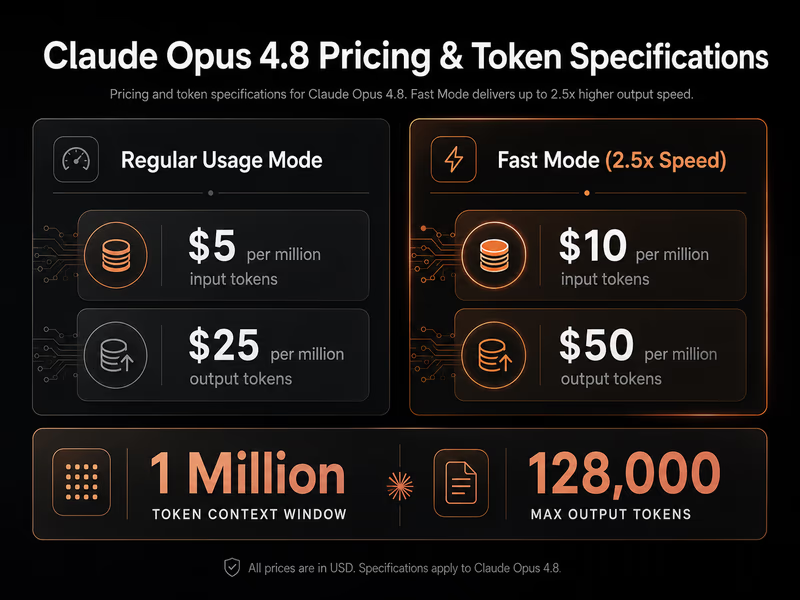
By offering a dual-tier speed option, Anthropic allows enterprises to segment their workloads. Low-priority, deep-reasoning background agents can run on the cheaper standard tier, while user-facing interactive tools run on the ultra-fast tier. This granularity makes budgetary forecasting far easier for large-scale deployments.
OpenAI, conversely, has leaned heavily into vertical integration and custom model tuning. While this is highly effective for bespoke enterprise applications, it requires a level of professional services and custom engineering that is difficult to scale. OpenAI’s hiring of Forward Deployed Engineering and Enterprise Sales Strategists in 2026 shows they recognize this bottleneck, but they are playing catch-up to Anthropic’s highly developer-friendly, self-serve API ecosystem.
The Sovereign Shift
So, who is winning the enterprise battle?
If you measure by sheer volume of users and brand recognition, OpenAI’s 7 million workplace seats and the ubiquitous ChatGPT brand keep them in the lead. Colin Fleming, OpenAI’s Business CMO, rightly claims they are "help[ing] set the standard for putting AI to work safely, usefully and at scale."
But if you measure by where the next generation of autonomous enterprise software is actually being built—the deep, programmatic API integrations that represent sticky, multi-year recurring revenue—the crown is sliding to Anthropic.
Anthropic’s massive $965 billion valuation isn't a bubble; it is a recognition that the future of enterprise software is agentic, and agents require the massive context, robust output limits, and impeccable reasoning of Opus 4.8. By focusing on developer trust, platform neutrality, and rock-solid execution over consumer hype, Anthropic has transformed Claude from an alternative into the enterprise default.