The Trillion-Dollar Closed Loop: Why Anthropic’s $965B Valuation is Both Real and Dangerous
Anthropic's $965B valuation looks insane, but its $47B revenue run-rate suggests a structural shift rather than a pure dot-com bubble.
When a five-year-old company is valued at nearly a trillion dollars, the default instinct of any seasoned market observer is to look for the exit sign. On May 28, 2026, Anthropic closed a massive $65 billion Series H funding round, minting a post-money valuation of $965 billion. This eye-watering figure officially vaults the safety-focused startup past its archrival OpenAI, which sat at $852 billion in March 2026. Critics immediately pointed to the transaction as peak bubble territory, drawing neat historical parallels to the dot-com hysteria of 1999.
But dismissing Anthropic's near-trillion-dollar milestone as mere speculative froth ignores a stark, deeply disruptive reality: the underlying math is unlike anything we have ever seen in the history of technology.
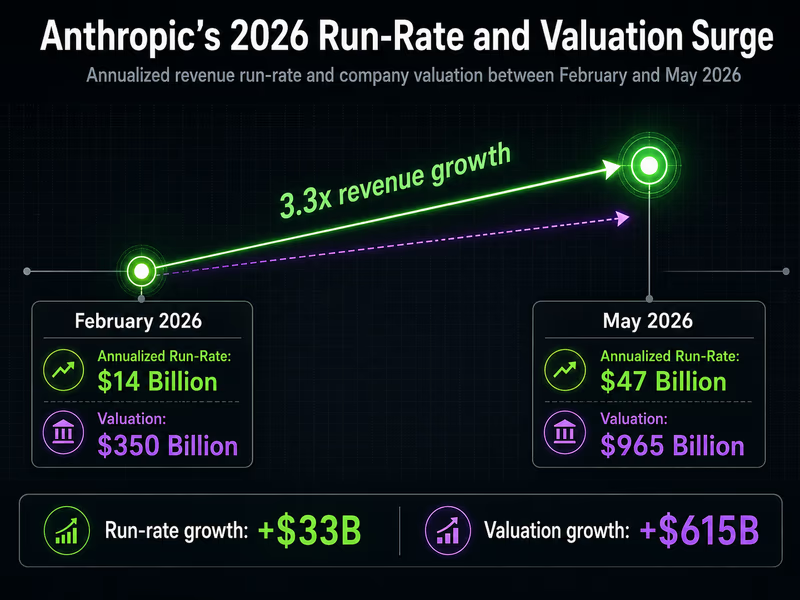
This is not a story of pre-revenue hype or vaporware. By May 2026, Anthropic's annualized run-rate revenue had skyrocketed to an astonishing $47 billion, up from $14 billion just three months prior in February. To put that in perspective, Anthropic is growing at a triple-digit quarter-over-quarter pace while operating at a scale that rivaled the legacy software giants of the previous decade. At a $965 billion valuation, Anthropic is trading at roughly 20.5 times its annualized revenue. During the SaaS boom of 2021, mature, slow-growing cloud software companies routinely commanded multiples of 30x to 40x. Viewed through this lens, Anthropic's valuation isn't a speculative fever dream—it is a rational, if aggressive, pricing of exponential enterprise demand.
The High-Growth Engine: Enterprise Pulls the Strings
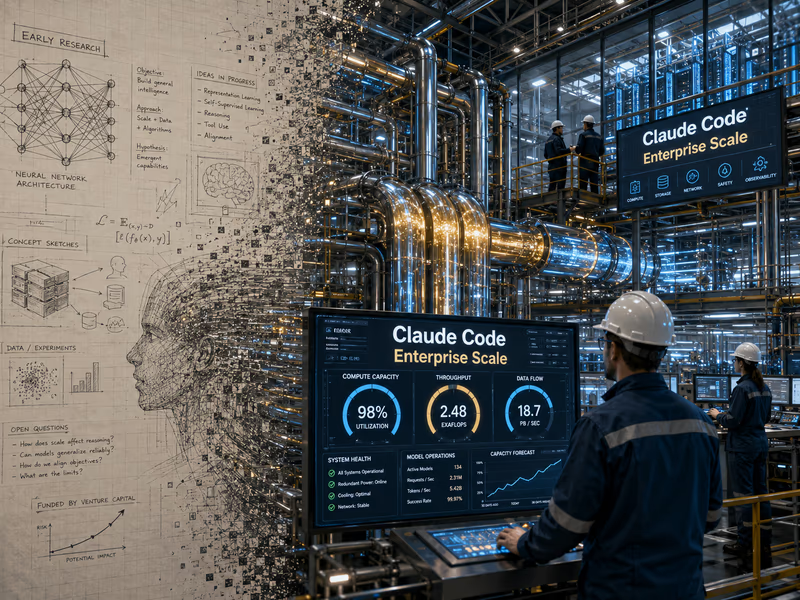
What is driving this unprecedented surge in top-line revenue? The answer lies in the aggressive enterprise adoption of the Claude model family. While early generative AI hype focused on consumer chat interfaces, the real money has moved to specialized developer tooling and workflow automation. Products like Claude Code have transformed software engineering from a human-only endeavor into an augmented pipeline.
As Dario Amodei, CEO and co-founder of Anthropic, put it: "Our users tell us Claude is increasingly essential to how they work, and we need to build the infrastructure to keep pace with rapidly growing demand." This sentiment is backed up by hard corporate spending. Enterprises are no longer merely playing with API sandboxes; they are building core production systems on top of Anthropic's models, drawn in large part by the company's explicit focus on safety, steerability, and interpretability.
Yet, maintaining this lead requires an almost unimaginable amount of capital. Krishna Rao, Chief Financial Officer of Anthropic, noted that the Series H funding "will help us serve the historic demand we are experiencing, stay at the research frontier, and bring Claude to more of the places where work happens." But "staying at the research frontier" is where the financial picture becomes complicated.
The Trillion-Dollar Closed Loop
To understand the true nature of Anthropic’s valuation, one must look at who is writing the checks. The Series H round was led by premier venture firms like Altimeter, Dragoneer, Greenoaks, and Sequoia. However, the foundational pillars of Anthropic’s balance sheet are the tech giants themselves—most notably Amazon and Google.
Amazon has committed $13 billion to date, with pledges of up to an additional $20 billion. In return, Anthropic has committed to spending over $100 billion on Amazon Web Services (AWS) infrastructure over the next ten years. Google has followed a similar playbook, committing up to $40 billion in investments alongside 5 gigawatts of computing capacity. Strategic hardware players like Micron, Samsung, and SK Hynix also joined the Series H round to lock in the supply chains for next-generation memory and logic chips.
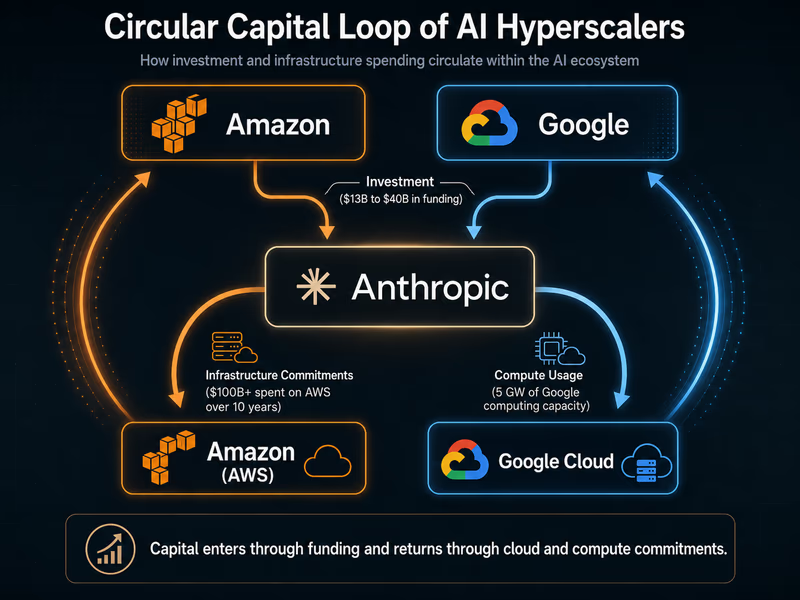
This arrangement exposes the central paradox of the modern AI economy: the circular flow of capital. Hyperscalers invest billions of dollars into AI startups, which those startups immediately hand back to the hyperscalers to pay for cloud computing, custom AI silicon, and power. As Amazon CEO Andy Jassy observed, "Our custom AI silicon offers high performance at significantly lower cost for customers, which is why it's in such hot demand."
This dynamic raises a profound question: Is Anthropic’s revenue organic enterprise demand, or is it a highly leveraged capital recycling scheme? If a hyperscaler invests $5 billion in a startup, and that startup immediately spends $5 billion on that hyperscaler’s cloud servers, the startup records massive computing costs while the hyperscaler records massive cloud revenue. This interdependence has made regulators and market skeptics intensely nervous.
OpenAI vs. Anthropic: A Tale of Two Strategies
The rivalry between OpenAI and Anthropic has evolved into a classic battle of tech philosophies. OpenAI, backed heavily by Microsoft, has pursued a consumer-first, highly publicized path to AGI, aiming to build a ubiquitous consumer brand. Anthropic, founded by OpenAI defectors who feared the commercialization of AI at the expense of safety, has carved out a distinct niche. By prioritizing safety and direct enterprise alignment, Anthropic has built a product suite that CIOs feel comfortable integrating into regulated environments like finance and healthcare.
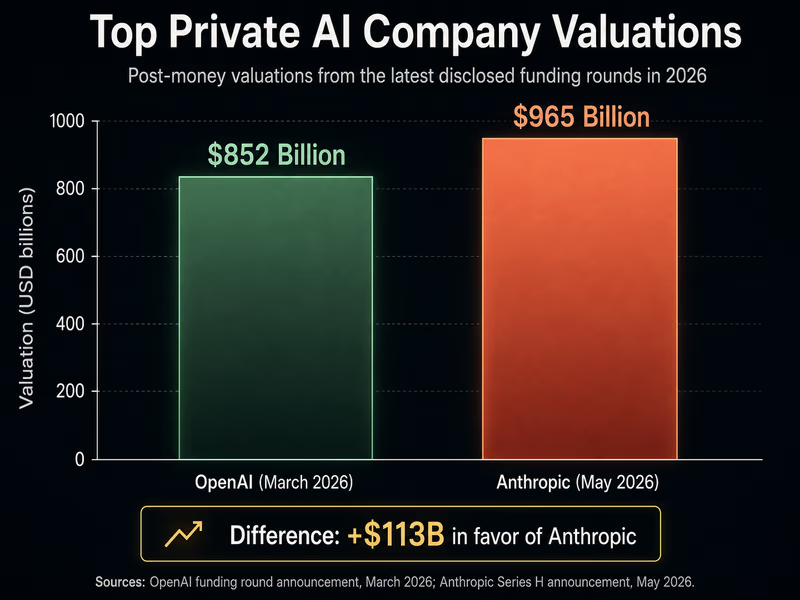
This strategic divergence is now reflecting in their valuations. OpenAI’s $852 billion valuation in March 2026 was a monument to brand dominance, but Anthropic’s $965 billion valuation just two months later proves that the market is placing a premium on enterprise-grade reliability and deep hardware integration.
However, some industry veterans remain deeply skeptical of both approaches. Venture capital pioneer Alan Patricof warned: "The AI revolution is a true revolution… [but] I am cautious about valuations and what people think can be accomplished in the short term… A lot of people have run into this field, and just because 'AI' is attached to the name, or they incorporate it into their business plan… [it] gets a lot of people excited." Even OpenAI’s own CEO, Sam Altman, admitted that "people will overinvest and lose money during this phase of the AI boom."
The S-1 Reckoning is Coming
We will not have to wait long to find out who is right. On the same day Anthropic closed its Series H round, the company confidentially submitted a draft S-1 registration statement to the SEC, setting the stage for a potential public listing as early as October 2026.
A public listing will force Anthropic to open its books, exposing the exact ratio of organic enterprise revenue to circular hyperscaler agreements. Public market investors are notoriously less forgiving of high-multiple, low-margin business models than private venture capitalists. If Anthropic’s gross margins are weighed down by the astronomical costs of its $100 billion AWS compute commitment, the public market response could be brutal.
For enterprise buyers and developers, however, Anthropic’s massive capital war chest guarantees one crucial thing: stability. Building core business logic on top of LLMs is a massive risk if your provider might run out of runway or fail to scale its compute. With nearly a trillion-dollar valuation and the backing of the world's largest cloud providers, Anthropic is cementing itself as a permanent utility of the cognitive era.
Whether this is a bubble or a market correction is ultimately the wrong question. What we are witnessing is the capital-intensive birth of a new computing paradigm. The transition from legacy software to cognitive compute requires investments on a scale that dwarfs the building of the early internet. Anthropic’s $965 billion valuation is a reflection of that reality—a high-stakes, all-or-nothing bet that the company will remain the primary cognitive engine powering the modern enterprise.