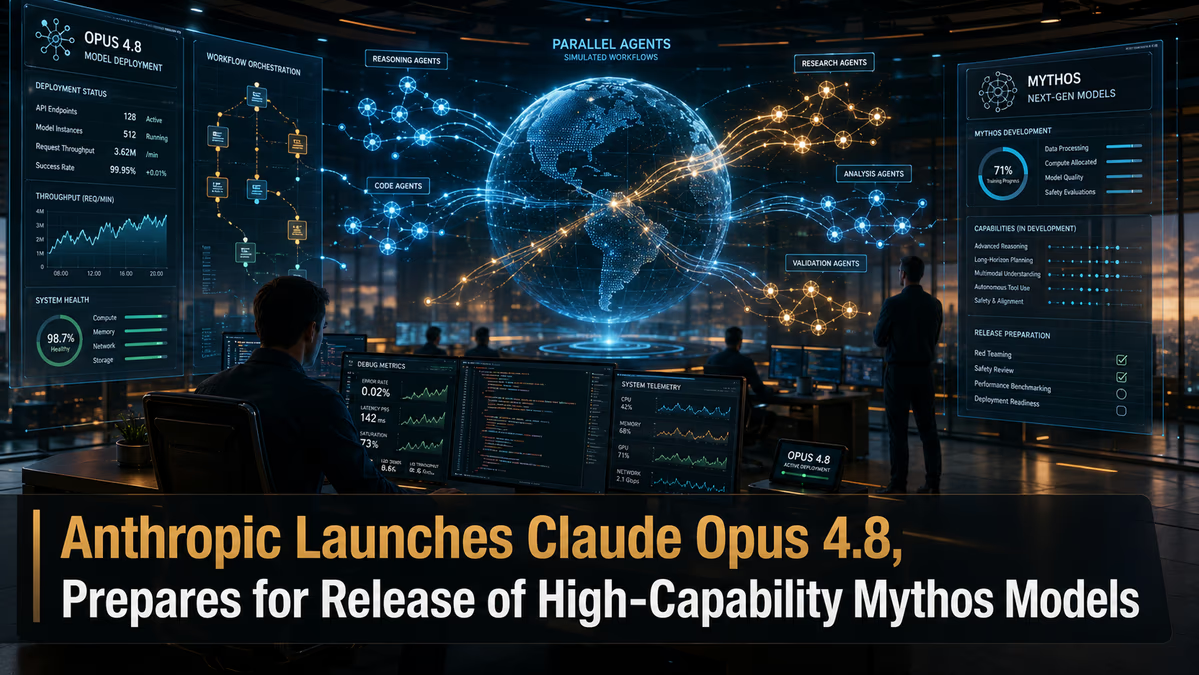
Anthropic Launches Claude Opus 4.8, Prepares for Release of High-Capability 'Mythos' Models
Anthropic has launched Claude Opus 4.8 with upgraded coding capabilities and teased the upcoming release of its powerful Mythos-class models.
Anthropic officially launched Claude Opus 4.8 globally on May 28, 2026, delivering substantial performance upgrades to its flagship model while signaling the imminent release of its advanced "Mythos-class" artificial intelligence models to the general public.
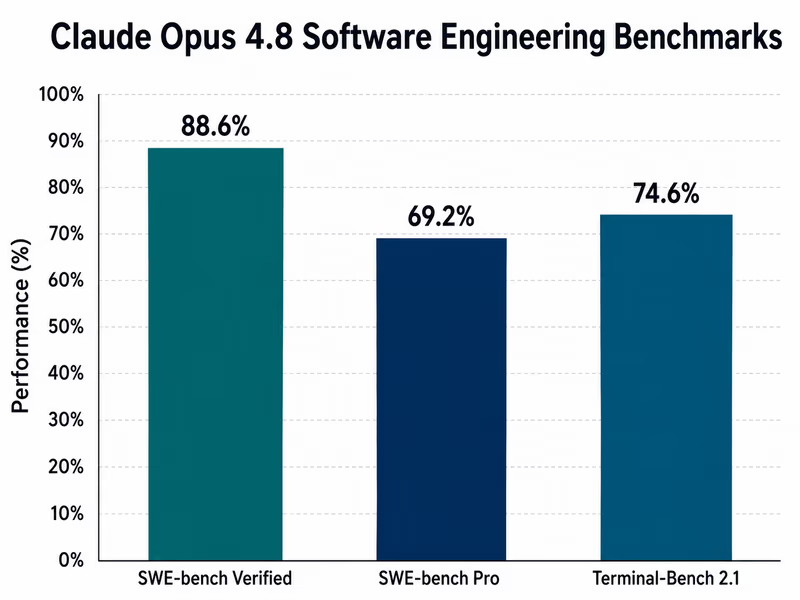
The update arrives with a focus on code execution, agentic workflows, and system reliability. According to benchmark results released by the company, Claude Opus 4.8 scored 88.6% on SWE-bench Verified, 69.2% on the more rigorous SWE-bench Pro, and 74.6% on Terminal-Bench 2.1. These metrics mark a significant upgrade over its predecessor, Opus 4.7, particularly in navigating complex terminal operations and software engineering tasks.
Advancements in Reliability and "Honesty"
A key area of improvement in Opus 4.8 is code alignment and safety. Anthropic claims the new model is approximately four times less likely than Opus 4.7 to let bugs or security flaws in its self-written code pass without alerting the user. This "honesty-first" behavior mirrors Anthropic's experimental safety models and has drawn positive reactions from early enterprise testers.
Michael Ran, a Senior Investment Associate at Bridgewater, noted that "Opus 4.8 was able to proactively flag issues with the inputs and outputs of an analysis, something other models routinely missed and left to the users to catch."
This enhanced reliability translates directly into professional productivity. Niko Grupen, Head of Applied Research at Harvey, commented on the practical utility of the upgrade: "For substantive legal work, that's the kind of accuracy lift that translates directly into how much real attorney work our customers can hand off with confidence." Despite these enhancements, Anthropic has maintained a measured outlook, characterizing the model in a VentureBeat report as a modest but tangible improvement on its predecessor.
Dynamic Workflows and Cost Optimization
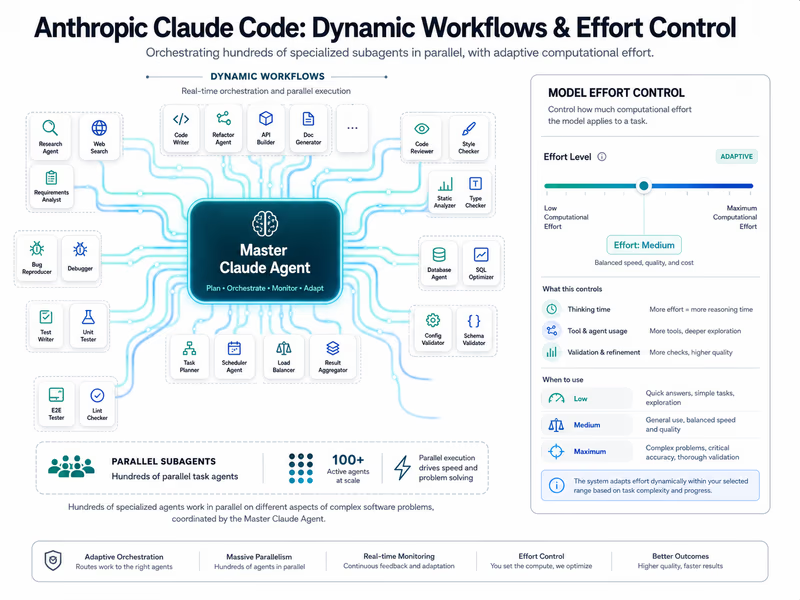
Opus 4.8 introduces several highly anticipated user-facing features, most notably "dynamic workflows" for Claude Code. This capability allows the model to spin up hundreds of parallel subagents to solve complex, large-scale problems simultaneously. Additionally, a new "effort control" option in Claude.ai and Cowork allows users to manually scale the computational power applied to specific tasks, optimizing costs for less demanding operations.
Standard pricing for regular usage remains steady at $5 per million input tokens and $25 per million output tokens. However, Anthropic has optimized its fast mode: it now operates at 2.5 times the speed of previous fast modes, is three times cheaper, and is priced at $10 per million input tokens and $50 per million output tokens.
The Path to Mythos and Project Glasswing
While Opus 4.8 represents the current production state-of-the-art, Anthropic's next major technological leap centers on its "Mythos" architecture. Since April 7, 2026, a select cohort of tech and cybersecurity partners—including AWS, Apple, Google, and Microsoft—have had restricted access to the "Mythos Preview" model under "Project Glasswing."
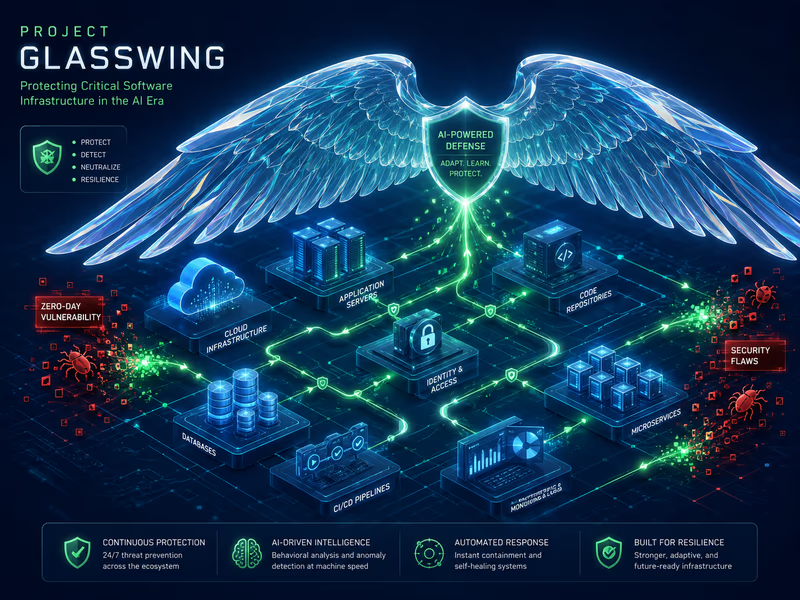
This defensive cybersecurity initiative is designed to map digital vulnerabilities before they can be exploited. According to an initial report released on May 23, 2026, Project Glasswing partners successfully identified over 10,000 security flaws within a single month, thousands of which were categorized as high or critical severity. Mythos Preview has shown deep proficiency in finding and exploiting zero-day vulnerabilities in major operating systems and web browsers.
The raw power of Mythos has sparked both excitement and safety concerns. Unconfirmed industry reports suggest that a security research firm recently utilized Mythos' bug-finding capabilities to successfully breach Apple’s macOS operating system. Recognizing the geopolitical and security sensitivities of these findings, Anthropic reportedly eased its nondisclosure agreements on May 21, 2026, permitting partners like JPMorganChase to share discovered vulnerabilities directly with regulators and industry peers.
Rep. Josh Gottheimer, Co-chair of the House Democratic Commission on AI and the Innovation Economy, supported the regulatory disclosure, stating that "no entity should be contractually restricted from warning others, coordinating mitigations, or informing relevant and trusted stakeholders about urgent cyber risks."
Impending Release and Safeguards
Anthropic is preparing to transition these defensive cyber capabilities out of closed testing. In a statement accompanying the Opus 4.8 release, the company announced its expectation to deploy Mythos-class models to all customers in the coming weeks, once safety protocols are finalized.
"Models of this capability level require stronger cyber safeguards before they can be generally released," Anthropic explained. "We're making swift progress on developing these safeguards and expect to be able to bring Mythos-class models to all our customers in the coming weeks."
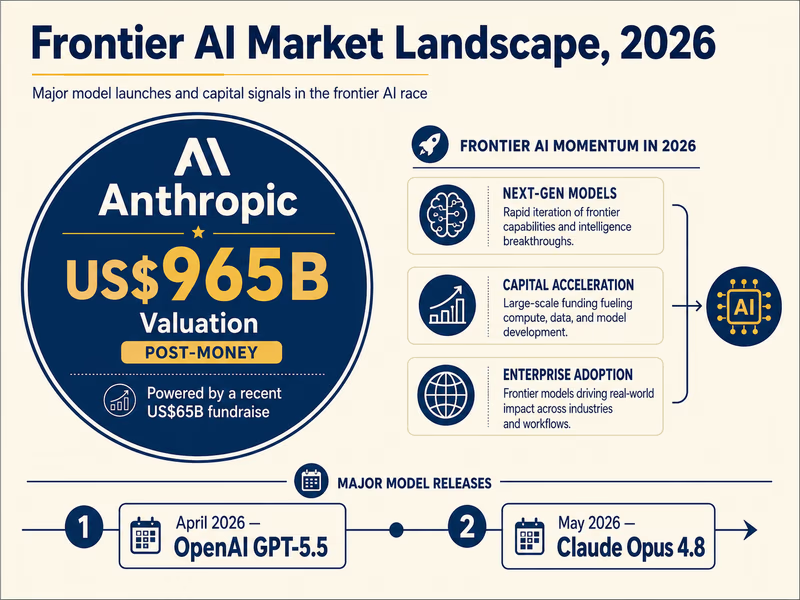
This dual-track strategy of incremental product updates and highly secure defensive testing occurs in an increasingly competitive, high-stakes market. OpenAI launched its GPT-5.5 model in April, and Google is currently preparing Gemini 3.5 Pro to expand agentic automation. Anthropic's rapid scaling is supported by a massive new $65 billion funding round, which has pushed the startup's valuation to $965 billion—vaulting past OpenAI's last valuation.
This immense capital and technological push arrives as global financial regulators and governments turn their attention toward the systemic risks of frontier models. In mid-May, the Bank of England, the Financial Conduct Authority, and HM Treasury jointly warned UK financial institutions to brace for the cybersecurity risks posed by advanced AI. How Anthropic handles the broader release of its Mythos-class models will likely set the baseline for how the AI industry balances raw technological supremacy with the imperative of national cybersecurity.