Anthropic Launches Claude Fable 5 and Claude Mythos 5, Introducing New 'Mythos-Class' Tier
Anthropic has launched Claude Fable 5 and Mythos 5, introducing a new Mythos-class tier with advanced software engineering and security capabilities.
Anthropic has officially launched two new AI models, Claude Fable 5 for general public use and Claude Mythos 5 for restricted, specialized access. Released on June 9, 2026, both models represent the company’s new "Mythos-class" capability tier, which surpasses the previous top-tier "Opus class" in performance and reasoning depth.
This release marks a significant departure from standard model deployment, split into an open commercial model and a restricted, highly specialized counterpart. While Claude Fable 5 serves as Anthropic's most capable public model—excelling in software engineering, knowledge work, scientific research, and vision tasks—Claude Mythos 5 is the same underlying model with critical safeguards lifted in areas such as cybersecurity and biology. This specific architectural access renders Mythos 5 the most capable cybersecurity model in the world.
Designing Access: Intelligent Safeguard Routing
To balance mass market availability with security, Anthropic has implemented a sophisticated safeguard system for Fable 5. When users query Fable 5 on highly sensitive subjects like cybersecurity, biology, chemistry, and health, the model utilizes intelligent routing to redirect the query. Instead of answering directly, Fable 5 routes these sensitive queries to Anthropic's less powerful Claude Opus 4.8 model, which acts as a safe fallback.
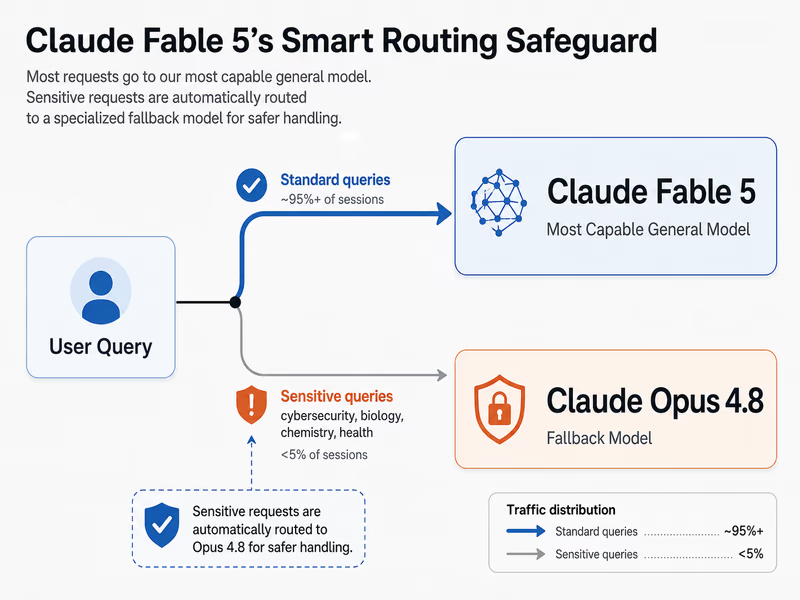
Anthropic reports that these safeguard triggers occur in fewer than 5% of overall user sessions. Explaining this tiered approach, the company noted: "Releasing a model this capable comes with risks. Without safeguards, Fable 5's capabilities in areas like cybersecurity could be misused to cause serious damage. We've therefore launched the model with safeguards that mean queries on some topics will instead receive a response from our next-most-capable model, Claude Opus 4.8."
Commenting on the strategy, Dario Amodei, CEO of Anthropic, stated: "We gated Mythos because it was too effective at its job. Fable 5 brings that power with the guardrails required for mass adoption."
Project Glasswing and National Security
Claude Mythos 5 is not available to the public. Instead, it is deployed exclusively through Project Glasswing, an ongoing collaboration with the U.S. government aimed at bolstering cyberdefenders.
The Mythos-class lineage originally began with Claude Mythos Preview in April 2026, which was distributed to a small, select group of cyberdefenders. Anthropic initially restricted public access due to the model's powerful ability to identify software vulnerabilities, which critics at the time allegedly dismissed. Unverified reports from the initial launch of Project Glasswing suggest some critics accused Anthropic of overhyping the threat posed by the model. However, the program has since expanded rapidly. By early June 2026, Project Glasswing grew to include approximately 200 organizations across more than 15 countries.

During its evaluation phase within Project Glasswing, Mythos 5 demonstrated immense defensive utility, identifying 23,000 critical vulnerabilities. These discoveries included a 27-year-old flaw in OpenBSD and 271 distinct vulnerabilities in Firefox. To ensure rigorous oversight, Anthropic requires a 30-day data retention period for all Mythos-class model traffic for safety monitoring. The company has clarified that this data retention policy is specifically designed for safety safeguard work and is unrelated to any White House executive order on sharing frontier models. Additionally, Anthropic committed that this traffic data will not be used to train new AI models.
Industry Adoption and Technical Specifications
This high-profile launch occurs during a period of rapid enterprise growth for Anthropic. According to the May 2026 Ramp AI Index, Anthropic reached 34.4% of business adoption, surpassing competitor OpenAI's 32.3%.
To support complex enterprise demands, both Fable 5 and Mythos 5 feature a standard 1 million token context window by default and support up to 128,000 output tokens per single request. This massive output capability is intended to allow the models to autonomously handle long-running engineering tasks, such as facilitating large-scale code migrations.
This premium capability is reflected in its pricing. Both models are priced at $10 per million input tokens and $50 per million output tokens. This rate is exactly double the cost of Claude Opus 4.8. For general users, Claude Fable 5 will be accessible for free on Pro, Max, and Team subscription plans initially, before transitioning to usage-based credits expected on June 22, 2026.
Performance Benchmarks and Implications
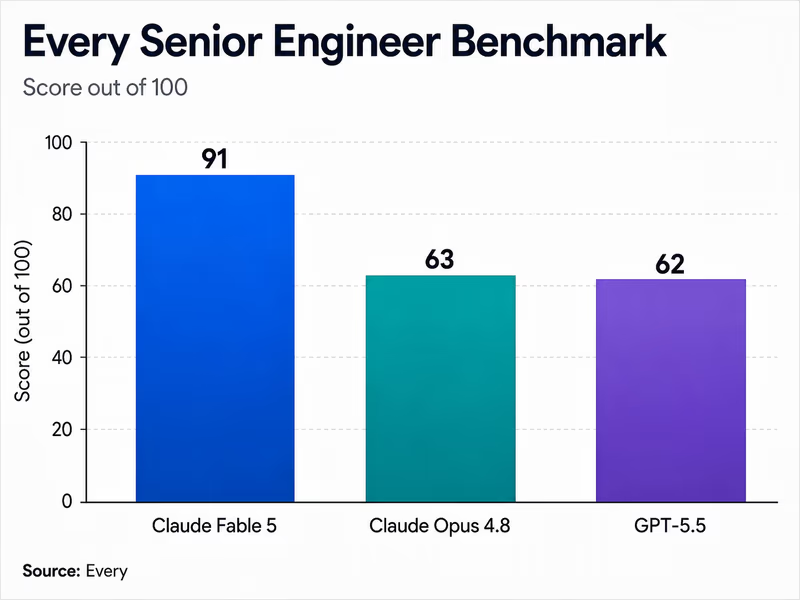
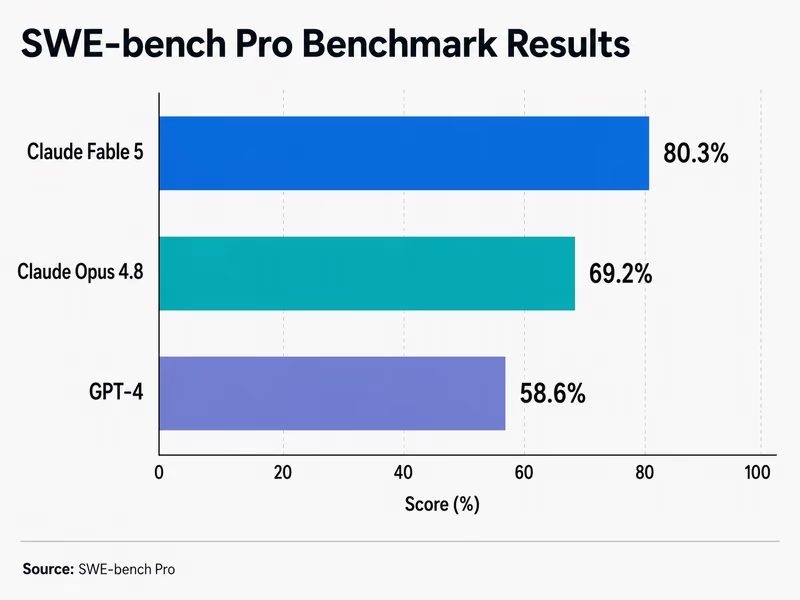
Third-party testing indicates that Fable 5 represents a major leap forward in coding proficiency. On Every's Senior Engineer benchmark, Fable 5 scored 91/100, dramatically outperforming Claude Opus 4.8 (which scored 63/100) and GPT-5.5 (which scored 62/100). Similarly, on SWE-bench Pro, Fable 5 achieved a score of 80.3%, compared to 69.2% for Claude Opus 4.8 and 58.6% for GPT-4.
Alongside the release, Anthropic published a corporate blog post addressing concerns regarding "recursive self-improvement" in frontier systems, advocating for measured, safe AI deployment. By structuring the launch of its Mythos-class tier through dual public-safeguarded and private-restricted models, Anthropic is championing a "designed access" framework. This tiered strategy will likely influence broader global AI governance discussions, balancing technical progress with critical infrastructure security.