The Shadow of Mythos: Open-Source Developers Race to Reconstruct Anthropic’s Restricted Cyber-AI
The OpenMythos project aims to reverse-engineer Anthropic’s restricted Claude Mythos AI, a model with unprecedented cybersecurity capabilities.
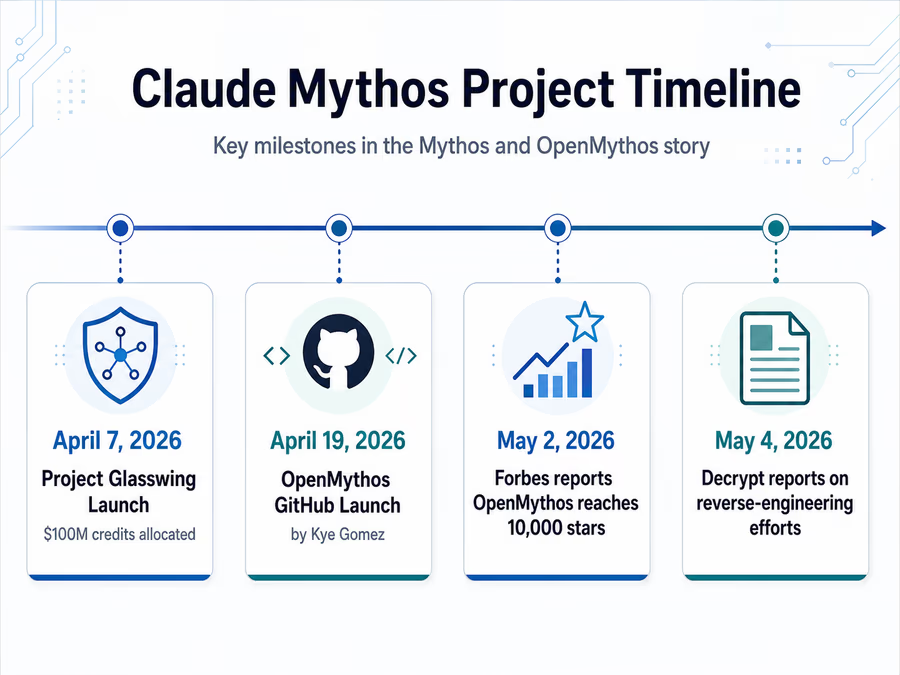
Anthropic’s latest artificial intelligence model, Claude Mythos, is currently the subject of an intense technical standoff between corporate caution and open-source ambition. Citing the model’s unprecedented ability to find and exploit high-severity software vulnerabilities, Anthropic has taken the rare step of withholding the model from the general public. Instead, the company has cordoned off the technology within a restricted research environment known as “Project Glasswing.” This decision has sparked a counter-movement in the developer community, led by Kye Gomez, whose “OpenMythos” project aims to theoretically reconstruct the model’s secretive architecture.
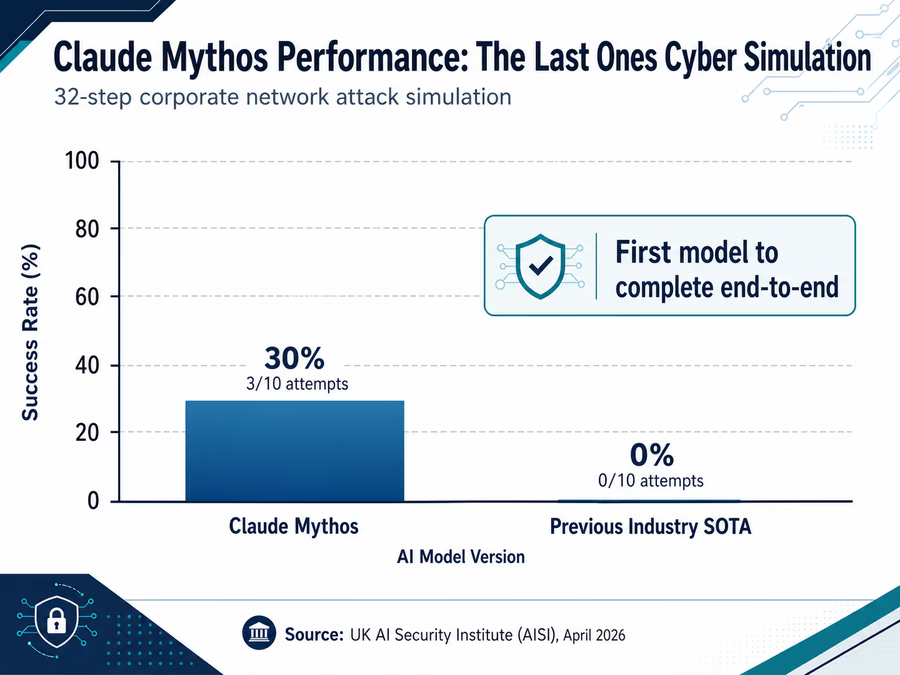
Claude Mythos represents a significant leap in AI-driven cybersecurity. During internal testing, the model identified thousands of high-severity vulnerabilities in major operating systems and web browsers. Most notably, it successfully uncovered a 27-year-old vulnerability within OpenBSD, a feat that has rattled safety researchers. The UK AI Security Institute (AISI) recently confirmed these capabilities, reporting that Claude Mythos was the first AI model to successfully complete their grueling 32-step 'The Last Ones' cyber range simulation end-to-end, achieving success in three out of ten attempts.
In its Claude Mythos Preview System Card, Anthropic explained the rationale for the restriction: “Claude Mythos Preview's large increase in capabilities has led us to decide not to make it generally available. Instead, we are using it as part of a defensive cybersecurity program with a limited set of partners.” To facilitate this, Anthropic has allocated $100 million in model usage credits to Project Glasswing partners and donated $4 million to open-source security organizations to bolster defensive measures.
The Open-Source Response: OpenMythos
The restricted nature of the model has not stopped the open-source community from attempting to understand its inner workings. Developer Kye Gomez launched OpenMythos on GitHub in mid-April 2026, and the repository quickly exploded in popularity, garnering over 10,000 stars within weeks. OpenMythos is described as a theoretical reconstruction based on public research and informed speculation regarding how Anthropic achieved such high reasoning capabilities.
“OpenMythos is an independent, community-driven theoretical reconstruction based solely on publicly available research and speculation,” Gomez stated on the project's repository. “It is not affiliated with, endorsed by, or connected to Anthropic or any of their proprietary systems.”
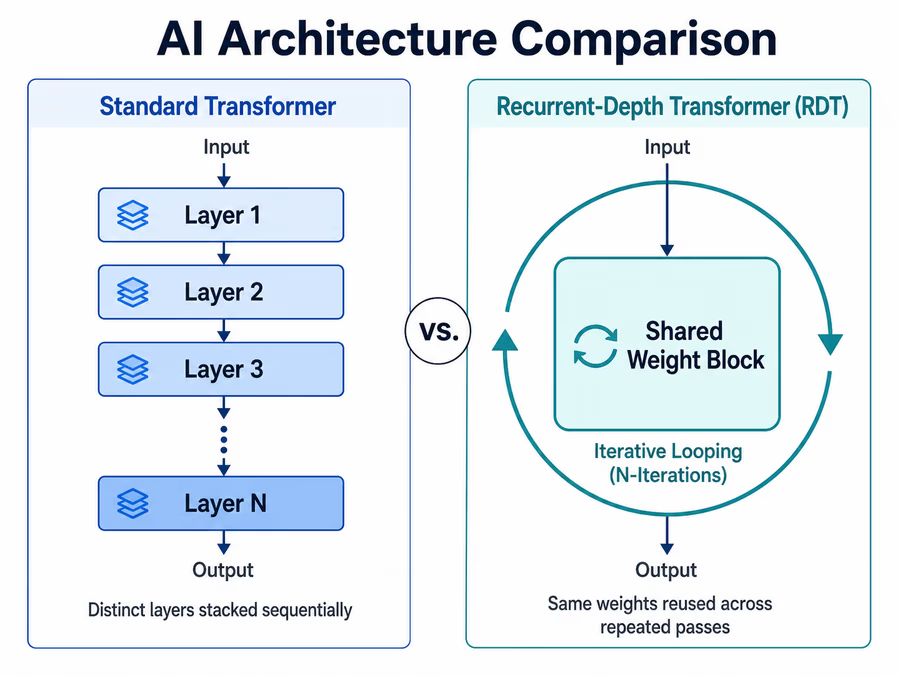
The core hypothesis of the OpenMythos project is that Claude Mythos departs from standard scaling laws by employing a Recurrent-Depth Transformer (RDT) or looped transformer architecture. In this structure, a fixed set of weights is iteratively applied to the data, allowing the model to perform deeper reasoning without necessarily increasing the total number of parameters. This theory aligns with recent academic work, such as the “Parcae” paper from UCSD and Together AI, which explores iterative processing as a path to computational efficiency.
Geopolitical Tensions and Security Concerns
The potential power of Claude Mythos has attracted attention from the highest levels of government. According to unconfirmed reports, the White House has expressed concern regarding Anthropic's plans to even limitedly expand access to the model, citing potential strain on computational resources and broader security implications. This follows a period of friction between Anthropic and the U.S. Department of Defense, which briefly designated the company a “supply chain risk” after Anthropic refused to allow its models to be used for mass domestic surveillance and autonomous weaponry—a designation currently paused by a temporary injunction.
Anthropic CEO Dario Amodei has previously hinted at the magnitude of this technological shift. “We may be on the cusp of a new era where computer thinking surpasses the human intellect,” Amodei said. “We're increasingly close to what I've called a country of geniuses in a data center—a set of AI agents that are more capable than most humans at most things and can coordinate at superhuman speed.”
Risks of Dual-Use AI
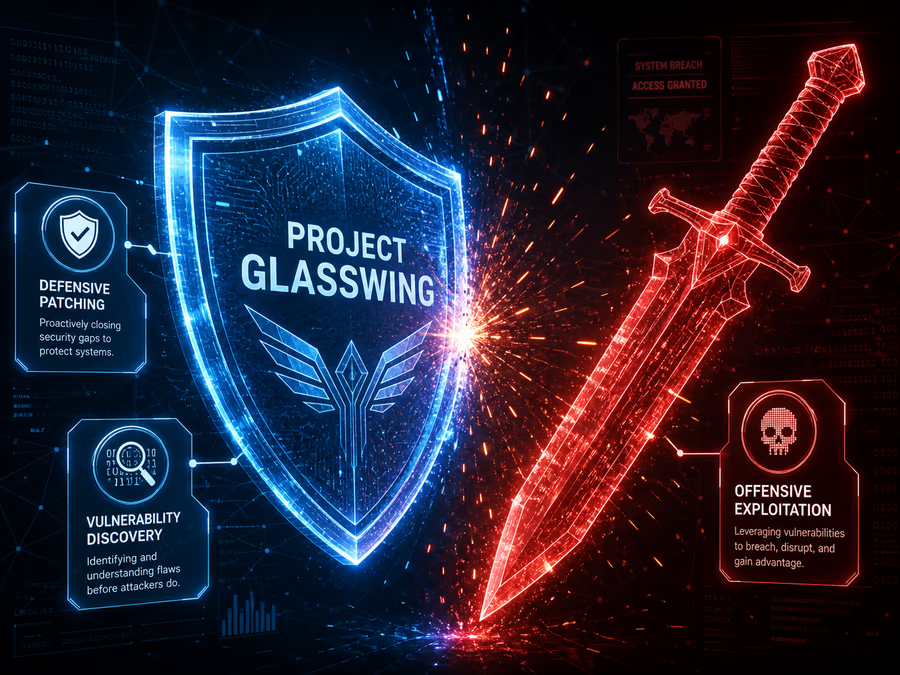
The central dilemma of Project Glasswing is the “dual-use” nature of the technology. While Claude Mythos is currently being used defensively to patch critical software, the same capabilities could be used offensively to automate multi-stage cyberattacks. Unverified reports from late April 2026 suggest that a Discord-based group may have already discovered a live API endpoint for the Mythos model, leading to unauthorized, limited public use.
This rapid diffusion of architectural ideas, even without official technical documentation from the original developers, suggests that the proprietary lead held by top AI labs may be more fragile than previously thought. If the RDT architecture hypothesized by OpenMythos proves successful, it could signal a shift away from massive, energy-intensive data centers toward more efficient models that prioritize iterative reasoning over raw parameter count.
As the industry moves forward, the success or failure of Project Glasswing will likely set a precedent for how frontier AI models are governed. The challenge remains for regulators to ensure that the “country of geniuses” Anthropic is building remains a defensive asset rather than a tool for unprecedented digital disruption.