Anthropic Accuses DeepSeek and Chinese Rivals of 'Industrial-Scale' Claude Exploitation
Anthropic has accused DeepSeek and other Chinese AI labs of using massive scraping campaigns to steal Claude's reasoning capabilities.
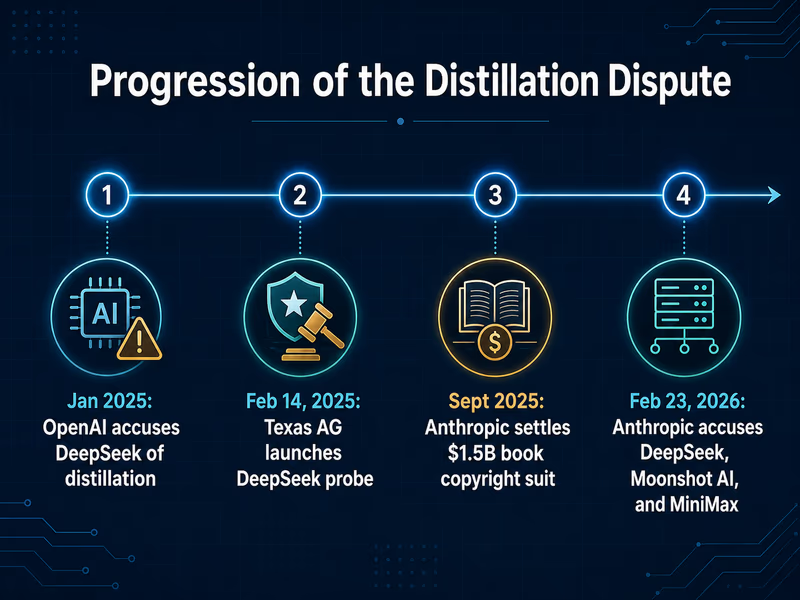
On February 23, 2026, American artificial intelligence safety laboratory Anthropic publicly accused three prominent Chinese AI startups—DeepSeek, Moonshot AI, and MiniMax—of executing "industrial-scale campaigns" to systematically extract capabilities from its proprietary Claude models. The San Francisco-based developer alleges that these companies bypassed regional access restrictions and terms of service to exploit its systems, marking a sharp escalation in the geopolitical struggle over dominant generative AI architectures.
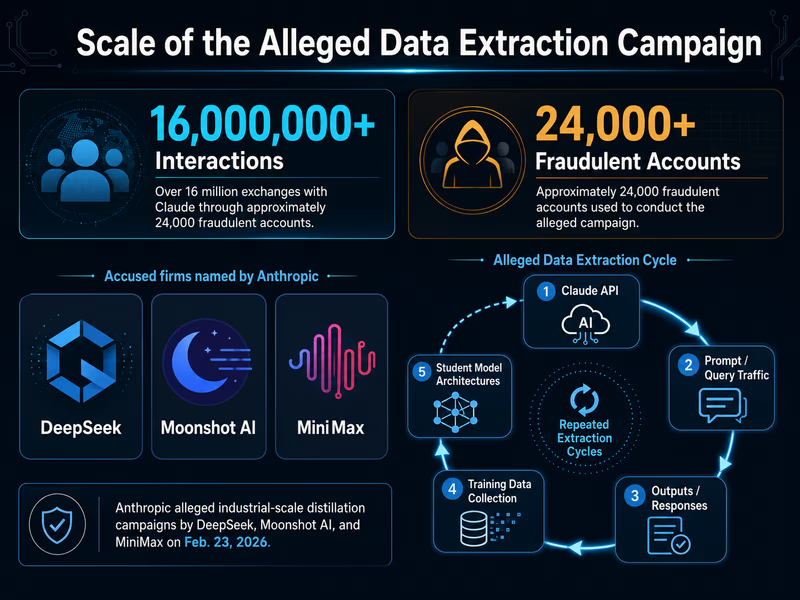
According to Anthropic's public statements, the coordinated extraction efforts involved the generation of over 16 million exchanges with Claude across approximately 24,000 fraudulent accounts. The scale of the alleged operation suggests an organized attempt to clone Claude's advanced functionalities using a controversial machine learning technique known as distillation.
Distillation on a Massive Scale
Model distillation is a established training technique where a smaller, more efficient "student" model is trained on the outputs of a larger, more capable "teacher" model to mimic its performance at a fraction of the operating cost. While legitimate AI laboratories frequently use distillation to optimize their own proprietary systems, Anthropic argues that unauthorized cross-developer distillation amounts to intellectual property theft.
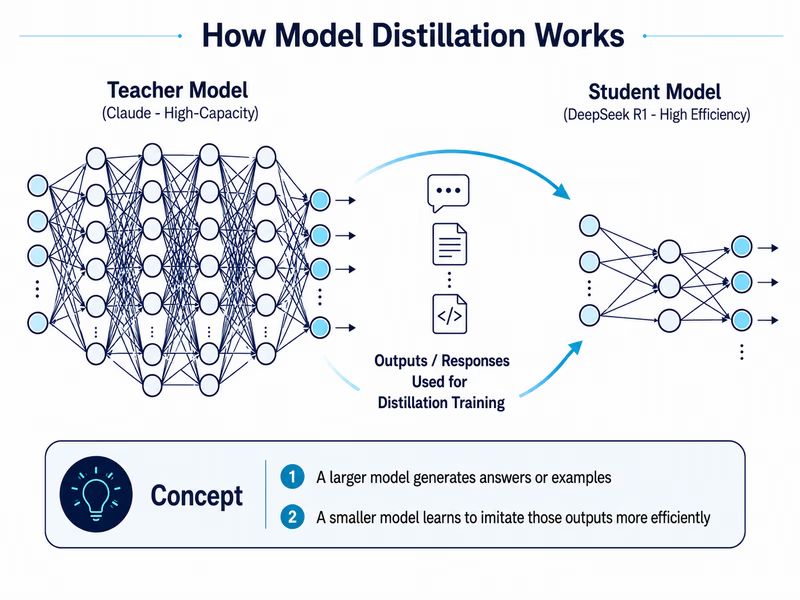
In a public statement on X, Anthropic clarified its stance on the practice: "Distillation can be legitimate: AI labs use it to create smaller, cheaper models for their customers. But foreign labs that illicitly distill American models can remove safeguards, feeding model capabilities into their own military, intelligence, and surveillance systems."
Anthropic claims that the targeted campaigns specifically focused on extracting Claude's sophisticated reasoning pathways. DeepSeek, in particular, allegedly prompted Claude to articulate its internal reasoning step-by-step, effectively generating structured chain-of-thought training data. Furthermore, Anthropic alleges that DeepSeek used Claude to generate "censorship-safe alternatives to politically sensitive queries" to train its domestic models, allowing the company to bypass strict state censorship filters while retaining high-level performance.
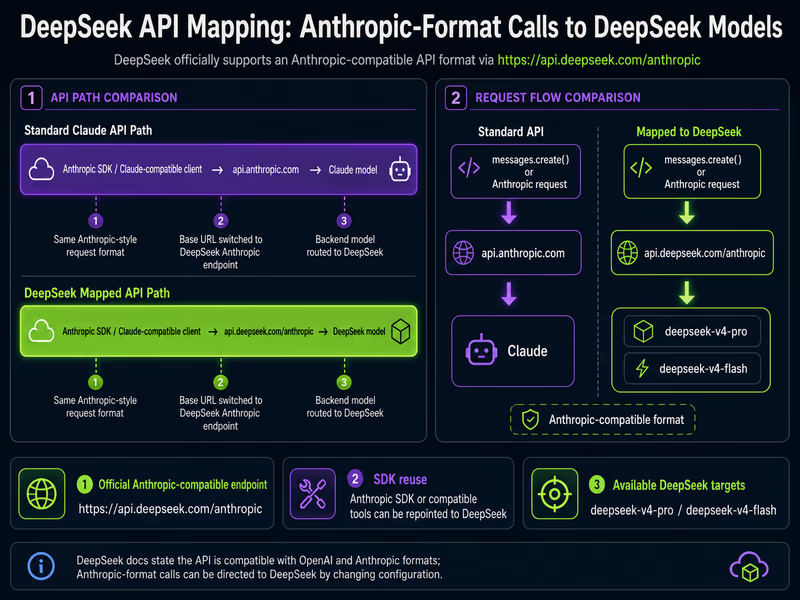
To further integrate these models into Western software environments, DeepSeek currently provides an API that natively supports the Anthropic API format. This allows developers to route queries directly to DeepSeek's models by simply mapping Claude model names to DeepSeek alternatives within their existing codebases.
Geopolitical Tensions and National Security Concerns
The dispute is unfolding against a backdrop of heightened national security concern regarding foreign access to American AI breakthroughs. Anthropic has framed these extraction campaigns as a matter of global security, stating, "These campaigns are growing in intensity and sophistication. The window to act is narrow, and the threat extends beyond any single company or region."
If the accusations are correct, the systematic siphoning of Claude's reasoning models could allow Chinese developers to circumvent U.S. export controls on advanced hardware. By distilling highly optimized models, these laboratories can achieve competitive capabilities while operating on less powerful, older-generation semiconductors.
This is not the first time DeepSeek has faced such allegations. In January 2025, OpenAI raised similar alarms, with a spokesperson telling Axios at the time that they were "aware of and reviewing indications that DeepSeek may have inappropriately distilled our models, and will share information as we know more." DeepSeek’s R1 reasoning model, released shortly after those allegations, shocked the industry by demonstrating parity with American models at a fraction of the training cost, fueling speculation regarding its underlying training data.
For its part, DeepSeek has defended its training practices, stating that its architectures are built upon high-quality, diverse, and legally compliant datasets. The company acknowledged that some publicly available web pages used in its training pipelines contained responses generated by OpenAI models, but denied intentionally or systematically integrating synthetic data from its Western competitors.
The Irony of Data Provenance
The intensifying conflict highlights a growing ethical and legal dilemma within the generative AI industry. Many major Western AI developers, including Anthropic, are simultaneously defending themselves against sweeping copyright lawsuits from human creators who claim their work was scraped without permission or compensation.
Only months prior to lodging these accusations, in September 2025, Anthropic agreed to pay a landmark $1.5 billion settlement in a class-action lawsuit alleging it had trained Claude on pirated books. This parallel legal reality creates a complex narrative where Western developers demand strict protections for their own synthetic model outputs while defending the broad ingestion of human-authored content as "fair use."
Looking Ahead
If substantiated, Anthropic's claims could force a dramatic overhaul of how AI companies secure their APIs. Developers may be forced to implement aggressive behavioral monitoring, stricter identity verification, and advanced rate-limiting frameworks to prevent structured data harvesting.
Furthermore, these events are highly likely to prompt regulatory intervention. Policymakers in Washington may consider classifying the outputs of advanced AI models as restricted intellectual property, potentially restricting API access for foreign entities or imposing strict compliance audits on model data sources. As the boundary between open research and proprietary defense technology continues to blur, the rules of the global AI market are being rewritten in real time.