AMD 'Gorgon Halo' Leak: Ryzen AI Max+ PRO 495 Promises 192GB Memory for Local LLMs
Leaked specifications for AMD's Ryzen AI Max+ PRO 495 reveal 16 Zen 5 cores and 192GB memory support, aiming for elite local AI performance.
Specifications for AMD’s next-generation flagship APU, the Ryzen AI Max+ PRO 495, have surfaced via a PassMark benchmark entry, signaling a significant leap in on-device artificial intelligence capabilities for commercial workstations. This processor, codenamed 'Gorgon Halo,' appears to be a high-performance refresh of the 'Strix Halo' architecture, pushing the boundaries of what integrated graphics and memory capacity can achieve in a single package.
A Powerhouse in One Package
The leaked data identifies the Ryzen AI Max+ PRO 495 as a 16-core, 32-thread powerhouse built on the latest 'Zen 5' architecture. Beyond the high core count, the leak highlights the inclusion of a Radeon 8065S integrated GPU. This graphics solution is based on the RDNA 3.5 architecture and is believed to be a higher-clocked variant of the Radeon 8060S, which already features 40 RDNA 3.5 Compute Units.
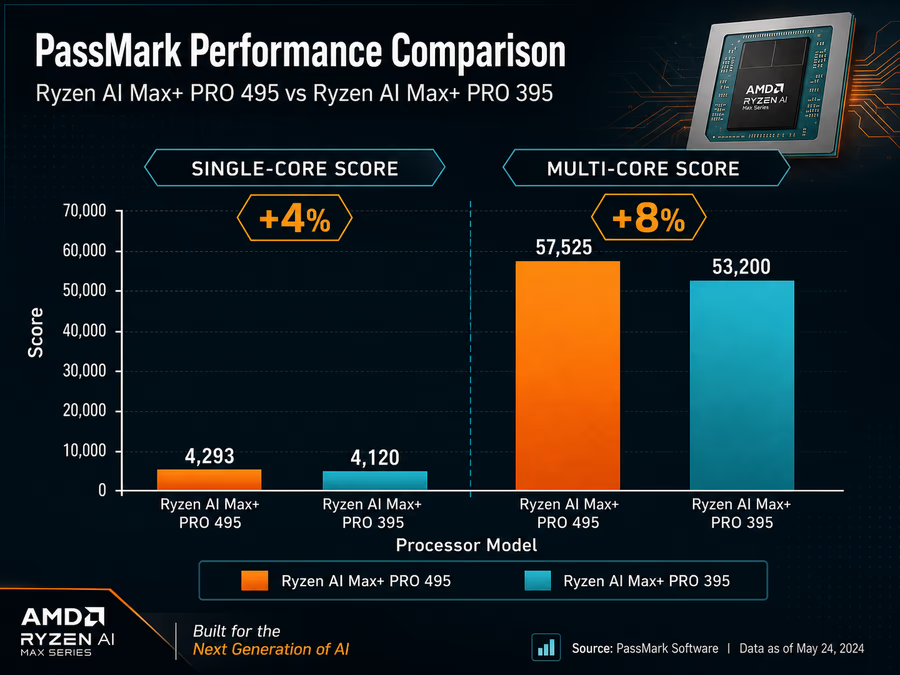
While AMD has not officially confirmed clock speeds, unverified reports accompanying the leak suggest that the CPU could feature boost clocks of 5.2 GHz, while the integrated GPU may reach 3.0 GHz. These figures represent iterative but meaningful increases over the previous Ryzen AI Max+ 395 flagship. The PassMark results support these claims, with the chip scoring 4,293 points in single-core performance and 57,525 points in multi-core tests. This indicates a performance uplift of roughly 3% to 5% in single-threaded tasks and a more substantial 4% to 10% gain in multi-threaded workloads compared to its predecessor.
The 192GB Memory Breakthrough
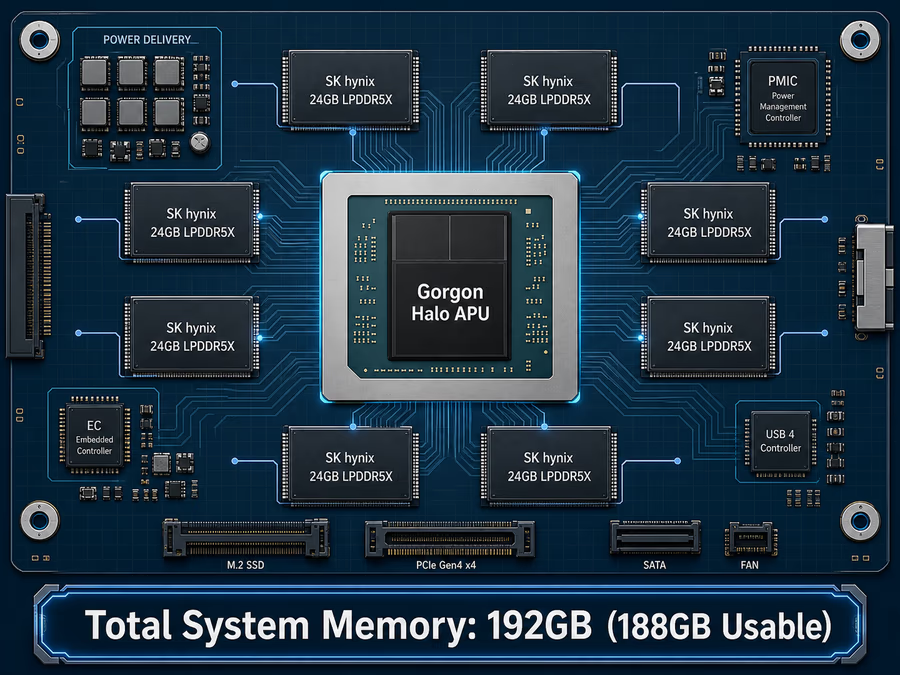
Perhaps the most impactful detail found in the leak is the system's memory configuration. The benchmarked unit was equipped with 192GB of LPDDR5X memory, achieved via eight 24GB SK hynix packages. The system reported 188GB of usable memory, a massive jump from the 128GB capacity typically supported by current high-end Strix Halo systems.
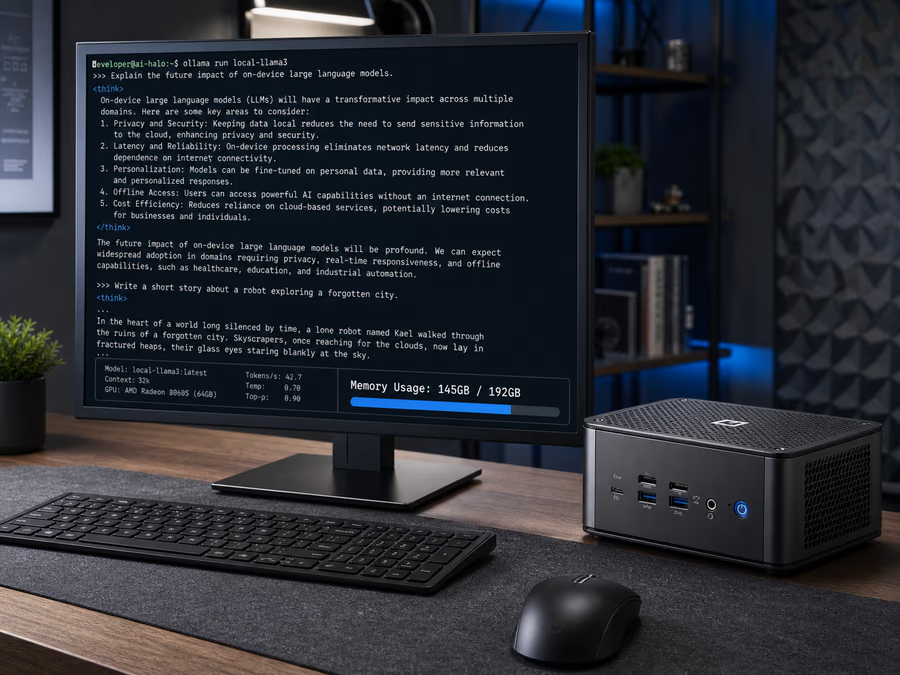
This expanded memory footprint is not merely for traditional multitasking; it is a strategic necessity for the modern AI landscape. By providing nearly 200GB of high-speed unified memory, AMD is positioning 'Gorgon Halo' as a premier platform for running large language models (LLMs) and complex AI workloads locally. Local execution offers businesses and developers distinct advantages in data privacy, lower latency, and reduced reliance on expensive cloud-based compute clusters.
Strategic Alignment: AI Everywhere
The emergence of the 'PRO' designated chip aligns with AMD’s broader commercial strategy. During her CES 2026 keynote, AMD CEO and Chair Dr. Lisa Su positioned recent announcements as part of a cohesive effort to scale AI capability seamlessly from consumer hardware to hyperscale and sovereign deployments. She further emphasized a clear ambition to bring AI everywhere for everyone, suggesting that high-performance client hardware is essential to democratizing AI access.
The 'PRO' branding signifies that this APU is intended for enterprise environments. These chips typically include enhanced security features, remote manageability, and guaranteed long-term software stability—features that are increasingly critical as companies integrate AI-assisted workflows into their core operations. By combining these enterprise-grade features with a powerful NPU and high memory capacity, AMD aims to secure its lead in the burgeoning 'AI PC' market.
Competitive Landscape and Market Impact
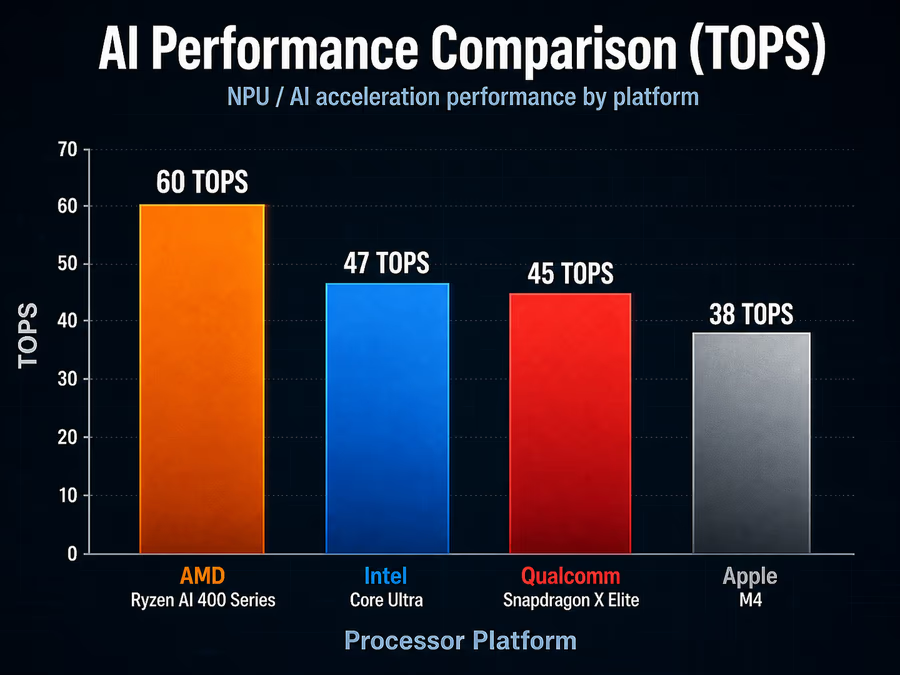
AMD's move comes at a time of intense competition. Intel’s Core Ultra processors and Qualcomm’s Snapdragon X Elite have set high bars for NPU performance, while Apple’s M-series chips continue to leverage unified memory for impressive AI efficiency. However, the reported 60 TOPS of AI compute from AMD's Ryzen AI 400 series—when combined with the 'Gorgon Halo' GPU and massive memory capacity—could provide a unique value proposition for power users who require more than just basic NPU acceleration.
For creative professionals and data scientists, the Ryzen AI Max+ PRO 495 could turn high-end laptops and small-form-factor workstations into capable AI development nodes. The ability to load larger models into memory without offloading to a discrete GPU or the cloud could fundamentally change the economics of AI development.
As systems featuring these new processors are expected to become available in the second quarter of 2026, the industry will be watching closely to see if 'Gorgon Halo' can deliver on the promise of the leaked benchmarks. If these specifications hold true, AMD will have successfully moved the goalposts for what constitutes a high-performance AI workstation.