Alphabet to Raise $80 Billion in Massive Equity Push to Fund AI Infrastructure
Alphabet is raising $80 billion in equity capital, backed by a $10 billion investment from Berkshire Hathaway, to expand its AI infrastructure.
Alphabet announced plans on June 1, 2026, to raise $80 billion in equity capital to finance a massive expansion of its artificial intelligence infrastructure. This fundraising plan marks the tech giant's first stock issuance since 2005, highlighting the staggering capital requirements needed to maintain competitiveness and lead in the rapidly escalating generative AI era.
The announcement reflects the intense financial pressure tech companies face as they race to build the massive data centers and hardware arrays necessary to run next-generation AI models. While Alphabet has historically relied on its robust organic cash flow, the sheer scale of the AI transition is driving the company to seek external capital to keep pace with demand.
Inside the $80 Billion Capital Plan
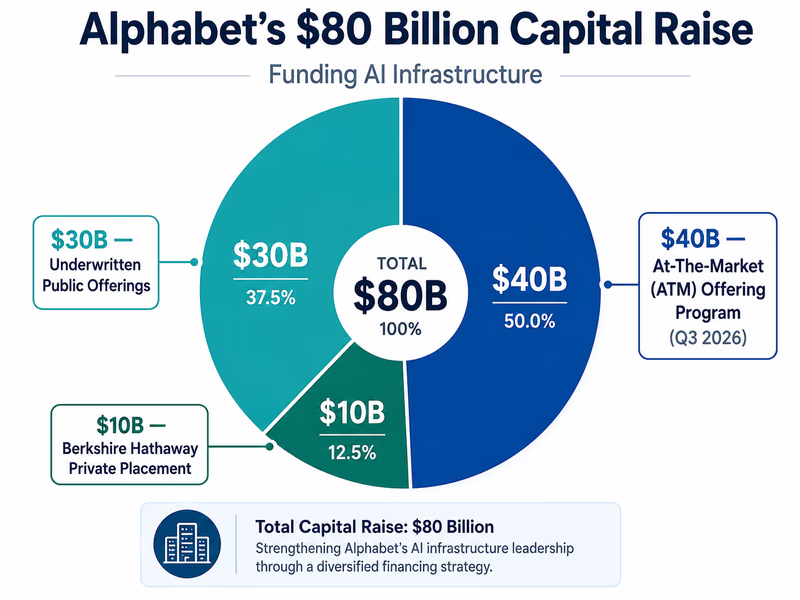
Alphabet's multi-stage capital-raising strategy is structured to balance immediate funding needs with long-term financial flexibility. The total $80 billion plan comprises three key components:
* $30 billion through underwritten public offerings.
* $40 billion through an at-the-market (ATM) offering program, which is expected to launch in Q3 2026.
* $10 billion via a private placement from Warren Buffett's Berkshire Hathaway.
Beyond raising capital, the $40 billion ATM program is designed to help Alphabet manage tax obligations associated with employee equity awards. By transitioning to a "sell-to-cover" model, the company can utilize the program to smoothly absorb these recurring financial obligations.
Investors initially reacted with caution to the scale of the equity issuance. Following the announcement, Alphabet's pre-market stock price experienced an initial drop of 2.6%, reflecting market concerns over potential share dilution and the immense capital commitments required to support the company's AI ambitions. Alphabet has also aggressively leveraged debt markets over the past year, accruing more than $85 billion across various currencies and pushing its total debt balance beyond $100 billion.
Berkshire Hathaway’s $10 Billion Endorsement
A major highlight of the fundraising effort is the $10 billion commitment from Berkshire Hathaway. The investment is split equally between two share classes: $5 billion in Class A shares priced at $351.81 per share, and $5 billion in Class C shares at $348.20 per share.
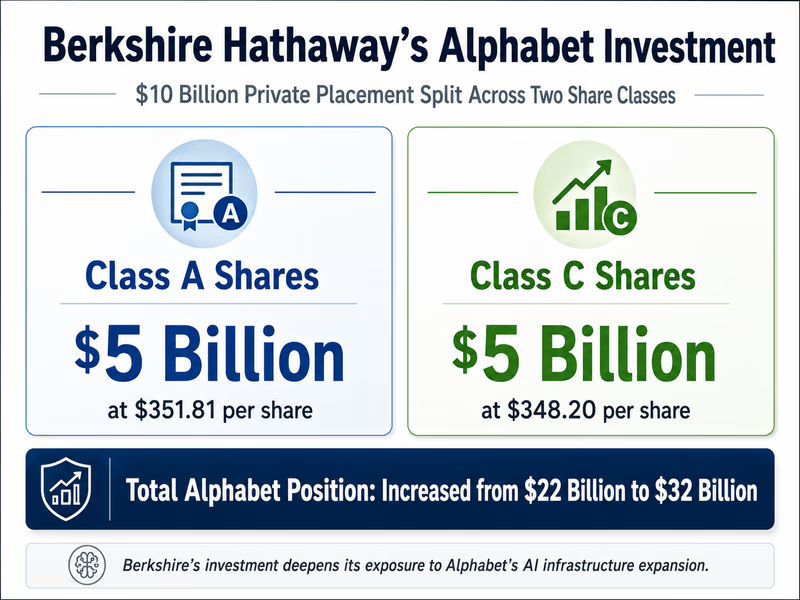
This represents one of the most significant technology sector moves under Berkshire Hathaway’s new CEO, Greg Abel. Berkshire began building its position in Alphabet in Q3 2025 and expanded it significantly in Q1 2026. Prior to this private placement, Berkshire held an Alphabet stake valued at approximately $22 billion; this new commitment will push its total holdings to roughly $32 billion.
Market experts view the purchase as a strong validation of Alphabet's trajectory. "All companies are thrilled when Berkshire takes positions, because it is the kind of shareholder that companies like to have," noted Steven Check, President and Chief Investment Officer of Check Capital Management.
Bill Stone, Chief Investment Officer at Glenview Trust Company, agreed that the commitment is a positive indicator for Alphabet's high-stakes capital strategy. Stone stated that this additional purchase underscores that Greg Abel believes that Alphabet will earn a reasonable return on its AI capex spending even with the firm issuing additional shares.
Overcoming Compute Constraints
The driving force behind this massive capital injection is an unprecedented surge in demand for artificial intelligence services. In public statements, Alphabet has noted that "AI is driving an expansionary moment" for the company, adding that it is experiencing strong demand for its AI solutions and services from enterprises and consumers, at levels that are exceeding the company's available supply.
According to Google CEO Sundar Pichai, the company is "compute constrained in the near term." To address these supply bottlenecks, Alphabet is aggressively scaling its investments to expand its foundational infrastructure to support the significant growth opportunity ahead.
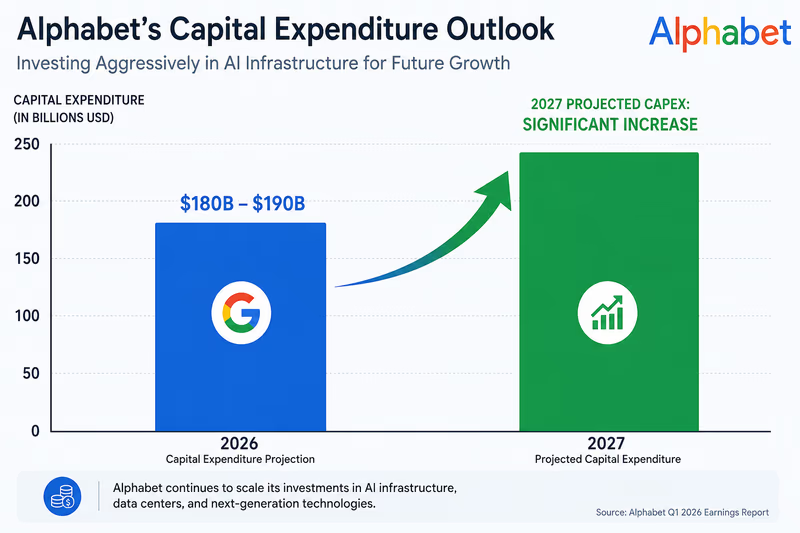
Alphabet has revised its capital expenditure forecast for 2026, projecting total spending to range between $180 billion and $190 billion. Looking further ahead, the company anticipates that its 2027 capital expenditures will "significantly increase" compared to its 2026 levels.
Broad Market and Energy Implications
Alphabet is not alone in its massive infrastructure spending. Major technology companies, including Amazon, Microsoft, Alphabet, and Meta, are projected to collectively spend over $700 billion this year on AI data centers, chips, and computing infrastructure. Microsoft has also publicly acknowledged facing capacity shortfalls in meeting the demand for AI infrastructure, emphasizing that supply constraints are a sector-wide challenge.
Alphabet’s investments are already yielding strong results in its enterprise division. Google Cloud reported a 63% year-over-year revenue increase in Q1 2026, reaching $20 billion, supported by a substantial $460 billion contract backlog driven by enterprise customers seeking AI compute capacity. To mitigate its reliance on third-party silicon, Google is actively promoting its homegrown Tensor Processing Units (TPUs) as a key alternative to Nvidia’s dominant AI processors.
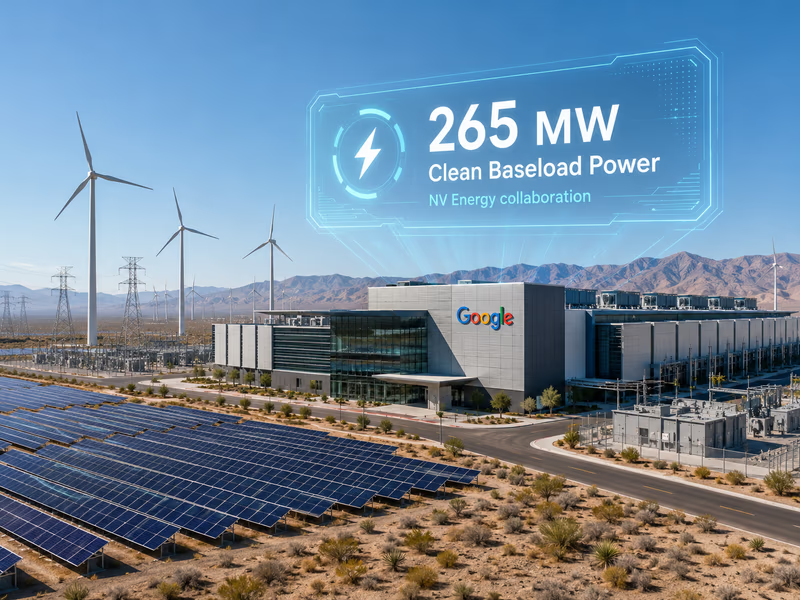
Furthermore, the physical infrastructure supporting generative AI requires vast amounts of electricity. Highlighting this trend, Berkshire Hathaway Energy's subsidiary, NV Energy, is reportedly collaborating with Google to supply 265 MW of clean, 24/7 baseload power to Google's Nevada operations. This partnership underscores how the AI infrastructure race is reshaping not only the financial markets but also the global energy sector.