
Alibaba Launches Qwen 3.6-Max-Preview as Strategic Pivot Toward Proprietary AI
Alibaba debuts Qwen 3.6-Max-Preview, its most powerful proprietary model to date, signaling a major strategic shift toward cloud-based monetization.
Alibaba Cloud’s New Flagship: Qwen 3.6-Max-Preview
Alibaba Cloud has officially released Qwen 3.6-Max-Preview, its most capable proprietary model to date, marking a definitive shift away from its historically open-source roots. Launched on April 20, 2026, the new flagship model is designed to excel in agentic coding and complex reasoning. Unlike many earlier iterations of the Qwen family, this model is proprietary and hosted, with no open weights available for download. It is currently accessible via Alibaba Cloud Model Studio, the Qwen Chat interface, and the third-party aggregator OpenRouter.
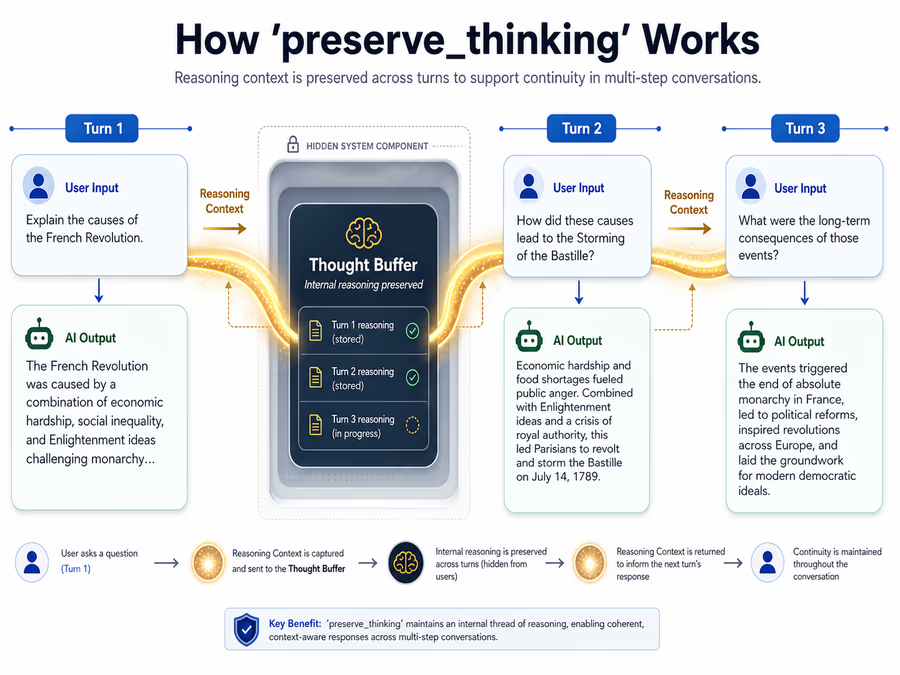
The model introduces a suite of improvements over its predecessor, Qwen 3.6-Plus, particularly in world knowledge, instruction following, and agentic workflows. One of the most significant technical additions is a feature called `preserve_thinking`, which allows the model to maintain and carry over internal reasoning content across multiple conversation turns. Alibaba researchers recommend this feature for complex agentic tasks where maintaining a coherent logical chain is critical for success.
Dominance on Coding and Agent Benchmarks
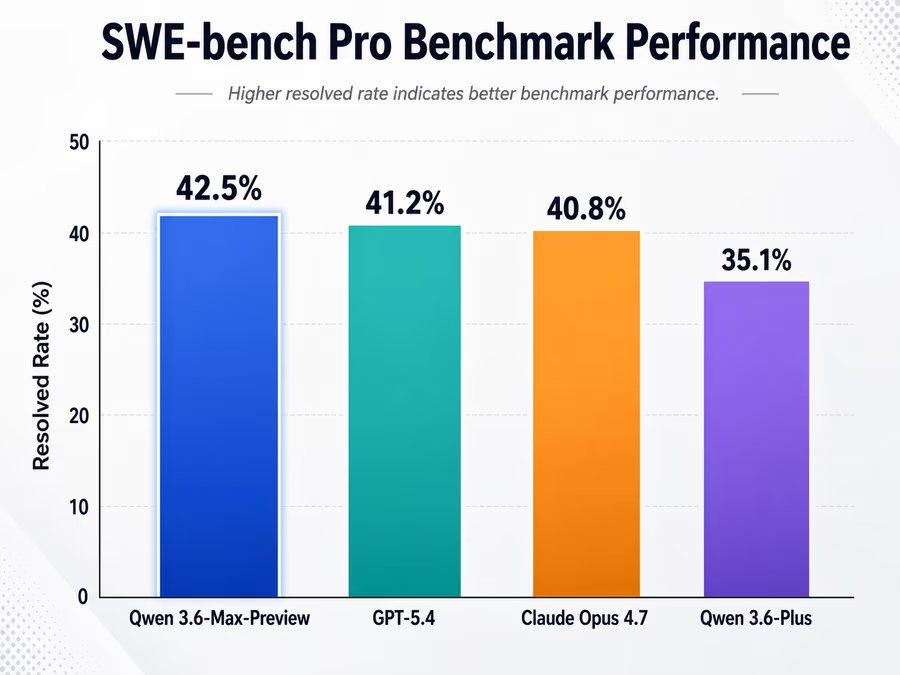
Alibaba claims the 3.6-Max-Preview has secured the top spot on six major industry benchmarks, specifically targeting coding and agent-based capabilities. According to the company’s internal reporting, the model leads the field on SWE-bench Pro, Terminal-Bench 2.0, SkillsBench, QwenClawBench, QwenWebBench, and SciCode. These results suggest a model highly optimized for autonomous software engineering and multi-step digital tasks.
However, the reception within the developer community has been mixed. While Alibaba’s internal metrics are impressive, independent testing in real-world coding environments suggests the model may actually rank third, trailing behind Anthropic’s Claude Opus 4.7 and OpenAI’s GPT-5.4. Furthermore, industry observers have pointed out that several of the benchmarks cited—such as QwenClawBench and QwenWebBench—are proprietary evaluations owned by Alibaba itself, leading to questions regarding potential optimization bias.
A Strategic Pivot to the "Agent-Driven Era"
The transition to a closed-weight, proprietary model signals a significant strategic change for Alibaba. Previously, the company was a champion of the open-source movement, with models like Qwen-7B and Qwen2.5-1M garnering over a billion cumulative downloads. This shift mirrors a broader trend among Chinese AI leaders, such as Zhipu AI, who are increasingly moving toward proprietary models to capture revenue through official cloud channels.
Alibaba Group CEO Eddie Wu recently characterized AI as one of the company’s primary growth engines. He stated that the company is witnessing a fundamental shift toward an agent-driven era of AI development, which he believes requires tight integration between the underlying model and the application layer. By keeping the weights proprietary, Alibaba can better monetize inference and cloud infrastructure.
This commercial reality was reinforced by Alibaba Group chairman Joe Tsai. When questioned about the company's previous open-source contributions, Tsai explained that the company does not make money directly from the models themselves, but rather through the monetization of inference and cloud services. By reserving the "Max" performance tier for its own cloud platform, Alibaba follows a playbook similar to Microsoft’s enterprise-first strategy.
Enterprise Integration and Ecosystem Expansion
Alibaba is already embedding Qwen 3.6-Max-Preview deep into its industrial ecosystem. The model is currently being integrated into vehicles from major manufacturers including BYD, Geely, and SAIC Volkswagen, where it will power next-generation voice-activated commands. Beyond automotive, the company is deploying the AI for consumer-facing services such as automated flight booking and food ordering.
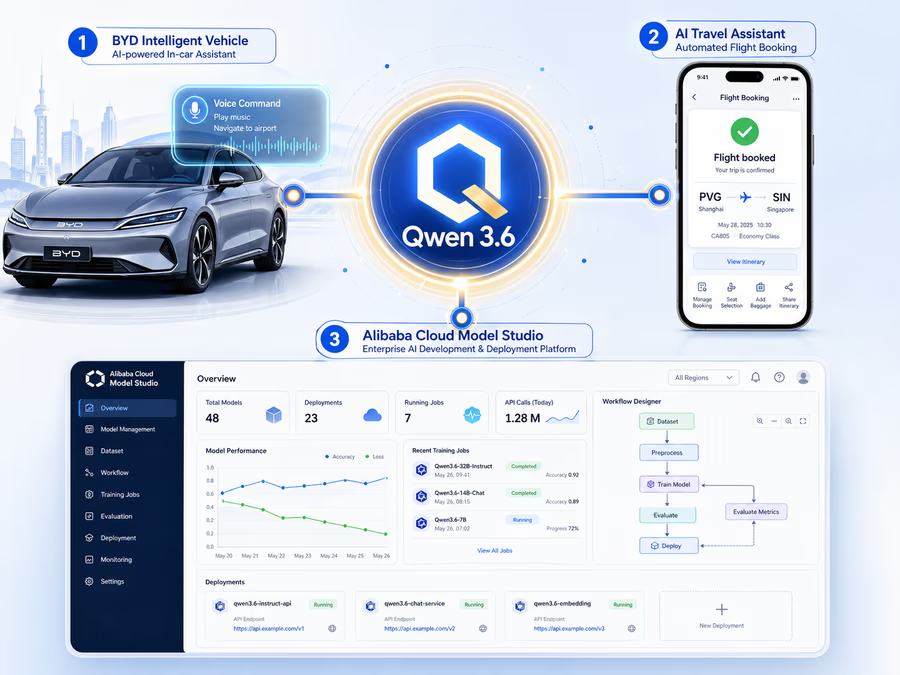
To support this rollout, Alibaba Cloud is investing heavily in its "Model-as-a-Service" (MaaS) platform and the newly established Wukong Business Unit, which focuses on enterprise AI agents. The company has committed over $52.4 billion in capital expenditure over the next three years to bolster its AI infrastructure.
Technical Trade-offs and Internal Transition
Despite the performance gains, the Qwen 3.6-Max-Preview launch has raised eyebrows due to a perceived downgrade in context handling. The model supports a 256k token context window, which is significantly smaller than the 1M token window offered by the previous Qwen 3.6-Plus. Additionally, the model is currently limited to text input, lacking the vision capabilities present in other contemporary frontier models.
These technical decisions come amid internal management shifts at Alibaba’s AI unit. Lin Junyang, the former head of the Qwen AI unit, resigned in March 2026. Following his departure, Alibaba formed a dedicated task force to accelerate foundation model development, of which the 3.6-Max-Preview is the first major output.
As the Chinese AI market becomes increasingly competitive with entries from DeepSeek and MiniMax, Alibaba’s move to protect its most powerful intellectual property marks a new chapter in the global AI race. The company is betting that the path to profitability lies not in the goodwill of the open-source community, but in the proprietary control of high-performance agents integrated into the fabric of global industry.