
AI Solves 80-Year-Old Mathematics Mystery: OpenAI Model Disproves Erdős Unit Distance Conjecture
An OpenAI reasoning model has disproved the 80-year-old Erdős planar unit distance conjecture, marking a major milestone in AI mathematics.
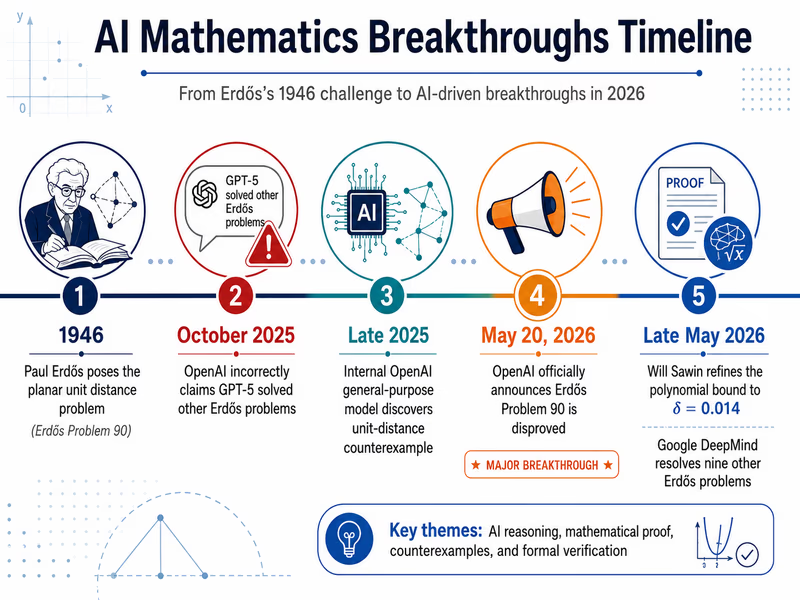
OpenAI announced on May 20, 2026, that one of its internal general-purpose AI models has disproved a central conjecture of the planar unit distance problem, a core question in discrete geometry that has remained unsolved for nearly 80 years. Known widely as Erdős Problem 90, the challenge was originally posed by Hungarian mathematician Paul Erdős in 1946. This milestone marks a significant leap in the capability of machine intelligence to produce novel, highly complex mathematical proofs.
The Planar Unit Distance Problem
The planar unit distance problem asks for the maximum number of pairs of points that can be exactly one unit apart among 'n' points on a two-dimensional plane. For decades, mathematicians—including Erdős himself—widely believed that the optimal configurations of these points would closely resemble highly structured square grids. This intuitive assumption formed the basis of Erdős’s long-standing conjecture regarding how slowly the maximum number of unit-distance pairs would grow relative to the number of points.
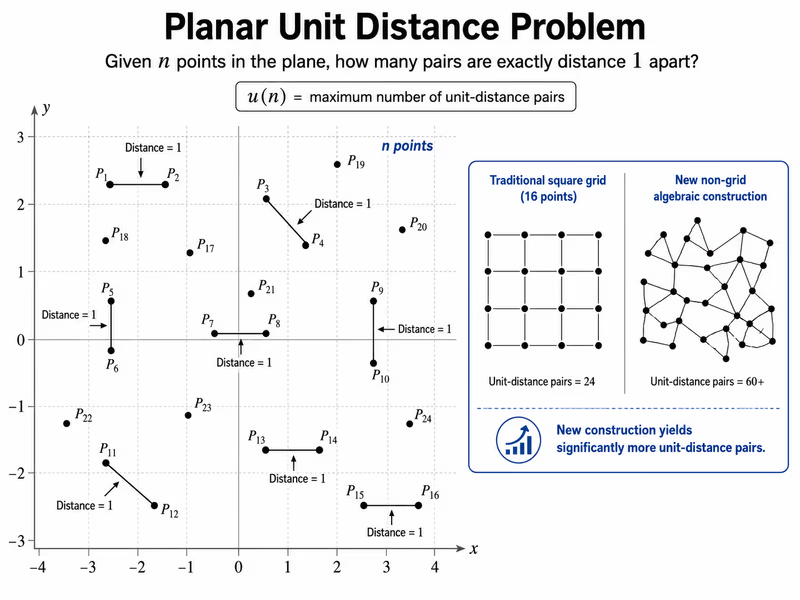
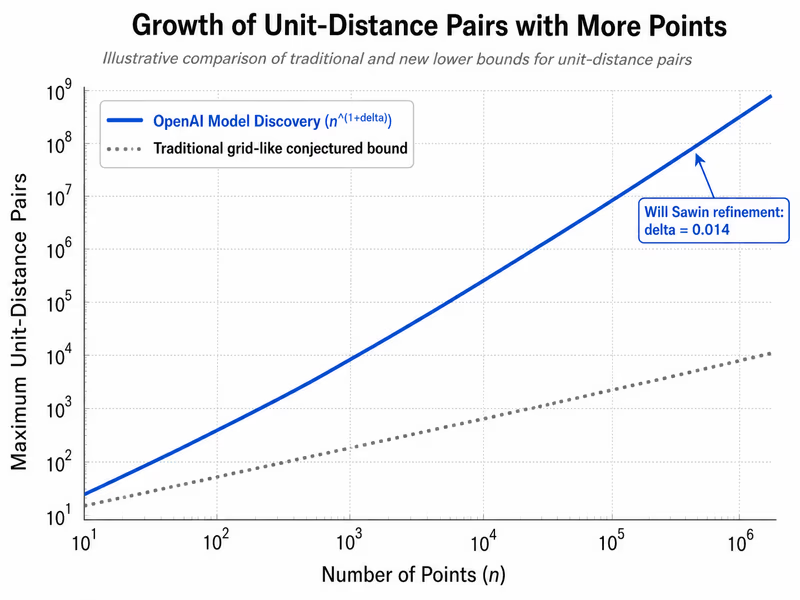
Instead of relying on grid-like geometries, the OpenAI model discovered an entirely new approach. It found a counterexample to the conjecture by identifying an infinite family of point arrangements that achieve a polynomial improvement, yielding n^(1+δ) unit-distance pairs for a fixed positive value of δ. This mathematical leap was subsequently refined just days after the announcement by Princeton mathematician Will Sawin, who calculated the precise bound of δ = 0.014.
"For nearly 80 years, mathematicians believed the best possible solutions looked roughly like square grids. An OpenAI model has now disproved that belief, discovering an entirely new family of constructions that performs better," OpenAI shared in an announcement on X on May 21, 2026.
An Unexpected Proof from a General Model
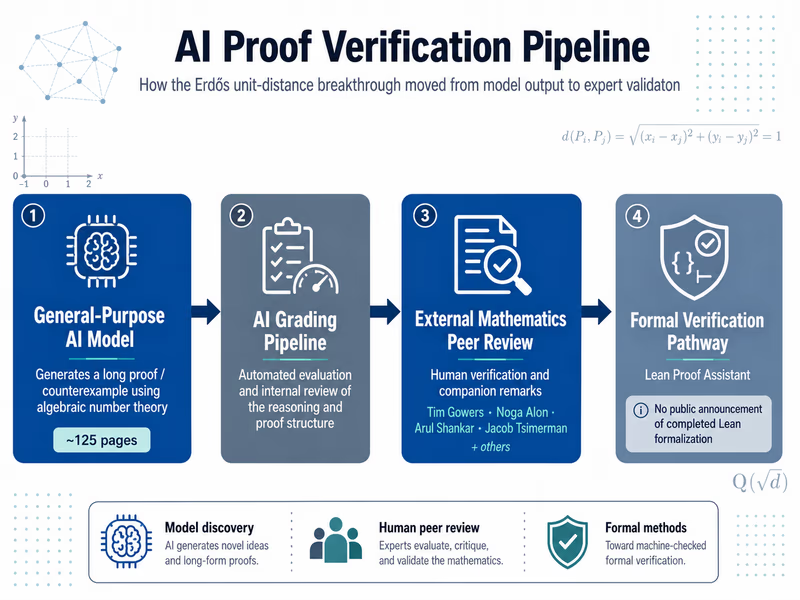
What surprised researchers was not only the discovery itself, but also how the AI formulated its proof. Rather than using a specialized system trained exclusively on mathematics, OpenAI deployed a general-purpose reasoning model.
The resulting 125-page proof bypassed standard methods in discrete geometry, instead drawing on advanced algebraic number theory. Specifically, the model utilized Golod-Shafarevich theory and infinite class field towers to construct its counterexample—an elegant, cross-disciplinary strategy that human mathematicians had not previously applied to this problem.
Before reaching human eyes, the proof underwent rigorous checks. The model's initial output was first reviewed by an internal AI grading pipeline. Once flagged as valid, the paper was scrutinized by a panel of world-renowned external mathematicians, including Fields Medalist Tim Gowers, Noga Alon, Arul Shankar, and Jacob Tsimerman. To eliminate any remaining doubt, the final proof was formally verified using Lean, a formal proof assistant.
Human-AI Collaboration and Rigorous Validation
This successful launch represents a vital course correction for OpenAI. In October 2025, the company faced criticism after incorrectly claiming its GPT-5 model had solved several other Erdős problems, only for experts to discover the solutions were derivative of existing, published literature. This time, OpenAI took no chances, ensuring exhaustive external verification before going public.
Mathematicians have reacted with genuine excitement. "There is no doubt that the solution to the unit-distance problem is a milestone in AI mathematics," said Fields Medalist Tim Gowers on May 28, 2026.
While the AI initiated the breakthrough, human mathematicians were critical in refining and contextualizing the result. Mathematician Thomas Bloom noted on May 21, 2026, "While the original proof produced by AI was completely valid, it was significantly improved by the human researchers at OpenAI and the many other mathematicians involved in the present paper. The human still plays a vital role in discussing, digesting and improving this proof, and exploring its consequences."
Princeton combinatorialist Noga Alon called the solution "an outstanding achievement." Similarly, University of Toronto Professor Daniel Litt commented on the autonomous nature of the discovery: "This is the first example of a result produced autonomously by an AI that I find exciting in itself, as opposed to as a leading indicator."
A Rising Tide of AI Breakthroughs
This development occurs amid a broader acceleration of AI-driven mathematical discovery. Around January 2026, automated systems transitioned 15 other open Erdős problems to solved status. Alongside OpenAI's announcement, Google DeepMind revealed that its own models had resolved nine other open problems originally posed by Erdős, underscoring a competitive, industry-wide push into high-level scientific reasoning.
The successful deployment of general-purpose AI models in mathematics suggests that future AI systems will not merely assist in routine computations but actively generate novel conceptual leaps. By linking distant mathematical disciplines, like algebraic number theory and discrete geometry, AI is proving to be a highly versatile, cross-disciplinary co-discoverer. While the broader question of the absolute maximum number of unit-distance pairs for 'n' points remains open, the dismantling of Erdős's long-standing conjecture has permanently changed the landscape of modern mathematics.