Adobe Debuts Firefly AI Assistant, Bringing Agentic Workflows to Creative Cloud
Adobe launches Firefly AI Assistant, an agentic AI integrating 30+ third-party models to automate complex creative workflows across Creative Cloud.
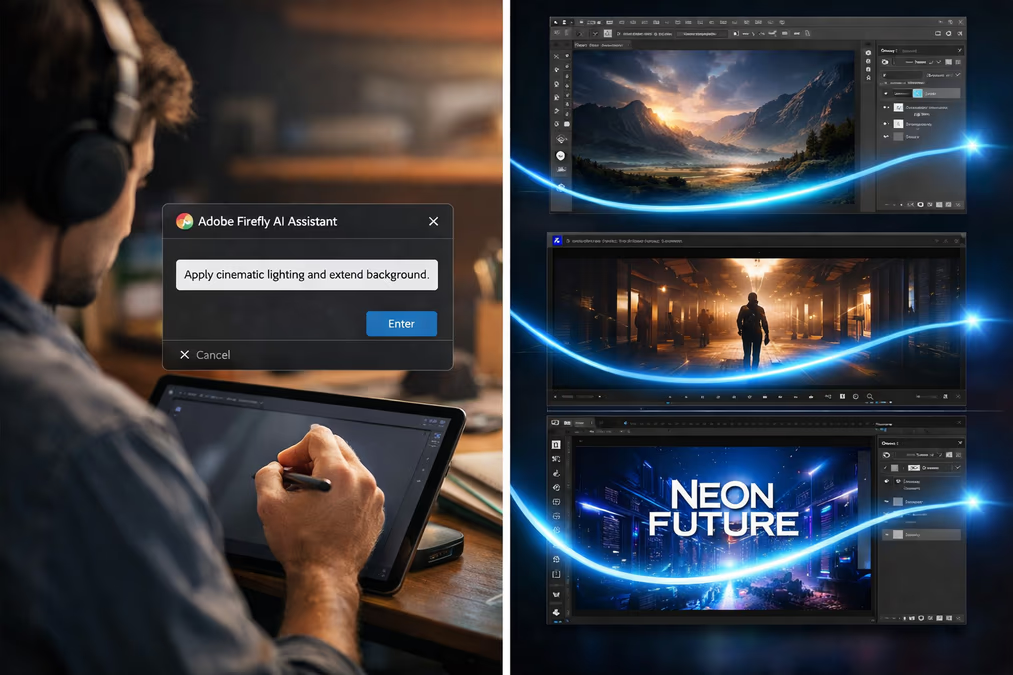
Adobe officially launched the Firefly AI Assistant on April 15, 2026, introducing a specialized creative agent designed to orchestrate complex content workflows through natural language. Previously developed under the codename 'Project Moonlight,' the assistant marks Adobe’s definitive move into the 'agentic era' of software, where AI systems transition from passive tools to active collaborators capable of executing multi-step tasks across a suite of professional applications.
The Firefly AI Assistant is not a standalone product but a deeply integrated layer across the Adobe Creative Cloud ecosystem. It is now available within Photoshop, Premiere Pro, Express, Lightroom, Illustrator, the Firefly web app, and Frame.io. By using natural language descriptions, creators can now direct the AI to handle technical execution—such as generating images, editing video sequences, or managing assets—while the human user maintains the role of creative director.
A Multi-Model Powerhouse
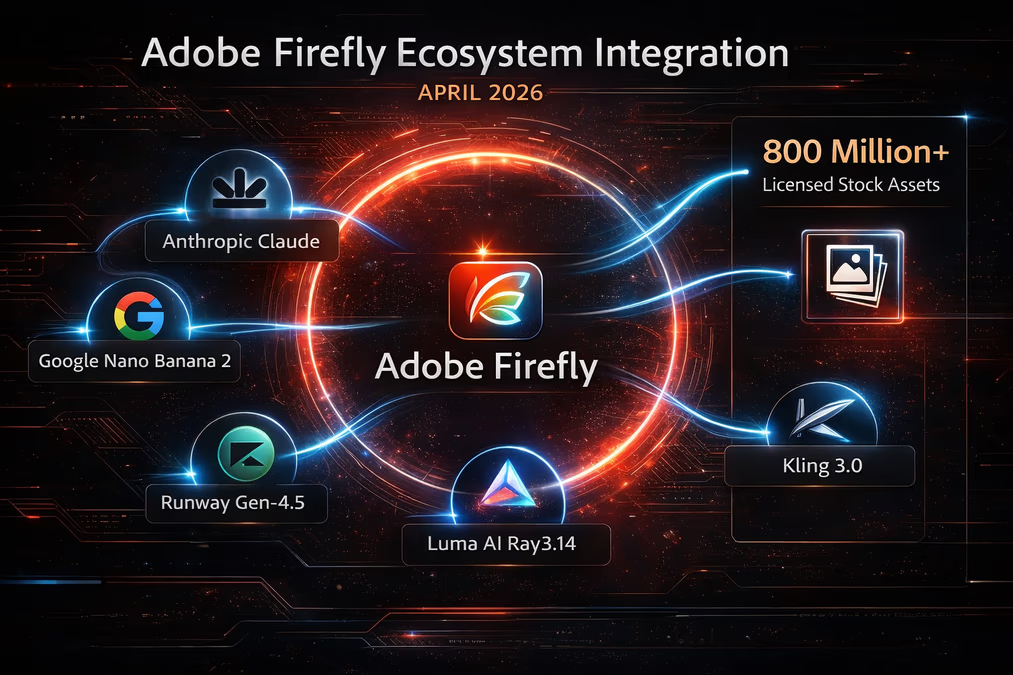
In a departure from the walled-garden approach common in the early generative AI race, Adobe has integrated the Firefly AI Assistant with over 30 third-party AI models. This strategic move provides creators with a massive palette of specialized tools directly within their existing workflows. The list of partners includes heavyweights like Google with Nano Banana 2 and Veo 3.1, Runway Gen-4.5, Luma AI’s Ray3.14, and Black Forest Labs' FLUX.2 [pro].
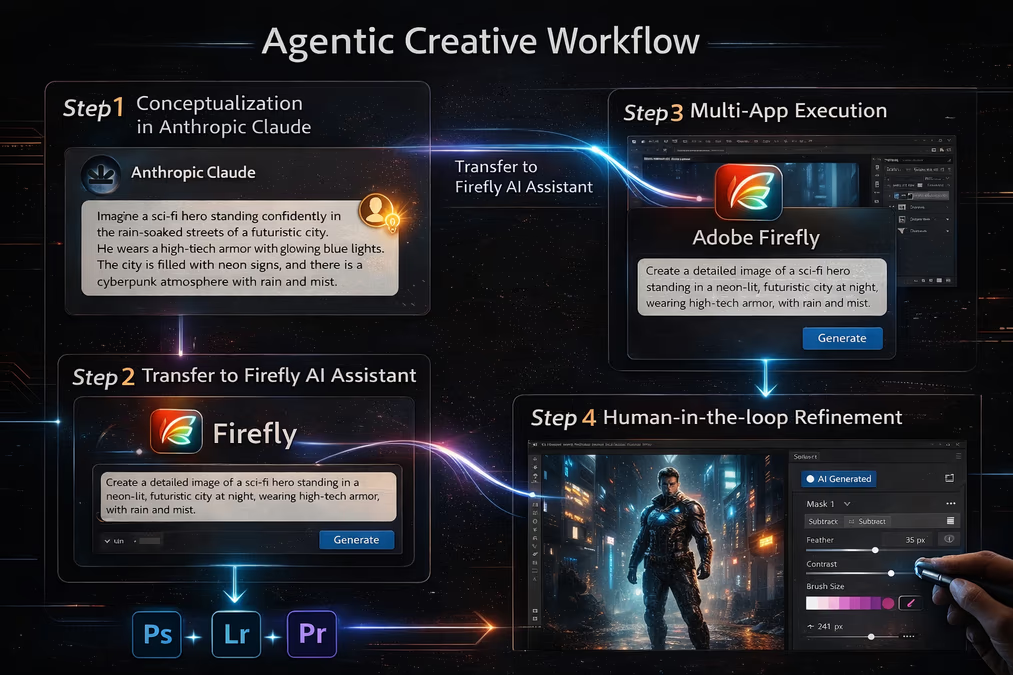
For video and audio professionals, the assistant bridges the gap between different specialized platforms by incorporating Kling 3.0, Kling 3.0 Omni, and ElevenLabs' Multilingual v2. High-end image enhancement is supported through Topaz Lab’s Topaz Astra. Perhaps most significantly, Adobe has forged a deep integration with Anthropic’s Claude. This allows creators to move seamlessly from the conceptual phase in Claude to direct execution within Adobe Firefly.
"The best creative work flows between thinking and making," said Paul Smith, Chief Commercial Officer at Anthropic. "Together with Adobe, we're exploring new ways to help creators conceptualize a project in Claude and reach straight into Adobe Firefly to execute it. That can bring about a meaningful change in how creative work gets done."
Redefining the Creative Workflow
The Firefly AI Assistant is context-aware, meaning it understands the specific project a user is working on and suggests relevant next steps. It features a growing library of pre-built 'Creative Skills,' which range from automated portrait retouching to generating optimized content for various social media channels. Over time, the assistant is designed to learn individual user preferences, tailoring its suggestions to a creator’s specific aesthetic or technical style.
David Wadhwani, President of the Creativity & Productivity Business at Adobe, described the launch as a fundamental shift in the industry. "Adobe is leading the shift into a new era of agentic creativity, where you direct how your work takes shape and your perspective, voice and taste become the most powerful creative instruments of all," Wadhwani said. "Adobe Firefly is a category of one, with the best models, the most powerful tools and now, a fundamentally new way of creating that gives you the combined power and precision of all our creative apps in one place."
To support this new level of automation, Adobe also released several new capabilities on April 15. Firefly plan customers now have access to 'Precision Flow' and 'AI Markup,' alongside studio-quality sound tools like 'Enhance Speech.' The assistant also has direct access to Adobe Stock’s library of over 800 million licensed assets, ensuring that generated content remains high-quality and commercially viable.
Accessibility and Professional Control
One of the primary goals of the Firefly AI Assistant is to collapse the distance between imagination and creation for both novices and veterans. By lowering the technical barrier to entry, Adobe is making professional-grade editing accessible to a wider audience while simultaneously freeing up professionals from repetitive tasks.
Alexandru Costin, Vice President of AI and Innovation at Adobe, highlighted this dual appeal. "We have the full spectrum covered from people coming new to our franchise and they don't know the full power of Photoshop and they want to achieve some amazing edits they can also tap into it and just talk to the assistant," Costin explained. "On the other side of the spectrum, the creative professionals that fully understand our tools can actually take those assets and continue editing them in our tools."
Adobe continues to emphasize its 'human-in-the-loop' philosophy. The assistant is designed to ask contextual questions and allow users to step in at any moment to guide, refine, or adjust the output. This ensures the human creator remains the ultimate arbiter of the work. Furthermore, Adobe maintains its commitment to ethical AI; Firefly models are trained on a commercially safe dataset that includes Adobe Stock images, openly licensed content, and public domain material.
Looking Ahead
The Firefly AI Assistant is scheduled to enter public beta in the coming weeks. Its rollout is part of a broader strategy that includes the recently announced Firefly Image Model 5 and 'Project Graph,' a node-based workflow system. As Adobe pushes further into agentic AI, the creative process is expected to become increasingly non-linear, allowing for rapid iteration and a focus on high-level artistic judgment over manual labor. For the creative industry, the arrival of the Firefly AI Assistant signals a future where the primary tool is no longer a brush or a timeline, but the user's own vision expressed through language.